
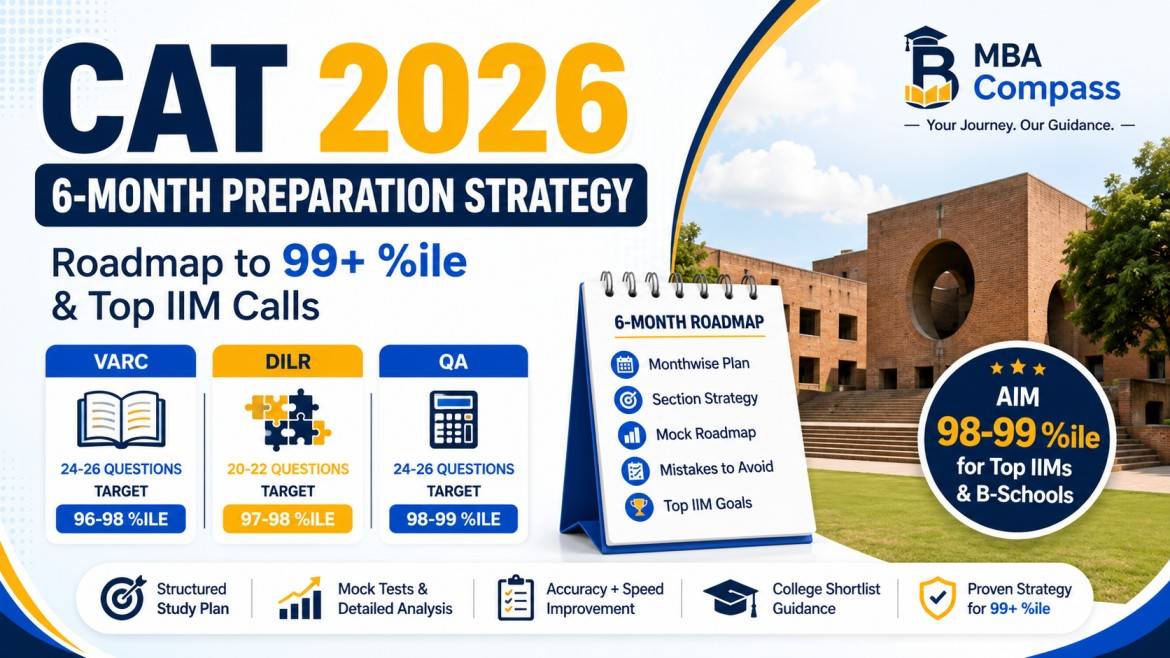
This CAT 2026 preparation strategy gives a tight 6-month roadmap with monthwise targets, mock counts, expected percentile bands, and quick fixes so you can aim for a 99 %ile+ score or a conservative 95-98 %ile depending on your starting point.
Summary: Read this section for month-by-month targets, when to peak your mocks, and the common mistakes that shave off 2-4 %ile during admissions season.
This plan is built for aspirants preparing for CAT while balancing work or final-year projects. It assumes you can study 3-5 hours daily on weekdays and 6-10 hours on weekends; adjust if you have more work experience or a different background.
Context: CAT sits alongside XAT, NMAT, SNAP and CMAT for 2026-27 admissions into IIMs, XLRI, FMS, MDI, SPJIMR and NMIMS. Based on placement reports and admission data released in 2026, top IIMs still see 300-600 recruits from consulting and tech every year; aim accordingly.
Fast checklist
Milestone | Target | Mocks | Expected %ile band | Action |
|---|---|---|---|---|
Finish basics in Month 1 | 0-4 | -- | Concept map + topic list | |
Accuracy focus | Month 2 | 4-8 | 70-85 %ile | Timed section tests |
Speed building | Month 3 | 8-14 | 85-95 %ile | Full-length mocks weekly |
Peak testing | Month 4 | 14-20 | 95-99 %ile | Analyze top 10 errors |
Revision & consolidation | Month 5 | 20-28 | 96-99 %ile | Mock-based weak-link repair |
Final tuning | Month 6 | 28-35+ (peak) | 99+ %ile target | Exam simulation + sleep hygiene |
Mock count — Aim for 30-40 quality mocks; use Mock Tests that mirror CAT pattern.
Section targets — VARC: 20-24 right, DILR: 8-12 sets, QA: 18-22 correct in targeted attempts.
Common mistakes — ignoring sectional timing, weak topic lists, over-practicing low-yield questions; these cost 2-4 %ile.
Work-ex angle — if you have 2-5 years experience, dedicate 20% time to resume stories and PI prep after mocks.
Short action — start weekly full-lengths from Month 3; analyze every mock with the 20-point error checklist.
Backup exams — plan XAT and NMAT windows; XAT expected in Jan 2027 and NMAT windows span Oct-Dec 2026 ().
Mentor tip: Want expert guidance for MBA admissions? Connect with our mentors today. Use the Profile Analyzer to benchmark your starting position and pair it with college shortlisting.
Month-by-month Study Plan
Direct answer: Follow a weekly calendar that splits VARC, DILR, and QA across focused blocks and reserves one full day for mocks and analysis; ramp intensity after month 3 to hit target percentiles.
Month 1 focus — build core concepts: VARC reading speed, DILR set patterns, QA arithmetic foundations and number theory basics. Spend 12-15 hours/week in this month. Use short daily drills and two topic tests weekly.
Month 2 focus — sectional depth: VARC: inference & para-jumbles, DILR: puzzles & sets, QA: algebra & geometry. Increase to 15-18 hours/week. Take 1 full-length mock every 10 days and analyse with error logs; consider /mocks for full-length practice.
Month 3 focus — strategy & timing: timed sectional tests, mixed-section practice and mid-length mocks. Push study time to 20+ hours/week. Based on placement reports from IIMs and NIRF 2026 context, target sectional accuracy >70% in QA to reach a 97-99 %ile band.
Months 4–6: simulation, fine-tuning, and percentiles
Month 4 — simulation: weekly full CAT-pattern mocks, focused weak-topic repair, and 2-day revision bursts. Work to stabilise speed: VARC 7-8 passages/hr, QA accuracy 85% on targeted topics.
Month 5 — advanced tactics: attempt-pattern analysis, negative-marking management, last-mile sectional cutoffs review. For a target of 98 %ile, reduce careless errors to under 6% per mock.
Month 6 — peaking: taper new learning, daily light practice, nightly 2-hour mock-review loops, PSU and consulting aspirants study caselets. Final two weeks: 3 full mocks/week with strict test-day routine.
Week | VARC (hrs) | DILR (hrs) | QA (hrs) | Mock/Analysis (hrs) |
|---|---|---|---|---|
1 | 3 | 3 | 4 | 2 |
2 | 3 | 3 | 4 | 2 |
3 | 2 | 3 | 6 | 2 |
4 | 3 | 4 | 6 | 3 |
5 | 2 | 4 | 8 | 3 |
6 | 3 | 4 | 8 | 4 |
Weekly milestones
Week 1–4: finish arithmetic, practice 10 RC passages, solve 20 basic LR sets.
Week 5–8: complete algebra & geometry modules, timed mixed-section tests twice weekly.
Week 9–12: 1 full mock/week, error-log with 3-point recovery plan per weak topic.
Week 13–18: 2 full mocks/week, focus on percentile-stabilising routines and time allocation.
Final 4 weeks: 3 full mocks/week, sleep and diet routine, test-day simulation with strict timings.
Worked examples:
Riya — engineer with 1.5 yrs experience targeting 93.5 %ile: start at 12 hrs/week, focus QA and DILR in months 1–3, add 1 mock/week from month 3; expected climb to target by month 5 with consistent error-log repair.
Akash — fresher aiming 98 %ile: start at 18 hrs/week, emphasise VARC reading speed and advanced QA problem sets, 2 mocks/week from month 2 and daily 60-min sectional drills; industry experts suggest this pattern for high-percentile aspirants.
Next steps: schedule your first diagnostic mock and then plug your weak areas into a college shortlist reflecting percentile targets using the /college-shortlister tool.
Sectional Strategy and Practice Routine
Direct answer: Focus each week on a target mix of timed drills and topic mastery for VARC, DILR, and QA, with a per-question time target and an accuracy goal; balance with full-length mocks every 2 weeks.
VARC approach: Prioritise RC selection, practice skimming, and build inference accuracy to reach a target accuracy of 70-75 % on RCs and 85 % on short para questions.
Question types, timing and target accuracy
Question Type | Section | Expected Time/Q | Target Accuracy | Practice Focus (hours/week) |
|---|---|---|---|---|
Long RC (300-800 words) | VARC | 3.5-4.5 min | 70-75 % | 4 |
Short RC / Para | VARC | 2-3 min | 85 % | 3 |
Logical DI (sets) | DILR | 6-8 min per set | 65-70 % | 5 |
Data interpretation (tables/graphs) | DILR | 2-4 min | 80 % | 3 |
Arithmetic (multi-step) | QA | 2.5-3.5 min | 80-85 % | 6 |
Algebra / Number Theory | QA | 3-5 min | 75-80 % | 5 |
Weekly routine: Split 6 days: 3 days VARC + DILR mixed timed drills, 2 days QA problem sets, 1 day review and concept study. Increase mock frequency to once per week in the final 6 weeks before CAT.
Timed drills — 30-45 minutes sessions, focus on pacing and sectional stamina.
Topic mastery — 90-120 minutes, deep practice on weak topics with error logs.
Mixed practice — alternate VARC and DILR sets to mimic CAT's switching demand.
Accuracy logging — track wrong reasoning types; aim to reduce repeat errors by 50 % in 8 weeks.
Sectional review — weekly 60-minute analysis of time leaks and concept gaps.
Comparison: timed drills vs topic mastery: Timed drills build speed and decision-making under pressure; topic mastery builds conceptual depth needed for high-difficulty QA and rare DILR sets. Use both: 60% drills, 40% mastery in months 3-4; switch to 70% drills in month 6.
Practice tools: Use full-length mocks and adaptive question banks to simulate CAT sections and track percentile projections; integrate sectional mocks from leading providers to get realistic 95+ %ile simulation on strong days. Based on placement reports and official admission data, top IIMs and XLRI shortlist heavily from high CAT %ile bands.
Need help? Want personalised college matching or ROI checks? Explore our College Shortlister and run an MBA ROI Calculator to decide which target colleges are worth your prep time.
Comparison Tables: Colleges, Cutoffs and Percentiles
Direct answer: These tables compare expected 2026 cutoff bands (percentile), fee ranges (INR), and average CTC bands (INR LPA) for 10 target colleges to help you set realistic shortlist and target percentiles.
Summary: Use the cutoff bands to prioritise focus: aim for >99 %ile for IIM-A/B, 96-98 %ile for IIM-C/XLRI/IIFT, and 92-96 %ile for FMS/MDI/SPJIMR/NMIMS/IMT. Fees vary from INR 3-25 lakh total; avg CTC bands run INR 12-32 LPA.
Based on placement reports and official admission data, these are expected bands for the 2026-27 cycle and should be verified with institute notices before applying.
College comparison table: cutoffs, fees, avg CTC
College | Expected 2026 Cutoff %ile | Fee range (Total INR) | Avg CTC band (INR LPA) | Top recruiters |
|---|---|---|---|---|
99.5-100 %ile | INR 23-27 lakh | INR 28-32 LPA | McKinsey, BCG, Bain, Goldman Sachs, J.P. Morgan | |
99.2-100 %ile | INR 22-26 lakh | INR 26-31 LPA | McKinsey, Accenture, ABG, HUL, Amazon | |
99-100 %ile | INR 20-24 lakh | INR 25-30 LPA | Goldman Sachs, BCG, Bain, Morgan Stanley, Deloitte | |
96-99 %ile | INR 20-25 lakh | INR 20-27 LPA | Tata, HUL, ITC, BCG, McKinsey | |
92-96 %ile | INR 3-5 lakh | INR 18-25 LPA | McKinsey, BCG, ABG, HUL, ICICI | |
92-96 %ile | INR 16-20 lakh | INR 16-24 LPA | Accenture, Deloitte, HUL, Tata, Amazon | |
92-96 %ile | INR 16-20 lakh | INR 15-22 LPA | HUL, ITC, L'Oreal, KPMG, Goldman Sachs | |
90-95 %ile | INR 15-20 lakh | INR 12-20 LPA | TCS, Infosys, Accenture, HUL, EY | |
96-99 %ile | INR 12-18 lakh | INR 16-24 LPA | Maruti, HUL, ICICI, Deloitte, Amazon | |
90-95 %ile | INR 10-14 lakh | INR 10-18 LPA | HCL, Amazon, Accenture, Deloitte, KPMG |
Below is a table comparing expected sectional cutoff focus for CAT, XAT and NMAT where these colleges accept scores.
Exam | Sections | Target %ile | Sectional focus | Notes |
|---|---|---|---|---|
VARC, DILR, QA | 95-100 %ile | Balance VARC and DILR; QA accuracy | Most IIMs use composite + sectional filters | |
VARC, DILR, QA, Decision Making | 92-expected percentile band around 99 %ile | Decision Making crucial for XLRI & XIM | XLRI uses XAT cutoff bands | |
Language, Quant, Reasoning | 85-expected percentile band around 95 %ile | Speed and sectional balance | Used by NMIMS and others | |
QA, VARC, LR | 80-92 %ile | Time management; negative marking | SPJIMR & others shortlisting | |
VARC, RC, QA & GK | 94-98 %ile | GK and RC accuracy | IIFT has separate exam and cutoff |
Deciding your target percentiles should map to realistic backup options and fee tolerance.
Target mapping — Aim for the top band if you can commit 6 months; otherwise prioritise IIM-B/IIM-C/XLRI slots at lower bands.
Fee fit — If your family budget is INR 5 lakh, focus strongly on FMS and IMT as primary targets.
ROI check — Use placement averages to compare expected returns over 3 years.
Exam fit — Pick exam(s) that match college acceptance: CAT for IIMs/FMS/MDI, XAT for XLRI, NMAT for NMIMS, IIFT for IIFT.
Backup plan — Have 3-4 colleges in 2 percentile bands below your target to convert on interview performance.
Important Data & Expert Insights
Direct answer: For CAT 2026 preparation strategy, target a steady mock-to-score improvement and aim for the expected percentile bands; use mocks to simulate exam conditions and focus on section balance.
Data point: Based on placement reports and admission trends for 2026-27, top IIMs (IIM Ahmedabad, IIM Bangalore) still require near-99.5 %ile in CAT while top non-IIMs (XLRI, SPJIMR, FMS) typically accept candidates in the 95-99 %ile band.
Mock-to-score mapping table
Mock Test Score (%) | Estimated CAT %ile Band | Sectional Balance Rule | Recommended Action (2-week) | Confidence |
|---|---|---|---|---|
85-90% | 99-99.9 %ile | All sections ≥30% | Polish weak sections; 4 full mocks | High |
75-84% | 96-99 %ile | No section <20% | Target sectional drills; 3 mocks | Medium-High |
65-74% | 90-96 %ile | Two sections ≥25% | Focused topic revision; 2 mocks | Medium |
50-64% | 75-90 %ile | At least one section ≥30% | Weekly topic tests; 1 mock | Low-Medium |
35-49% | 40-75 %ile | Sectional imbalance likely | Rework basics; sectional practice | Low |
<35% | <40 %ile | Foundation gaps | Restart plan; re-study basics | Very Low |
Expert tip: Industry experts suggest taking at least 12-18 full-length mocks before the exam window and grading them for accuracy, time-management and negative-marking error patterns.
Expected cutoff bands 2026-27
College / Program | Expected CAT %ile Band | Expected Fees (INR) | Typical Avg CTC (INR LPA) | Notes |
|---|---|---|---|---|
99.5-99.9 %ile | expected INR 24-28 lakh | expected 36-44 LPA | Based on placement reports | |
99.4-99.9 %ile | expected INR 23-27 lakh | expected 35-42 LPA | Verify official 2026 data | |
96-99 %ile | expected INR 18-22 lakh | expected 22-30 LPA | Strong HR/Consulting recruiters | |
95-98 %ile | expected INR 16-20 lakh | expected 18-28 LPA | Large finance and consulting pool | |
95-98 %ile | expected INR 3-5 lakh | expected 20-28 LPA | Low fee; high ROI | |
94-97 %ile | expected INR 14-18 lakh | expected 14-22 LPA | Strong HR & Consulting recruiters |
Common pitfalls:
Over-mock — taking >30 mocks without analysis reduces returns.
Section neglect — treating VARC, DILR or QA in isolation hurts percentile.
Poor time tracking — 40-50% of students mismanage last 20 minutes.
No negative-mark check — leads to surprise score drops in final weeks.
Ignoring college fit — chasing percentiles without ROI view; use MBA ROI Calculator.
Action checklist (next 2 weeks):
Run a full timed mock and map to the table above.
Analyze top 10 error types and build a 7-day correction plan.
Schedule 4 sectional drills: VARC, DILR, QA, Revision.
Create a college-fit list of 6 targets using predicted %ile bands and fees; review with MBA Compass.
Work on time-on-question: target 1.2 minutes for QA easy questions.
Summary: Follow the mock-to-score mapping, respect expected cutoff bands, and use the action checklist rigorously to raise your CAT 2026 preparation strategy from practice to performance.
Takeaways
Study blocks Follow a 6-month schedule split into learning (months 1-3), consolidation (month 4), mocks + analysis (month 5), and revision + stress management (month 6).
Mock volume Aim for 40-60 full-length mocks, increasing to 2-3/week in months 4-6 to reach 98-99+ %ile potential.
Sectional balance Allocate weekly 60:30:40 minutes to VARC:DI-LR:QA practice depending on your weak areas; adjust after every 6 mocks.
Cutoff bands Expect IIM-A/B/C general cutoff bands in the 98-100 %ile range for 2026; verify official releases but plan targets at 99.5 %ile for top IIMs.
Time allocation Reserve 12-15 hours/week if you’re a fresher and 8-10 hours/week if working (night/weekend) to stay on track.
Frequently Asked Questions
How should I start CAT 2026 preparation strategy with six months left?
Start with a diagnostic mock to identify weaknesses, then create a 6-month calendar prioritizing conceptual gaps in months 1-3 and mock-heavy practice in months 4-6. Take an initial full-length mock in week 1 and a topic-wise test for VARC, DILR, QA within week 2; expect to re-evaluate after every 6 mocks.
What is the ideal mock test schedule in a 6-month CAT plan?
Gradually increase to 2-3 full-length mocks per week by month 4, with one timed sectional test weekly. Begin with 1 mock every 10–14 days in months 1-2, 1 mock weekly in month 3, and 2–3 mocks weekly in months 4–6 to reach 40–60 mocks total.
How many mocks should I take to reach 99+ %ile?
Take 40–60 high-quality full-length mocks with detailed analysis; quantity matters less than focused review. Many aspirants who reached 99+ %ile completed around 50 mocks and retested weak topics after each mock cycle of 6 tests.
Which topics in QA carry the most weight for CAT 2026?
Focus on Arithmetic (30–35% of QA), Algebra (20–25%), Number Theory & Elementary Geometry (combined 20–25%), and Combinatorics/Probability (15–20%). Prioritise Arithmetic first if you must choose topics under time constraints.
How do I convert mock scores to expected CAT percentiles?
Use percentile conversion where the top mock scores in a large test series map to 99+ %ile; expect a 85–90 raw score to become ~98–99 %ile depending on test difficulty and scale. Compare your rank distribution across 30+ mocks to estimate trend stability.
Can a fresher with no work-ex reach IIMs with six months of prep?
Yes, a fresher can convert IIM calls with focused preparation; aim for 99+ %ile and strong academic profile (70%+ graduation) to clear shortlists. Many freshers who made IIMs had 6–9 months of disciplined prep and 40–50 mocks.
What are expected CAT 2026 cutoff bands for IIM-A, IIM-B, IIM-C?
Expected general cutoff bands for 2026 are IIM-A 99–99.9 %ile, IIM-B 98.5–99.7 %ile, IIM-C 98–99.5 %ile; these are expected bands — official cutoffs will come from the institutes. Plan for 99.5 %ile to be safe for all three.
When should I start sectional revision and full-length mocks?
Begin sectional revision in month 3 and ramp to full-length mocks in month
- Use months 1–3 for concept building and topic tests, then switch to mock-focused practice with weekly sectional drills and 2–3 full mocks weekly by month 5.
Conclusion
You can crack CAT 2026 with a focused, measurable CAT 2026 preparation strategy that balances concept-building, 40–60 full-length mocks, and disciplined revision in the last 6–8 weeks. Track percentiles across test series, aim for 99+ %ile for top IIMs, and prioritise high-weight QA and DI-LR topics.
Start mapping your six-month calendar today and test your profile fit against target colleges using our tools — try the College Shortlister and Profile Analyzer to convert effort into college calls.
About MBA Compass
MBA Compass is an MBA discovery and decision platform built by B School Buzz for Indian aspirants and working professionals. It brings college data, exam info, coaching options and prep tools into one place so you can make admission choices with less guesswork.
The platform helps you shortlist colleges, run a profile fit analysis, compare programmes by fee and expected placement, and practise with full-length mock tests. Use the College Shortlister and Profile Analyzer to match realistic targets and plan applications.
MBA Compass also helps with the financial side: compare fees, estimate expected packages and calculate ROI before you commit to an MBA. Try the MBA ROI Calculator to see long-term wealth outcomes and make smarter investment decisions.