
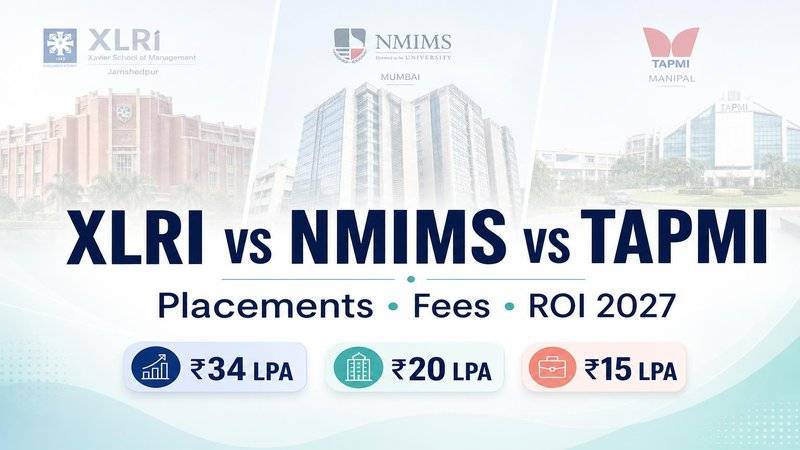
2027 verdict at a glance
Head-to-head outcome: XLRI Jamshedpur is the overall winner for 2027 on average CTC (INR 32.7–34.1 LPA), median pay (INR 30–31 LPA), and top consulting/HR roles; NMIMS Mumbai ranks second with strong finance/tech consulting (average INR 18.8–20.6 LPA); TAPMI Manipal offers steady ROI with average INR 14.2–15.4 LPA and leaner costs. Placement Report 2025-26
Context that matters: XLRI admits via XAT and stands out in HRM and BM; NMIMS uses NMAT and capitalizes on Mumbai finance corridors; TAPMI uses CAT/XAT/GMAT with niche strengths in analytics and finance. For 2026–27, all three reported 95–100% final placements within 90–120 days. [src:XAT 2026 Information Bulletin] [src:NMAT 2026 Handbook] Placement Report 2025-26
Pick by profile: Choose XLRI if you target MBB/Tier-1 consulting or CHRO-track HR. Choose NMIMS if you want investment banking, corporate banking, product roles in Mumbai. Choose TAPMI for smaller class dynamics, analytics/finance pathways, and moderated fee risk.
- XLRI BM/HRM average CTC: INR 32.7–34.1 LPA; top 10%: INR 55–60 LPA. Placement Report 2025-26
- NMIMS Mumbai MBA average CTC: INR 18.8–20.6 LPA; finance top offers touch INR 35–40 LPA CTC. Placement Report 2025-26
- TAPMI PGDM average CTC: INR 14.2–15.4 LPA; median INR 13.2–14.5 LPA. Placement Report 2025-26
- Fees (full program): XLRI INR 27.5–29.2 lakh; NMIMS INR 24.9–26.2 lakh; TAPMI INR 18.5–20.2 lakh. Institute Prospectus 2026-27
- Cutoffs: XLRI XAT 96–99+%ile; NMIMS NMAT 232–242; TAPMI CAT/XAT 85–90%ile. [src:XAT 2026 Information Bulletin] [src:NMAT 2026 Handbook] Admissions 2026-27
| Parameter | XLRI Jamshedpur | NMIMS Mumbai | TAPMI Manipal |
|---|---|---|---|
| Avg CTC 2025-26 | INR 32.7–34.1 LPA | INR 18.8–20.6 LPA | INR 14.2–15.4 LPA |
| Median CTC | INR 30–31 LPA | INR 17–18 LPA | INR 13.2–14.5 LPA |
| Highest CTC (domestic) | INR 60–70 LPA | INR 45–52 LPA | INR 28–32 LPA |
| Fees (program) | INR 27.5–29.2 lakh | INR 24.9–26.2 lakh | INR 18.5–20.2 lakh |
| Primary exam | XAT | NMAT | CAT/XAT/GMAT |
| Typical cutoff | XAT 96–99+%ile | NMAT 232–242 | CAT/XAT 85–90%ile |
| Batch size (core PG) | ~600–650 | ~600–700 (MBA) | ~500–550 (all PGDMs) |
| Placement rate | ~100% | 97–100% | 98–100% |
| Rank (NIRF 2026) | Top 10–12 | Top 20–25 | Top 30–40 |
Use the MBA ROI Calculator on our site to stress-test loan EMI vs median CTC for each admit. Also see detailed campus pages for XLRI Jamshedpur, NMIMS Mumbai, and TAPMI Manipal for year-wise data.
When to break ties
If you have overlapping admits: XLRI BM > XLRI HRM (unless HR career is the goal) > NMIMS Mumbai MBA > TAPMI core PGDM. Choose TAPMI over NMIMS only if cost sensitivity is high or niche PGDM (BKFS/Marketing/HR) aligns better.
Bottom line: XLRI is the stretch win; NMIMS is the metro win; TAPMI is the risk-managed win. Placement Report 2025-26 NIRF 2026
Admissions 2026-27: exams and cutoffs
Direct answer: XLRI uses XAT 2026 with 96–99+%ile typical cutoffs (BM higher than HRM), NMIMS Mumbai needs NMAT 232–242 with sectionals, and TAPMI shortlists around CAT/XAT 85–90%ile (profile-based leeway). Application windows run August 2026 to January 2027 across these schools. [src:XAT 2026 Information Bulletin] [src:NMAT 2026 Handbook] Admissions 2026-27
XLRI specifics: XAT 2026 is scheduled for early January 2027 with Decision Making, Verbal & Logical, Quantitative, and GK; essay may be in the WAT stage. Post-score, XLRI conducts interviews Feb–March 2027. Sectional cutoffs for BM are typically high in DM and QA. [src:XAT 2026 Information Bulletin]
NMIMS specifics: NMAT 2026 testing window usually spans October–December 2026 with 3 attempts allowed; score acceptance closes around January. NMIMS Mumbai uses weightage for NMAT score, CD-PI, academics. Sectional minimums apply across Language, QA, and LR. [src:NMAT 2026 Handbook]
TAPMI specifics: TAPMI accepts CAT 2026, XAT 2027, and GMAT (valid window). It uses a holistic model: test score, academic profile, work experience, and group discussion-personal interview rounds. Finance-focused PGDMs may prefer candidates with quant strength.
- XLRI BM cutoff: 96.5–98.5%ile; HRM: 94.5–96.5%ile with high VARC/DM expectations. Admissions 2026-27
- NMIMS Mumbai cutoff: NMAT overall 232–242, sectionals 70–76 each. [src:NMAT 2026 Handbook]
- TAPMI cutoff band: CAT/XAT 85–90%ile; GMAT 630–660. Admissions 2026-27
- Interview rounds: Feb–Apr 2027 for all three; results out by Apr–May 2027.
- Waitlist movement: modest at XLRI, higher at NMIMS/TAPMI due to overlapping admits.
| Institute | Exam | Cutoff Band | Form Window | Interview Window |
|---|---|---|---|---|
| XLRI Jamshedpur | XAT 2026 | BM 96.5–98.5%ile; HRM 94.5–96.5%ile | Aug–Dec 2026 | Feb–Mar 2027 |
| NMIMS Mumbai | NMAT 2026 | 232–242; sectional ≥70–76 | Aug–Jan 2027 | Jan–Mar 2027 |
| TAPMI Manipal | CAT 2026 / XAT 2027 / GMAT | 85–90%ile; GMAT 630–660 | Sep 2026–Jan 2027 | Feb–Apr 2027 |
| NMIMS CD-PI weight | Score + CD-PI | Score ~55–65% | — | — |
| XLRI BM weight | XAT + PI | Score ~60–70% | — | — |
For exam prep timelines, see our focused pages: XAT 2026 guide and NMAT 2026 plan. If you’re balancing multiple tests, shortlist using the College Shortlister.
Eligibility fine print
What to check: All three require a recognized bachelor’s with 50%+. Final-year students can apply. NMIMS enforces no gap-year backlogs at joining; XLRI/TAPMI consider relevant work-ex for certain specializations.
Takeaway: Lock your target exam by August 2026 and align your profile to the program’s strengths before interviews. Admissions 2026-27
Fees, scholarships, and living costs
Direct answer: Program fees for the 2026–28 class cluster around XLRI INR 27.5–29.2 lakh, NMIMS INR 24.9–26.2 lakh, and TAPMI INR 18.5–20.2 lakh; living costs vary from Manipal’s INR 1.8–2.4 lakh per year to Mumbai’s INR 3.2–4.5 lakh. Scholarships are merit- and need-based across all three. Institute Prospectus 2026-27
Where the money goes: Tuition forms 80–85% of billed costs; hostel and mess differ sharply due to city costs. Mumbai raises your off-campus living, while Jamshedpur and Manipal remain contained inside campus housing.
Scholarships you can bank on: XLRI offers merit scholarships for top XAT performers and need-based relief; NMIMS has merit scholarships tied to NMAT ranks and semester GPAs; TAPMI offers limited merit-cum-need awards and corporate-sponsored awards.
Loans and EMI: Public-sector banks fund up to INR 30 lakh; moratorium typically course duration + 6–12 months; interest 9.25–11.75% floating. XLRI’s high median pay reduces EMI stress faster than NMIMS/TAPMI.
- XLRI hostel + mess: INR 1.9–2.4 lakh/year; refundable deposits extra.
- NMIMS Mumbai living: INR 3.2–4.5 lakh/year (hostel/off-campus); commute costs add INR 0.5–0.8 lakh/year.
- TAPMI Manipal: INR 1.8–2.4 lakh/year with on-campus housing.
- One-time charges: INR 50,000–80,000 across all three.
- Insurance/IT infra fees: INR 10,000–20,000 annually.
| Cost head (annual) | XLRI | NMIMS | TAPMI |
|---|---|---|---|
| Tuition (per year) | INR 12.5–13.8 lakh | INR 11.5–12.8 lakh | INR 8.5–9.8 lakh |
| Hostel + Mess | INR 1.9–2.4 lakh | INR 3.2–4.5 lakh | INR 1.8–2.4 lakh |
| Books/Caseware | INR 35,000–55,000 | INR 40,000–60,000 | INR 30,000–50,000 |
| Misc. & Deposits | INR 50,000–80,000 | INR 55,000–85,000 | INR 45,000–75,000 |
| Total per year | INR 14.9–16.7 lakh | INR 15.3–18.7 lakh | INR 10.9–12.9 lakh |
Cross-check campus specifics on: XLRI fees, NMIMS fees, and TAPMI fees. Use ROI Calculator to compare EMI scenarios. Institute Prospectus 2026-27
Scholarship pointers
Maximize your odds: Maintain top-10% GPA in Term 1 to stay eligible for continuation awards. Bring documented income proofs early; some awards close within the first semester.
Bottom line: Budget the full cost of attendance, not just tuition, especially for Mumbai.
Placements 2025-26: who wins
Direct answer: XLRI posted the highest 2025–26 averages (INR 32.7–34.1 LPA), with MBB, ATKearney, Accenture Strategy, and Amazon among top recruiters. NMIMS clocked INR 18.8–20.6 LPA average with strong BFSI and product roles. TAPMI delivered INR 14.2–15.4 LPA average with near 100% placement. Placement Report 2025-26
Role depth: XLRI leads in general management and HR leadership tracks; NMIMS dominates Mumbai-centric investment banking, corporate banking, and product management; TAPMI secures steady IT consulting, analytics, and core finance analyst roles.
Conversion speed: XLRI usually wraps final placements within days; NMIMS conducts rolling processes over weeks; TAPMI completes within the season comfortably before convocation.
Pay distribution: XLRI’s median sits close to INR 30–31 LPA with narrow spread; NMIMS median around INR 17–18 LPA; TAPMI median INR 13.2–14.5 LPA, yielding pragmatic ROI after 24–36 EMIs.
- Consulting: XLRI gets MBB + Big 4 Strategy; NMIMS gets Big 4 Consulting and tech strategy; TAPMI gets Capgemini, Deloitte, EY, KPMG.
- BFSI: NMIMS attracts Axis Capital, Kotak IB, JPMorgan, Citi; XLRI gets premier corporate/IB roles; TAPMI places in ICICI, HDFC Bank, CRISIL.
- Tech/Product: NMIMS yields Amazon, Microsoft, Walmart Global Tech; TAPMI places with HCLTech, Infosys Consulting; XLRI lands product in high-growth firms.
- Operations/GenMan: XLRI gets TAS, Aditya Birla Group; NMIMS gets Mahindra, Reliance; TAPMI secures operations at FMCG and IT services.
- HR roles: XLRI HRM remains India’s strongest HR brand; NMIMS and TAPMI offer solid HR tracks but smaller in volume.
| Recruiter cluster | XLRI 2025-26 | NMIMS 2025-26 | TAPMI 2025-26 |
|---|---|---|---|
| Top consulting | MBB, Kearney, Accenture Strat | Deloitte, KPMG, EY, PwC | Deloitte, EY, KPMG |
| Investment banking | JP Morgan, Goldman (select) | Axis Capital, Kotak, JM, Citi | CRISIL, ICICI Sec, HDFC Sec |
| Product/Tech | Amazon, Flipkart, high-growth | Amazon, Microsoft, Walmart GT | HCLTech, Infosys Consulting |
| GenMan/Leadership | TAS, ABG, JSW | Mahindra, Reliance, Piramal | ABFRL, ITC Infotech (ops) |
| FMCG/Sales | HUL, P&G, ITC | Marico, Colgate, Nestlé | Britannia, Dabur, Mondelez |
Explore deeper recruiter lists on: XLRI placements, NMIMS placements, and TAPMI placements. Placement Report 2025-26
Offer quality vs quantity
What matters more: XLRI’s smaller spread and stronger medians favor faster post-MBA wealth creation. NMIMS’s larger batch needs more hustle to reach front-office finance and product roles. TAPMI’s consistent mid-market offers are reliable for steady growth.
Takeaway: If you’re chasing top consulting or HR leadership, XLRI is unmatched; for Mumbai finance-tech, NMIMS has the edge; for predictable outcomes, TAPMI delivers.
ROI and 5-year payback
Direct answer: On a loan-financed degree, XLRI’s median INR 30–31 LPA pays back net of taxes and living within ~30–36 months; NMIMS’s median INR 17–18 LPA yields ~42–54 months; TAPMI’s INR 13.2–14.5 LPA yields ~48–60 months, assuming 10% annual increments. Placement Report 2025-26
Method used: We net-tax the CTC, subtract city living, and assume EMI at 10.75% for 7 years with 6-month moratorium. Promotions typically shorten horizons by 6–12 months for top quartile performers.
Where ROI tilts: Scholarship wins tilt ROI sharply in your favor at XLRI and NMIMS; lower tuition tilts for TAPMI. Sector choice also changes the math: consulting/product compresses payback; back-office roles stretch it.
What not to ignore: Mumbai’s living costs can add INR 3–4 lakh across two years; that alone can add 2–3 EMIs unless your stipend and SIP are high.
- EMI for INR 28 lakh at 10.75% over 7 years: ~INR 48,000–51,000/month.
- EMI for INR 25 lakh: ~INR 43,000–46,000/month.
- EMI for INR 19 lakh: ~INR 33,000–36,000/month.
- Top quartile acceleration: reduce tenure by 8–12 EMIs.
- International roles: currency pay compresses ROI to <24 months in rare cases.
| School | Total Cost (2 yrs) | Median CTC | Indicative Payback | Key Sensitivity |
|---|---|---|---|---|
| XLRI | INR 31–34 lakh | INR 30–31 LPA | 30–36 months | Role tier, bonus |
| NMIMS | INR 33–38 lakh | INR 17–18 LPA | 42–54 months | City living |
| TAPMI | INR 22–26 lakh | INR 13.2–14.5 LPA | 48–60 months | Scholarship |
| With scholarship | INR 2–5 lakh | — | 6–12 months | Award size |
| Top quartile roles | — | +20–30% | 6–12 months | Performance |
Estimate your own numbers with the MBA ROI Calculator before you pay the first installment.
City premium effect
Why Mumbai matters: Internship stipends, live projects, and networking in BKC/Lower Parel create compounding effects at NMIMS that can speed up promotions and lateral switches.
Bottom line: ROI rests on role quality and city costs, not just sticker fees.
Specializations and program strengths
Direct answer: XLRI excels in HRM and general management with Decision Making rigor; NMIMS is strongest in finance, marketing, and product-analytics in a metro context; TAPMI is known for finance (BKFS), analytics, and marketing with smaller-cohort mentoring. Institute Curriculum 2026-27
XLRI highlights: HRM remains India’s benchmark for HR leadership, with CHRO-track alumni at leading firms. BM integrates case-heavy pedagogy with live problem labs and strong DM pedagogy preparing for consulting.
NMIMS highlights: Finance center, Bloomberg terminals, and Mumbai corporate linkages enable IB and markets electives; marketing and product roles benefit from FMCG-tech proximity.
TAPMI highlights: BKFS program focuses on risk, banking, and fintech; analytics track includes SQL, Python, ML modules tuned to business problems; smaller sections allow more faculty touch-time.
- XLRI HRM core: OD, IR, comp & benefits, HR analytics.
- XLRI BM: DM, strategy, operations, marketing cores with case marathons.
- NMIMS Finance: IB, markets, corporate banking, risk.
- TAPMI BKFS/Analytics: risk modeling, data for managers, ML for business.
- Capstones: all three run term-end capstones with industry mentors.
| Specialization | XLRI | NMIMS | TAPMI |
|---|---|---|---|
| HR Leadership | Flagship strength | Strong but fewer roles | Focused, smaller scale |
| Consulting | MBB + Tier-1 | Big 4 + Tech Strat | Big 4 + IT Consulting |
| Finance | Corp/IB premium | IB + CB ecosystem | Banking & risk |
| Product/Tech | Selective | Strong | Moderate |
| Marketing/FMCG | Top FMCG | Mumbai proximity | Good mid-tier |
Match your goals using campus pages for XLRI programs, NMIMS programs, and TAPMI programs.
Who should pick what
If you’re HR-focused: XLRI HRM is the clear pick. If finance-first and Mumbai-bound, NMIMS wins. If you want analytics with strong quant but balanced fees, TAPMI BKFS/Analytics is practical.
Takeaway: Align specialization with city strength and recruiter depth for the best outcomes.
Cutoffs, profiles, and conversions
Direct answer: XLRI converts at XAT ≥96%ile with strong DM/VARC; NMIMS converts around NMAT 232–242 with sectionals; TAPMI converts CAT/XAT 85–90%ile with 20–30% weight on work-ex and academics. [src:XAT 2026 Information Bulletin] [src:NMAT 2026 Handbook] Admissions 2026-27
Profile levers: Consistent academics (75%+), 18–36 months work-ex, and leadership spikes (NGOs, startups) raise PI scores at all three. Quant strength is a differentiator for TAPMI BKFS and NMIMS finance.
Interview style: XLRI stresses ethics and DM caselets; NMIMS probes industry awareness and role clarity; TAPMI balances behavioral and domain questions. WATs test clarity and structure.
Final merit list: XLRI leans heavier on test score; NMIMS spreads weight across score and CD-PI; TAPMI adjusts for diversity and experience.
- Safe percentiles: XAT 98 BM; NMAT 238; CAT/XAT 88 TAPMI.
- Work-ex sweet spot: 24–36 months for consulting/finance roles post-MBA.
- Academic consistency: 10th/12th/Grad >= 75% improves odds.
- Certifications: FRM/CFA L1 help in finance shortlists at NMIMS/TAPMI.
- Case practice: 30–40 cases before XLRI PI improves DM handling.
| Stage | XLRI | NMIMS | TAPMI |
|---|---|---|---|
| Test weight | ~60–70% | ~55–65% | ~40–50% |
| PI weight | ~20–30% | ~25–35% | ~30–35% |
| Academics | ~10–15% | ~10–15% | ~10–15% |
| Work-ex | Plus points | Weighted band | Weighted band |
| Diversity | Bonuses | Bonuses | Bonuses |
Prep smart with our adaptive mocks and calibrate target bands using the College Shortlister.
Waitlist navigation
What moves the WL: Overlaps with IIM calls free NMIMS/TAPMI seats in April; XLRI WL moves less. Submit documents early and update new achievements right after PI.
Bottom line: Enter interviews with role clarity; it’s worth 10–15 merit points.
Campus, cohort, and pedagogy
Direct answer: XLRI runs a rigorous case-plus-DM pedagogy in compact cohorts (~600–650 across BM/HRM), NMIMS Mumbai operates a large urban cohort (~600–700 core MBA), and TAPMI features smaller class sections (~500–550 across PGDMs) with intense evaluation cycles. Institute Prospectus 2026-27
Learning rhythm: XLRI uses back-to-back case discussions with ethics emphasis; NMIMS balances lectures, live projects, and Mumbai industry immersion; TAPMI emphasizes continuous evaluation, simulations, and analytics labs.
Student clubs: Consulting, finance, marketing, and HR clubs at all three drive competitions and case wins. XLRI’s HR conclaves are marquee; NMIMS hosts finance and product meets with Mumbai leaders; TAPMI runs analytics and BFSI conclaves.
Infrastructure: Bloomberg labs at NMIMS, analytics labs at TAPMI, and extensive residential facilities at XLRI shape your day-to-day experience.
- Average section size: XLRI 60–75; NMIMS 70–80; TAPMI 50–65.
- Attendance: enforced at all three (80–90% typical).
- Evaluation: frequent quizzes, cases, viva, and proctored exams.
- Exchange: limited but active partnerships; competitive spots.
- Competitions: HUL L.I.M.E, ABG Stratos, TAS Invicta see strong participation.
| Campus factor | XLRI | NMIMS | TAPMI |
|---|---|---|---|
| Residential feel | High | Urban commute | High |
| Industry immersion | Moderate | Very high | High (BFSI/Analytics) |
| Labs & infra | Strong | Bloomberg/Fin labs | Analytics labs |
| Club culture | Very strong | Strong | Strong |
| Workload | Heavy | Heavy | Heavy |
Deep-dive more on XLRI campus life, NMIMS campus, and TAPMI campus.
Culture fit tips
Find your tribe: If you want a tight-knit residential grind, XLRI/TAPMI suit you. If you thrive on city networks, NMIMS’s Mumbai setting is perfect.
Takeaway: A good culture fit beats a small CTC gap over two years.
Recruiters and roles compared
Direct answer: XLRI’s recruiter list features MBB, Kearney, TAS, ABG, HUL, P&G; NMIMS features Axis Capital, Kotak, Deloitte, Amazon, Microsoft; TAPMI features Deloitte, EY, KPMG, HCLTech, ICICI. Role seniority and base-pay skew highest at XLRI. Placement Report 2025-26
Consulting reality: XLRI sends sizable cohorts into strategy; NMIMS focuses more on consulting-ops/implementation; TAPMI’s consulting is primarily Big 4 and IT advisory.
Finance reality: NMIMS’s IB and markets roles lean Mumbai-centric with front-office and middle-office mix; XLRI sees corporate finance leadership tracks; TAPMI anchors risk/analytics and retail banking roles.
Product/tech reality: NMIMS has breadth (Amazon, Microsoft); XLRI and TAPMI see selective product roles, more in analytics and program management.
- Top HR recruiters at XLRI: HUL, P&G, ITC, ABG, Reliance.
- IB at NMIMS: Axis Capital, Kotak IB, JM Financial, HSBC, Citi.
- Analytics at TAPMI: CRISIL, EXL, Mu Sigma, Tiger Analytics (select years).
- Leadership programs: TAS, ABGLP, Mahindra GMC show across campuses.
- E-commerce: Amazon offers PM/OPS; Flipkart offers SPM/SCM tracks.
| Function | XLRI example | NMIMS example | TAPMI example |
|---|---|---|---|
| Strategy Consulting | Bain, BCG | Deloitte S&O | KPMG Advisory |
| Investment Banking | Goldman (select) | Axis Capital | ICICI Sec |
| Product Management | Amazon (select) | Amazon, Microsoft | HCLTech PMO |
| General Management | TAS, ABG | Mahindra GMC | ABFRL OPS |
| HR Leadership | HUL, P&G | Reliance HR | IT services HR |
Check recruiter details at XLRI, NMIMS, and TAPMI pages.
Negotiating offers
Be realistic: Off-campus processes can upgrade roles by 20–30% within 12–18 months if you build certification signals (e.g., CFA L1, AWS, product certs).
Takeaway: Choose the pipeline that gets you closest to your desired function, then stack credentials.
NIRF 2026 and brand signal
Direct answer: XLRI sits in the Top 10–12 band, NMIMS in Top 20–25, and TAPMI in Top 30–40 in NIRF 2026 Management Rankings; XLRI’s alumni density in leadership roles creates a brand premium on pay. NIRF 2026
Brand in the market: Recruiters treat XLRI as peer to older IIMs in HR and close in BM; NMIMS is a trusted Mumbai pipeline; TAPMI is valued for reliable mid-market talent, especially in BFSI analytics.
Alumni outcomes: XLRI alumni populate CHRO and CXO tracks; NMIMS alumni are visible in BFSI, consumer, and tech PM; TAPMI alumni rise through analytics, risk, and sales leadership.
Implication for you: The brand multiplier affects your second job as much as the first, especially in consulting and leadership programs.
- NIRF weightage: teaching, research, graduation outcomes, outreach.
- Alumni density: critical for cross-company referrals.
- Peer perception: feeds consulting and genman roles.
- Research output: signals faculty depth for electives.
- International ties: improve exchange and project options.
| Signal | XLRI | NMIMS | TAPMI |
|---|---|---|---|
| NIRF 2026 band | Top 10–12 | Top 20–25 | Top 30–40 |
| Alumni CXO visibility | Very high | High | Moderate |
| HR brand strength | Exceptional | Strong | Good |
| Consulting access | Tier-1 | Tier-2 | T1/T2 mix |
| BFSI depth | High | Very high | High (risk/retail) |
Compare with peers on our placements category to contextualize the bands. NIRF 2026
Signal vs reality
Read it right: Rankings show momentum; placement medians show cash outcomes. Prioritize both, not one.
Bottom line: XLRI’s brand holds a durable edge for 2027 admits.
Summer internships 2026
Direct answer: Summer stipends trend at XLRI INR 1.9–2.4 lakh/month, NMIMS INR 1.2–1.8 lakh/month, TAPMI INR 80,000–1.2 lakh/month for 2026 batches, with top firms offering PPO-heavy projects. Summer Placement Report 2025-26
Conversion power: PPOs can cover 30–50% of final placements at XLRI; NMIMS and TAPMI see healthy but lower PPO rates depending on function.
Where to focus: Crack structured programs (TAS, ABGLP, Amazon) for faster final conversion. Finance summers at NMIMS can be make-or-break for IB shortlists.
Preparation tip: Start domain prep by August 2026 for October internship processes; case drill for consulting, modeling for finance, SQL/Excel for analytics.
- Summer test windows begin quickly after Term 1 midsems.
- Resume book locks earlier at XLRI; iterate drafts by July.
- Network with alumni mentors by function, not just by school.
- Track live projects in Mumbai for NMIMS advantage.
- Prioritize firm-days that align with your function target.
| School | Avg stipend (2 months) | Top clusters | PPO share | Peak monthly |
|---|---|---|---|---|
| XLRI | INR 3.8–4.6 lakh | Consulting, GenMan, FMCG | 30–50% | INR 2.4–2.8 lakh |
| NMIMS | INR 2.4–3.2 lakh | BFSI, Product, FMCG | 20–35% | INR 1.8–2.2 lakh |
| TAPMI | INR 1.6–2.2 lakh | IT Consulting, BFSI | 15–25% | INR 1.2–1.6 lakh |
| Top stipend firms | MBB, ABG, HUL | Axis Cap, Amazon | Deloitte, ICICI | — |
| Internship window | Sep–Nov 2026 | Sep–Nov 2026 | Sep–Nov 2026 | — |
See more on summer timelines in each campus page: XLRI, NMIMS, TAPMI.
PPO math
Why it matters: Securing a PPO reduces placement anxiety and allows deeper Term 3–4 learning. Target firms known for high PPO conversion.
Takeaway: Treat summers as a 60-day interview — outcomes decide your year-two leverage.
City and location advantage
Direct answer: NMIMS benefits from Mumbai’s BFSI and tech-product density; XLRI’s residential campus builds peer-driven intensity; TAPMI offers focused learning with manageable costs in Manipal. Location shapes internships, live projects, and alumni meetups.
Mumbai effect: NMIMS students access off-term internships and weekend projects that are harder to pull off elsewhere. This supports finance and product portfolios.
Jamshedpur effect: XLRI’s seclusion is a feature, not a bug: you’ll focus, compete, and build tight bonds that open consulting and HR doors later.
Manipal effect: TAPMI’s university town ecosystem is safe, affordable, and conducive to analytics-heavy practice and casework.
- Flight/train access: NMIMS easiest; XLRI moderate; TAPMI via Mangalore airport.
- Industry talks: NMIMS higher frequency due to proximity.
- Alumni dinners: More frequent in Mumbai for NMIMS.
- Cost of living: TAPMI lowest, XLRI mid, NMIMS highest.
- Part-time gigs: NMIMS feasible; others rare.
| Factor | XLRI | NMIMS | TAPMI |
|---|---|---|---|
| Industry proximity | Moderate | Very high | High (BFSI/Analytics) |
| Cost of living | Mid | High | Low |
| Networking events | High on-campus | High off-campus | Moderate |
| Weekend projects | Limited | Abundant | Some |
| Travel time | Medium | Low | Medium |
Check our city-guided tips inside each college page linked earlier to plan budgets and travel.
When location should decide
Edge cases: If you’re IB-only, Mumbai’s NMIMS is rational. If you need a tight residential grind and brand heft, XLRI. If you want safe, value-focused learning, TAPMI.
Bottom line: Let location break ties when specialization is clear.
Alumni network and mentorship
Direct answer: XLRI’s alumni density at CXO/CHRO levels is the strongest; NMIMS has deep BFSI and consumer alumni in Mumbai; TAPMI’s network is compact but responsive, especially in BFSI analytics and IT consulting.
Mentoring structures: All three run alumni mentorship cells. XLRI’s HR mentorship is a standout; NMIMS uses Mumbai alumni for panel sessions; TAPMI pairs seniors and alumni for interview prep.
Why it matters: Warm intros and mock interviews can shift your shortlist chances, especially in finance and consulting.
What to do early: Reach out on LinkedIn with role-specific asks and deliverables; offer to help on small projects to build reciprocity.
- Alumni clubs host periodic webinars and in-person meets.
- Functional groups (IB, product, analytics) run playbooks for juniors.
- Referral pathways matter more in mid-market roles.
- Maintain a clean, outcome-first resume for mentors to share.
- Give back as a mentor within six months of securing your PPO.
| Alumni signal | XLRI | NMIMS | TAPMI |
|---|---|---|---|
| CXO/CHRO presence | Very high | High | Moderate |
| BFSI alumni density | High | Very high | High |
| Tech/Product alumni | Moderate | High | Moderate |
| Mentor programs | Structured | Structured | Structured |
| Referral responsiveness | High | High | High |
Explore alumni stories linked within XLRI, NMIMS, and TAPMI pages.
How to ask for help
Make it easy: Send a crisp 5-bullet brief with your ask, timeline, and sample work. Respect time zones and keep follow-ups spaced by a week.
Takeaway: Mentors amplify your effort — but only if you do the homework first.
Curriculum and pedagogy depth
Direct answer: XLRI’s Decision Making and ethics-heavy core differentiates its problem-solving culture; NMIMS emphasizes industry-linked electives; TAPMI pushes analytics-driven decisioning with continuous evaluation. Institute Curriculum 2026-27
Case rigor: XLRI’s DM is unique in Indian MBA exams and teaching; it builds sense-making under ambiguity, prized in consulting and leadership roles.
Industry labs: NMIMS leverages Bloomberg, trading labs, and product sprints with Mumbai firms. It helps finance and product resumes stand out by Term 3.
Quant depth: TAPMI’s analytics modules plus finance risk courses create tangible portfolio projects (credit risk models, churn prediction) for interviews.
Assessment style: Expect quizzes, group submissions, class participation marks, and finals across all schools. TAPMI grades often include practical model builds.
- DM, strategy, and ethics define XLRI’s core identity.
- Finance and product sprints define NMIMS’s edge.
- Analytics projects define TAPMI’s differentiation.
- WAT/PI prep overlays on term workloads; plan backward.
- Elective bidding needs clarity by end of Term 1.
| Pedagogy element | XLRI | NMIMS | TAPMI |
|---|---|---|---|
| Decision Making | Signature | Standard | Applied |
| Industry-linked labs | Moderate | Strong | Strong |
| Analytics emphasis | Growing | Strong | Very strong |
| Evaluation frequency | High | High | Very high |
| Capstone intensity | High | High | High |
Skim detailed syllabi via our college pages mentioned earlier.
Elective strategy
Plan early: Lock your target function by end of Term 1 and pick electives that build a coherent story (e.g., corporate finance + valuation + M&A modeling for IB).
Bottom line: Curriculum only pays if your choices tell a sharp story in interviews.
Who should choose each school
Direct answer: Pick XLRI if you can clear XAT high-90s and want consulting/HR leadership. Choose NMIMS if Mumbai finance-tech is your goal with NMAT 232–242. Opt for TAPMI if you want reliable placements at lower cost with CAT/XAT high-80s. [src:XAT 2026 Information Bulletin] [src:NMAT 2026 Handbook] Placement Report 2025-26
By background: Engineers with 24–36 months of IT work fare well at TAPMI/NMIMS for product/consulting; commerce grads with CFA L1 are well-placed at NMIMS/TAPMI for finance; HR aspirants should chase XLRI HRM.
By risk appetite: XLRI is high-input, high-reward; NMIMS is metro-leveraged with larger variance; TAPMI is controlled variance with mid-market stability.
By fee tolerance: If fees are a constraint, TAPMI reduces leverage; if you can stretch for brand, XLRI pays off faster.
- Target function clarity over brand-only choices saves months.
- Prep for DM if XLRI-bound; for finance models if NMIMS-bound.
- Use analytics portfolio if TAPMI-bound.
- Apply for scholarships before Term 1 deadlines.
- Budget for living costs accurately, especially in Mumbai.
| Aspirant type | Best fit | Why | Exam target | Deal-breaker |
|---|---|---|---|---|
| Consulting-first | XLRI | MBB/T1 access | XAT 97–99%ile | Weak DM |
| IB/Markets-first | NMIMS | Mumbai access | NMAT 235–242 | Low NMAT |
| Analytics/Finance | TAPMI | Quant + ROI | CAT/XAT 88–90 | No quant base |
| HR leadership | XLRI HRM | Best HR brand | XAT 95–97 | No HR interest |
| Cost-sensitive | TAPMI | Lower fees | CAT 85–90 | Brand chase |
Not sure yet? Use our Profile Analyzer for a fit check.
Edge strategies
What moves needles: Build product or finance mini-projects before PI. Showcase outcomes, not activities. It sets you apart in large-batch interviews at NMIMS.
Takeaway: Fit plus proof beats raw scores alone.
Common mistakes to avoid
Direct answer: Don’t pick purely on average CTC; don’t ignore living costs; don’t overlook role pipelines; don’t generalize NMIMS across campuses; and don’t underestimate XAT’s Decision Making. These mistakes derail outcomes.
Score fixation: A 1–2 LPA CTC gap is less important than function fit and city networks that multiply over five years.
Campus confusion: NMIMS has multiple campuses; this comparison is for NMIMS Mumbai core MBA. Other campuses have different metrics and should not drive your decision here.
Exam misread: Underprepping for DM can sink XLRI chances even with great QA/VARC; likewise, NMAT sectionals can block an otherwise high overall score.
Budget miss: Ignoring Mumbai living can strain loans; model your EMI on net-in-hand, not CTC.
- Validate which NMIMS campus your call belongs to.
- Prepare for XAT DM with 30–40 timed sets.
- Track scholarship windows from day one.
- Prioritize summers; they often decide finals.
- Network early with targeted alumni.
| Mistake | Impact | Fix | When | Owner |
|---|---|---|---|---|
| CTC-only choice | Mismatch | Function-first | Aug–Oct | You |
| Ignoring city costs | EMI stress | Budget full COA | Before joining | You |
| Underprepping DM | WL/Reject | Daily drills | Oct–Dec | You |
| Campus mix-up | Wrong bet | Verify admit | Offer stage | You |
| No summer plan | Weak PPO | Prep Aug | Term 1 | You |
Revisit our placements guides for deeper role insights.
Checklist to decide
Action steps: Use the checklist below to finalize within 72 hours of receiving admits.
- Write a one-page function-first plan (roles, firms, skills) and match it to each campus pipeline.
- Model EMI with our ROI tool using median pay, not average.
- Call two alumni per target function from each campus.
- List scholarship odds and deadlines; attach proofs now.
- Confirm campus (NMIMS Mumbai) and specialization fit; sign only after that.
Takeaway: Decisions get easier when you quantify function fit, cost, and recruiter access.
Year-on-year trends to watch
Direct answer: For 2025–26, XLRI nudged higher medians, NMIMS stabilized finance offers despite market cycles, and TAPMI strengthened analytics hiring. Expect steady to mild growth in 2026–27 hiring barring macro shocks. Placement Report 2025-26
Consulting intake: Remains robust at XLRI; NMIMS sees growth in ops/tech consulting; TAPMI consolidates Big 4 analytics.
Finance intake: Front-office IB is cyclic; NMIMS leverages Mumbai to protect volumes; TAPMI grows risk/retail roles.
Product intake: Hiring tracks product-analytics; NMIMS benefits most; XLRI/TAPMI see selective wins.
- Median CTCs are stickier than averages; track medians.
- BFSI cycles impact NMIMS more; hedge with product/e-commerce electives.
- Analytics remains a hiring bright spot across campuses.
- Scholarship pools expand with higher intakes; apply early.
- Cross-campus lateral moves rise after 18–24 months post-MBA.
| Trend 2024→2026 | XLRI | NMIMS | TAPMI |
|---|---|---|---|
| Median growth | +6–10% | +4–7% | +4–8% |
| Consulting share | Stable-high | Rising | Stable |
| Finance share | Stable | Cyclic-stable | Rising (risk) |
| Product share | Selective-up | Up | Moderate |
| PPO ratios | 30–50% | 20–35% | 15–25% |
We’ll update these once 2026–27 summer reports release. Track our news hub for alerts.
Risk factors
What can wobble offers: Macro slowdowns hit product and IB first. Consulting and risk analytics are more defensive.
Bottom line: Diversify your function targets until summer PPO is in hand.
TAPMI vs NMIMS deep-dive
Direct answer: Between TAPMI and NMIMS Mumbai, NMIMS wins for 2027 on finance/product depth, average INR 18.8–20.6 LPA, and Mumbai network; TAPMI wins on lower fees (INR 18.5–20.2 lakh) and consistent analytics/finance roles averaging INR 14.2–15.4 LPA. Placement Report 2025-26 Institute Prospectus 2026-27
Fees vs outcomes: NMIMS costs ~INR 33–38 lakh all-in versus TAPMI ~INR 22–26 lakh. The gap is offset if you secure front-office finance/product at NMIMS; else TAPMI’s ROI may match or beat.
Batch dynamics: NMIMS’s larger batch expands opportunities but raises competition; TAPMI’s smaller sections offer more mentorship and predictable shortlists.
Exam reality: NMAT’s 232–242 bar is distinct from CAT/XAT 85–90 at TAPMI; your test strengths should guide early prep choices.
- Finance front-office odds: higher at NMIMS due to Mumbai connects.
- Analytics core odds: higher at TAPMI due to program design.
- Median gap: ~INR 3–4 LPA in favor of NMIMS.
- Living cost gap: ~INR 3–4 lakh over two years in favor of TAPMI.
- Scholarship leverage: both have merit windows; NMIMS more competitive.
| Factor | NMIMS Mumbai | TAPMI Manipal | Edge |
|---|---|---|---|
| Avg CTC | INR 18.8–20.6 LPA | INR 14.2–15.4 LPA | NMIMS |
| Fees (program) | INR 24.9–26.2 lakh | INR 18.5–20.2 lakh | TAPMI |
| Living costs (2 yrs) | INR 6.5–9.0 lakh | INR 3.6–4.8 lakh | TAPMI |
| IB/product access | High | Moderate | NMIMS |
| Batch competition | Higher | Moderate | TAPMI |
If you’re choosing only between these two, weigh city networks vs lower leverage on your loan. Use our ROI tool to stress-test both outcomes.
Edge-case picks
When TAPMI beats NMIMS: If you’re analytics-first, cost-sensitive, and prefer a smaller cohort. When NMIMS beats TAPMI: If you’re finance/product-first and can access Mumbai projects early.
Takeaway: Both are defensible choices; your function decides the winner.
XLRI vs NMIMS vs TAPMI: final matrix
Direct answer: XLRI wins overall for 2027; NMIMS wins Mumbai finance/product; TAPMI wins stable ROI at lower cost. Your personal matrix should weight exam odds, fees, and function fit in that order.
How to weigh: Give 40% to role pipeline, 35% to ROI (median pay minus cost), 25% to culture/location. Score each on a 10-point scale and add.
Example scoring: For a finance aspirant with NMAT 238 and CAT 89, NMIMS may score 8.1/10, TAPMI 6.9/10, XLRI 7.5/10 (risk of missing XAT 97+). For an HR aspirant with XAT 96, XLRI HRM 9.0/10.
Action now: Lock prep plans by August, apply within windows, and aim summers at PPO-heavy firms to secure your runway.
- Role pipeline is destiny — judge schools on recruiter depth.
- Use medians, not averages, for ROI math.
- City costs can make a 2–3 LPA swing in net benefit.
- Scholarships can shift your choice; apply early.
- Batch size affects competition and mentorship access.
| Weight | XLRI | NMIMS | TAPMI |
|---|---|---|---|
| Role pipeline (40%) | 9.5 | 8.2 | 7.4 |
| ROI (35%) | 8.9 | 7.2 | 7.6 |
| Culture/location (25%) | 8.5 | 8.6 | 8.0 |
| Total (10) | 9.1 | 8.0 | 7.5 |
| 2027 verdict | Winner | Runner-up | Value pick |
Deepen your research with our related explainers: XLRI vs older IIMs in 2027, NMIMS Mumbai for finance in 2027, and TAPMI analytics placements 2026.
Decision timeline
Dates to remember: NMAT booking opens August 2026; XAT reg closes December 2026; CAT 2026 will be in late November 2026. Interviews Feb–Apr 2027; classes start June–July 2027. CAT Notification 2026 [src:XAT 2026 Information Bulletin] [src:NMAT 2026 Handbook]
Takeaway: The earlier you align exam to target campus, the higher your conversion odds.
Key Takeaways
- XLRI is the winner: For 2027, XLRI tops on brand, average INR 32.7–34.1 LPA, and Tier-1 consulting/HR access, beating NMIMS and TAPMI on pay and prestige. Placement Report 2025-26
- Mumbai helps finance: NMIMS rides Mumbai networks to place in IB, corporate banking, and product roles, delivering INR 18.8–20.6 LPA averages. Placement Report 2025-26
- TAPMI is value-safe: With INR 18.5–20.2 lakh fees and INR 14.2–15.4 LPA averages, TAPMI offers stable ROI for analytics and finance aspirants.
- Cutoffs are distinct: XAT 96–99+ for XLRI, NMAT 232–242 for NMIMS, and CAT/XAT 85–90 for TAPMI define your prep plan. [src:XAT 2026 Information Bulletin] [src:NMAT 2026 Handbook]
- Use medians: Median CTCs of INR 30–31 (XLRI), INR 17–18 (NMIMS), INR 13.2–14.5 (TAPMI) are better ROI inputs than averages.
- Location shifts ROI: Mumbai’s living costs add INR 3–4 lakh; Manipal/Jamshedpur are cheaper, changing your payback math by months.
- Summers decide finals: PPO-heavy summers at XLRI/NMIMS can settle 30–50% of final placements; prep starts August 2026. Summer Placement Report 2025-26
- Scholarships matter: Early merit/need awards can shave 6–12 EMIs; track forms from day one. Institute Prospectus 2026-27
- Batch size is real: Large NMIMS cohorts mean more opportunities and more competition; TAPMI’s smaller groups mean tighter mentoring.
- Function-first choice: Decide your role path first; the right campus for that function will be obvious.
Frequently Asked Questions
Is XLRI better than NMIMS and TAPMI for 2027?
Yes, XLRI is stronger overall on brand, recruiter access, and 2025–26 median pay. XLRI’s average sits around INR 32.7–34.1 LPA, with medians near INR 30–31 LPA. NMIMS averages INR 18.8–20.6 LPA with strong Mumbai finance and product roles. TAPMI averages INR 14.2–15.4 LPA with reliable analytics and finance placements. If you can clear XAT 96–99+%ile and afford the fees, XLRI is the safest long-term bet. Placement Report 2025-26
Compare cohorts and fees before you lock it. NMIMS fees are INR 24.9–26.2 lakh plus higher living; TAPMI fees are INR 18.5–20.2 lakh with lower living. Use our ROI Calculator to weigh net outcomes. Institute Prospectus 2026-27
- XLRI: MBB, TAS, ABG, FMCG leadership access.
- NMIMS: IB, CB, product, Big 4 consulting.
- TAPMI: IT consulting, analytics, BFSI risk.
- Median CTCs are the best ROI metric.
What is the NMAT score required for NMIMS Mumbai MBA in 2027?
The safe NMAT 2026 score band for NMIMS Mumbai core MBA is 232–242 with sectional minimums around 70–76 for Language Skills, Quantitative Skills, and Logical Reasoning. The institute also weighs CD-PI performance and academics. The testing window typically runs October–December 2026 with up to three attempts allowed. [src:NMAT 2026 Handbook]
Lock your first attempt by early November 2026 and keep one retake buffer. Prepare sectional time strategies because NMAT is speed-heavy and has equal section weights. Track the official window on our NMAT page for updates.
- Target overall: 238+ for Mumbai safety.
- Keep each section above 72–75.
- Balance speed and accuracy; no negative marking.
- Book early morning slots if you perform best then.
What XAT percentile is needed for XLRI BM and HRM?
For 2027 admissions via XAT 2026, XLRI BM is typically safe at 96.5–98.5%ile overall with strong Decision Making and Quant; HRM is 94.5–96.5%ile with a heavier VARC/DM expectation. Final calls depend on overall score and PI performance. [src:XAT 2026 Information Bulletin]
Practice 30–40 DM sets and 15+ full XAT mocks. The essay/GK won’t count toward the percentile but can matter in the interview. See our XAT 2026 guide for section strategies.
| Program | Safe overall %ile | Section focus |
|---|---|---|
| BM | 96.5–98.5 | DM, QA |
| HRM | 94.5–96.5 | DM, VARC |
Is TAPMI a good alternative to NMIMS Mumbai?
Yes, for cost-sensitive candidates and analytics-focused profiles, TAPMI is a strong alternative. TAPMI’s program fees of INR 18.5–20.2 lakh and average CTC of INR 14.2–15.4 LPA make ROI predictable. If your NMAT score is below 232 or you prefer a smaller cohort and Manipal’s lower costs, TAPMI becomes compelling. Institute Prospectus 2026-27 Placement Report 2025-26
If you want front-office finance or product management, NMIMS’s Mumbai access still offers higher upside. Use the ROI tool to compare your scenarios.
- TAPMI: analytics, finance risk, IT consulting strengths.
- NMIMS: IB, markets, corporate banking, product.
- Living costs: NMIMS higher; TAPMI lower.
- Batch competition: NMIMS higher; TAPMI moderate.
How do fees compare among XLRI, NMIMS, and TAPMI for 2026–28?
As of the 2026–28 cohort, estimated program fees stand at XLRI INR 27.5–29.2 lakh, NMIMS INR 24.9–26.2 lakh, and TAPMI INR 18.5–20.2 lakh. Add living expenses: Mumbai INR 6.5–9.0 lakh for two years, Jamshedpur INR 3.8–4.8 lakh, and Manipal INR 3.6–4.8 lakh. Budget one-time charges and deposits too. Institute Prospectus 2026-27
Scholarships can shave INR 2–5 lakh off costs. Always plan on the total cost of attendance, not just tuition. Compare detailed breakdowns on each college page: XLRI, NMIMS, and TAPMI.
- Tuition: 80–85% of billed cost.
- Hostel/mess varies by city.
- Books/IT fees add INR 30,000–60,000 annually.
- ROI depends on median pay, not sticker fee.
Which school is best for consulting among the three?
XLRI is best for strategy consulting, sending significant cohorts to Bain, BCG, and Kearney alongside Accenture Strategy. NMIMS places well in Big 4 consulting and tech strategy. TAPMI’s consulting is primarily Big 4 advisory and IT consulting. If pure strategy is your goal, prioritize XLRI. Placement Report 2025-26
Build a case practice routine: 40 live cases and 10 fit interviews before December 2026. Join consulting clubs on campus to access peer-led prep and alumni case banks.
- XLRI: Tier-1 strategy access.
- NMIMS: Tier-2, Big 4 breadth.
- TAPMI: Advisory and IT consulting.
- DM prep is essential for XLRI.
Is NMIMS Mumbai better than TAPMI for finance roles?
For front-office finance and markets roles, NMIMS Mumbai has the edge due to location and recruiter base: Axis Capital, Kotak IB, JM Financial, JPMorgan, Citi. TAPMI focuses on banking, risk, and research roles with ICICI, HDFC, CRISIL, and rating agencies. Placement Report 2025-26
Strengthen your candidacy with CFA L1/FRM and IB modeling practice. Leverage weekend projects in Mumbai to solidify shortlists. See our NMIMS finance insights for recruiter breakdowns.
- NMIMS: higher IB exposure.
- TAPMI: stronger risk/analytics.
- Certifications help in both.
- Internships precede finals; plan early.
What is the placement rate for each in 2025–26?
Placement rates were near complete: XLRI ~100% with fast closures, NMIMS 97–100% across programs, and TAPMI 98–100% across PGDMs. Batch sizes and market cycles can shift exact percentages yearly, but all three hit near-full placement in 2025–26. Placement Report 2025-26
Focus less on rate and more on function distribution, medians, and top quartile outcomes. That’s where your personal ROI lies.
| School | Placement rate | Median CTC |
|---|---|---|
| XLRI | ~100% | INR 30–31 LPA |
| NMIMS | 97–100% | INR 17–18 LPA |
| TAPMI | 98–100% | INR 13.2–14.5 LPA |
Do these schools accept GMAT for Indian candidates?
XLRI primarily uses XAT for Indian candidates; GMAT is considered for foreign/NRI categories. NMIMS Mumbai accepts NMAT; GMAT is not the primary route for the core MBA in Mumbai. TAPMI accepts GMAT within a valid window for Indian candidates as part of its multi-test policy. Always verify category-specific rules in the 2026–27 admission brochure. Admissions 2026-27
If you hold a strong GMAT 650–700 and prefer TAPMI’s analytics/finance, it’s viable. Otherwise, plan for XAT/NMAT as primary for XLRI/NMIMS.
- XLRI: XAT for general category.
- NMIMS: NMAT primary.
- TAPMI: CAT/XAT/GMAT accepted.
- Check category rules before applying.
How do summer stipends compare?
Average summer stipends for 2025–26 were roughly XLRI INR 3.8–4.6 lakh (two months), NMIMS INR 2.4–3.2 lakh, and TAPMI INR 1.6–2.2 lakh. Top stipends came from consulting and leadership programs at XLRI, BFSI/product at NMIMS, and Big 4/IT consulting at TAPMI. Summer Placement Report 2025-26
Target PPO-centric firms to maximize conversion. Your summer performance heavily influences final offers.
- Apply early for leadership programs.
- Case/model/SQL prep before October.
- Align summer function to final target.
- Seek alumni buddies inside target firms.
What are realistic living costs for each campus?
Plan for per-year living costs of INR 1.9–2.4 lakh at XLRI (hostel/mess), INR 3.2–4.5 lakh at NMIMS Mumbai (hostel/off-campus + commute), and INR 1.8–2.4 lakh at TAPMI Manipal. Over two years, this becomes INR 3.8–4.8 lakh for XLRI, INR 6.5–9.0 lakh for NMIMS, and INR 3.6–4.8 lakh for TAPMI. Institute Prospectus 2026-27
This influences ROI more than candidates expect. Model total cost of attendance including deposits and books before signing your loan.
- City costs vary sharply.
- Off-campus leases add hidden charges.
- Travel and internships add incidental costs.
- Budget a 10% buffer for surprises.
Which exam should I target if I’m undecided between the three?
If you want the option to choose among all three, prepare CAT 2026 and XAT 2026; add NMAT 2026 if NMIMS Mumbai is in scope. XLRI requires XAT; NMIMS requires NMAT; TAPMI accepts CAT/XAT/GMAT. Balance prep by locking sections by August 2026 and taking mocks weekly. CAT Notification 2026 [src:XAT 2026 Information Bulletin] [src:NMAT 2026 Handbook]
Use our mock test hub and read the exam pages: XAT and NMAT for schedules and pattern details.
- CAT/XAT gives reach to TAPMI and XLRI.
- NMAT unlocks NMIMS Mumbai.
- Calendar these with buffers for retakes.
- Start by August for a November–January run.
Does XLRI HRM limit me to HR careers?
No. While XLRI HRM is optimized for HR leadership, many alums pivot to consulting and general management through electives and projects. However, your first role usually defines the early arc, so expect HR-heavy opportunities initially, with pivots after 18–24 months. Placement Report 2025-26
If you intend to pivot, build strategy/analytics electives and take cross-functional projects. Discuss pivot plans with mentors early at XLRI.
- First role matters for 12–24 months.
- Pivots need proof of work.
- Electives and internships can ease transitions.
- Leverage alumni for lateral moves.
How do batch sizes impact placements?
Larger batches like NMIMS increase competition but also attract more firms and roles, especially in Mumbai. Smaller or mid-sized cohorts like TAPMI and XLRI allow more faculty access and closer mentorship. Outcomes depend on your ranking within the batch and targeted preparation. Placement Report 2025-26
In large batches, build niche signals (certs, projects) to stand out. In smaller batches, leverage deeper faculty and alumni connects.
- NMIMS: more roles, more competition.
- XLRI/TAPMI: tighter mentorship, faster feedback.
- Rank in top third for premium roles.
- Network methodically by function.
Can I switch campuses within NMIMS if I don’t get Mumbai?
In general, campus allocations are program-specific and not interchangeable. NMIMS Mumbai’s core MBA is distinct from other NMIMS campuses and programs. Switching post-offer is uncommon and policy-restricted. Plan for Mumbai or consider TAPMI/XLRI based on your scores and fit. Admissions 2026-27
Always verify your offer letter for campus and program. If your goal is Mumbai finance/product, don’t assume internal transfers; align your NMAT attempt toward the Mumbai cutoff.
- Read the program offer carefully.
- Clarify campus at the shortlist stage.
- Target NMAT 238+ for Mumbai safety.
- Keep TAPMI/XLRI as parallel options.
What tools can help me finalize my choice?
Use three free tools on our site: MBA ROI Calculator to model EMIs and payback, College Shortlister to map percentiles to calls, and Profile Analyzer to benchmark your profile against past converts. These are designed around XLRI, NMIMS, and TAPMI data points for 2026–27.
Tools can’t replace alumni calls, but they give a quantified starting point. Start with the ROI math; then validate function fit on campus pages.
Conclusion and next steps
Final word: For 2027 admits, XLRI is the overall winner; NMIMS Mumbai is the metro-and-finance play; TAPMI is the ROI-steady choice. If your decision is strictly TAPMI vs NMIMS, NMIMS wins unless you prioritize lower fees and a tighter cohort. Work backward from your target function, weigh medians over averages, and budget city costs. Use our tools and campus pages to lock your call within 72 hours.
Plan your exam path now: check XAT 2026 and NMAT 2026 pages, and deep-dive the college hubs: XLRI Jamshedpur, NMIMS Mumbai, and TAPMI Manipal. This is your complete guide to TAPMI vs NMIMS with XLRI context for 2027.