
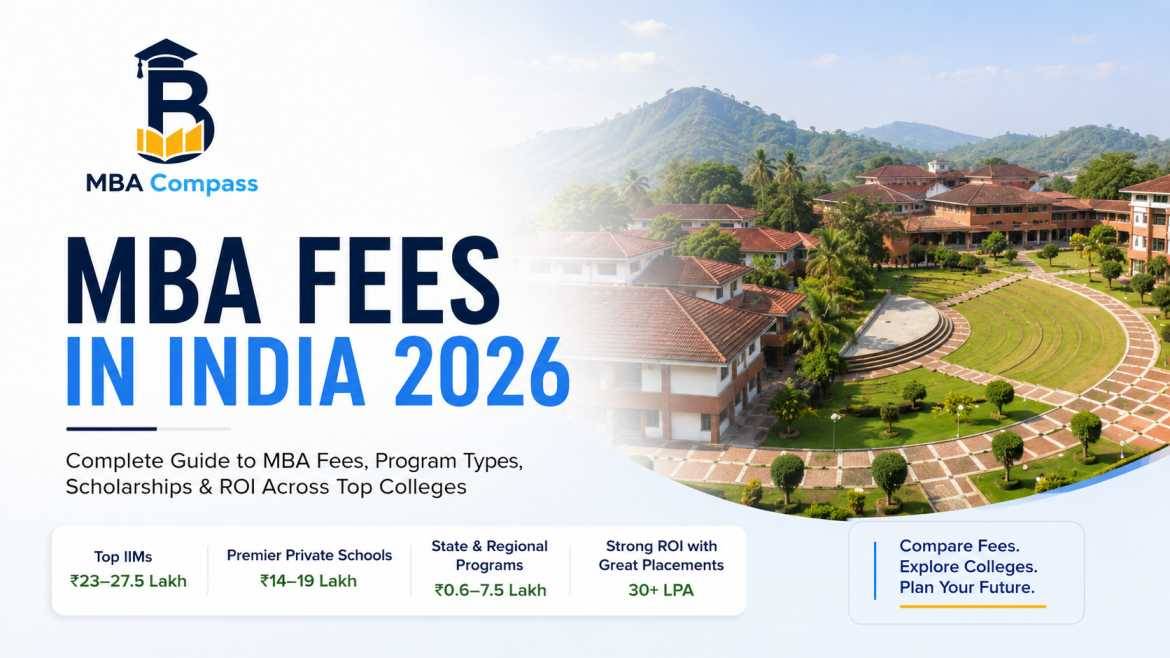
MBA fees in India 2026 vary widely by programme and college tier — expect top IIMs and IIM Bangalore fees around INR 23–27.5 lakh, premier private schools INR 14–19 lakh, and many state or regional programmes INR 0.6–7.5 lakh total.
Context: Based on placement reports and official admission data for the 2025-26 and 2026 admission cycle, CAT, XAT, NMAT, SNAP and CMAT remain the primary entrance exams that feed these programmes.
Program mix: one-year executive MBAs and two-year PGPs differ: one-year programmes at top schools can cost INR 14–23 lakh, while two-year PGPs at Tier-3 state universities may be INR 0.6–7.5 lakh.
Snapshot table: program types vs fee bands
Program type | Typical fee band (total, 2026) | Typical avg package band (LPA) | Notes |
|---|---|---|---|
INR 23–27.5 lakh | 30–36 LPA | CAT entrance; highest packages cross INR 2.2 Crore | |
INR 23.4 lakh (IIM Bangalore) | 29–31 LPA | Selective intake; GRE/GMAT for some execs | |
INR 16.5 lakh | 18–22 LPA | XAT/GMAT accepted | |
INR 14–19 lakh | 8–10 LPA | Strong industry ties in tech and consulting | |
INR 0.6–11.5 lakh | 3.5–14 LPA | Large fee spread; check campus-specific data |
IIM fees band: INR 23–27.5 lakh for flagship PGPs (IIM Ahmedabad & IIM Calcutta figures are in the same band).
Executive/One-year programmes: typical band INR 14–23 lakh at top schools.
Tier-3/state universities: many programmes sit between INR 0.6–7.5 lakh total (e.g., Vidyasagar University, Kashmir University).
Top private (e.g., IFIM, XIME, XISS): expect INR 8.5–19 lakh depending on campus and programme.
Entrance exams: CAT, XAT, NMAT, SNAP, CMAT drive admissions; expect sectional cutoffs in the 85–99 %ile range for top IIMs and 70–85 %ile for many private programmes.
Exceptions: public universities like Vidyasagar and Nagaland University list fees at INR 0.6 lakh total, while select private campuses (XIME Bangalore, XIM University) report fees up to INR 19 lakh or more. Verify on the official college website or admission brochure before committing.
Recruiter note: Based on placement reports, consultancies (McKinsey, BCG, Bain), tech majors (Accenture, TCS), and FMCG (HUL, ITC) remain active across tiers, but average CTC expectations fall with fee bands and tier.
Mentor tip: Want expert guidance for MBA admissions? Connect with our mentors today. Use the Profile Analyzer to check fit and the College Shortlister to build a realistic list.
Program-wise Fee Breakdown
Direct answer: This section breaks down typical mba fees across program types in 2026-27 and shows how Tier-1 and Tier-3 institutes compare on total fees, average packages and accepted entrance exams.
Overview: Based on placement reports and official admission data, full-time 2-year PGPs, one-year MBAs/EPGPs, executive MBAs, part-time MBAs and specialised MS/MBA tracks show distinct fee bands and package expectations.
The first table lists full-time 2-year PGPs with exact fees from institute records, average/median packages and accepted exams like CAT, XAT, NMAT and CMAT.
Full-time 2-year PGPs (exact fees and packages)
College | Fee (total) | Avg package | Median package | Exams accepted |
|---|---|---|---|---|
₹27,50,000 | ₹35.22 LPA | ₹34.53 LPA | CAT | |
₹23.4 lakh | ₹30.5 LPA | ₹29 LPA | CAT/GMAT | |
₹21,00,000 | ₹33.2 LPA | ₹32.9 LPA | CAT | |
₹16.5 lakh | ₹18-22 LPA | ₹17-19 LPA | CAT/XAT/GMAT | |
₹5.5 lakh | ₹12-14 LPA | ₹11-13 LPA | CAT/CMAT/MAT |
One-year MBA/EPGPs: One-year MBAs typically carry higher per-year cost but shorter duration; fees vary and attract senior professionals. Example table below lists institutes that offer one-year options in the verified sheet.
College | Fee (total) | Avg package | Median package | Exams accepted |
|---|---|---|---|---|
₹23.4 lakh | ₹30.5 LPA | ₹29 LPA | CAT/GMAT | |
₹27,50,000 | ₹35.22 LPA | ₹34.53 LPA | CAT | |
₹16.5 lakh | ₹18-22 LPA | ₹17-19 LPA | XAT/CAT/GMAT | |
₹14 lakh | ₹8.5-9.5 LPA | ₹8-9 LPA | CAT/CMAT/GMAT | |
₹19 lakh | ₹9.8 LPA | ₹9.0 LPA | CAT/XAT/GMAT |
Executive, part-time and specialised tracks: The next list summarises fee bands and where to expect a higher ROI based on average packages and recruiter mix.
Executive MBA — fees range from ₹11.5 lakh (SDM IMD Mysore) to ₹23.4 lakh (IIM Bangalore for EPGP).
Part-time MBA — fees often sit between ₹5.5 lakh and ₹11.5 lakh depending on city and institute.
Specialised MS/MBA — expect narrower cohorts; fee varies and median package often tracks between ₹6-10 LPA.
Tier variance — Tier-1 average packages: ₹29-36 LPA; Tier-3 average packages: ₹4-10 LPA.
Exams mix — CAT, XAT, NMAT, CMAT, MAT are the primary entrance tests for the programmes listed.
Decision rule: If your target ROI horizon is 3 years, prefer programmes where the fee-to-average-package ratio is under 0.7 (fee / avg package in LPA), based on placement reports and industry expert guidance.
Comparison Tables: Tier-1 vs Tier-3 Colleges
Direct answer: This table contrasts Tier-1 and Tier-3 MBA fees, average and highest packages, NIRF rank and entrance exams so you can compare cost vs returns quickly.
Summary: Use the table to compare concrete fee and placement bands; follow the decision bullets below to pick a program that matches ROI, city preference and exam strength.
College | NIRF Rank 2026 | Fee (total, INR) | Avg Package (INR LPA) | Highest Package (INR) | Exams Accepted |
|---|---|---|---|---|---|
1 | ₹27,50,000 | ₹35.22 LPA | ₹2.20 Crore | CAT | |
3 | ₹23.4 lakh | ₹30.5 LPA | ₹82 LPA (domestic) | CAT/GMAT | |
4 | ₹21,00,000 | ₹33.2 LPA | ₹1 Crore | CAT | |
3 | ₹16.5 lakh | ₹18-22 LPA | ₹42 LPA | CAT/XAT | |
3 | ₹9.5 lakh | ₹24-26 LPA | ₹62 LPA | CAT/XAT/GMAT/IIFT Exam | |
3 | ₹6.5 lakh | ₹12.5-14 LPA | ₹28-32 LPA | CAT/NMAT/CMAT | |
3 | ₹3 lakh | ₹6.0-7.8 LPA | ₹12-15 LPA | CAT/CMAT/GMAT | |
3 | ₹2.4 lakh | ₹4.5-5.5 LPA | ₹9-12 LPA | CAT/CMAT/MAT/KMAT | |
3 | ₹0.6 lakh | ₹4.2 LPA (approx) | ₹9.0 LPA (approx) | CAT/MAT/EB-CET |
How to read this table and decide
Rule 1 — ROI filter: If your target is an average package above ₹25 LPA, prioritise IIM Ahmedabad, IIM Lucknow and IIM Bangalore where averages are in the ₹30-35 LPA band based on placement reports.
Rule 2 — Fee sensitivity: If total fee is a hard cap under ₹7 lakh, consider NMIMS Dhule, Ganpat University or Calicut where fees are between ₹0.6-6.5 lakh.
Rule 3 — Exam fit: If your strong exam is XAT, prioritise XLRI and IIFT; if CAT is your strength, focus on IIMs and NIT Warangal.
Persona A: Riya, CSE grad with 1.5 yrs exp and CAT 96.2 %ile, targets IIM Lucknow for ROI; fallback NMIMS Dhule for fee control.
Persona B: Amit, commerce grad, fresher with strong XAT prep, targets XLRI Delhi NCR for HR/consulting roles; expects median ₹17-19 LPA.
Persona C: Sneha, working professional 4 yrs in operations, budget ₹6 lakh, considers NMIMS Dhule or Ganpat University MBA to preserve savings and still get placements ~₹12 LPA.
Decision step: Build a 12-college shortlist that mixes 3 Tier-1 reach options, 4 mid targets, and 5 safe fee-friendly options.
Timing: Verify final admission notifications (CAT/XAT/NMAT dates) as per official admission data; seat acceptance windows vary by college.
Need help? Need help selecting the right MBA college? Explore our College Shortlister and run an MBA ROI Calculator to compare long-term cost vs returns.
Important Data & Statistics
Direct answer: MBA fees have risen in an expected band of 4-8 % annually for most full-time two-year programmes between 2024 and 2026; one-year executives and IIM/XLRI-level programmes show larger absolute increases because of higher base fees.
Based on placement reports from IIMs, XLRI and top private schools and as per NIRF 2026 summaries, fee increases are correlated with stronger median packages and recruiter counts in Tier-1 institutes.
What this means for you: if you’re targeting a Tier-1 PGP with a fee near ₹23–27 lakh, expect breakeven to shift earlier only if median packages stay above ₹30 LPA. For Tier-3 colleges with fees ₹3–8 lakh, ROI depends on sector placement strength (IT, BFSI, FMCG).
Year-on-year fee movement (expected bands 2024–2026)
Year | Program Type | Typical Fee Band (INR) | Annual % Movement | Notes / Drivers |
|---|---|---|---|---|
2024 | Tier-1 two-year PGP (IIMs) | ₹21–27 lakh | +5–7 % | Higher campus development, international recruitments |
2025 | Tier-1 two-year PGP (IIMs) | ₹22–27.5 lakh | +4–6 % | Currency-linked costs for internships, faculty |
2026 (expected) | Tier-1 two-year PGP (IIMs) | ₹23–27.5 lakh | +4–6 % (expected) | Fee band aligned with IIM Ahmedabad and IIM Bangalore ranges |
2024 | Top private MBA (NMIMS, XLRI, SPJIMR) | ₹12–19 lakh | +6–8 % | Higher campus hiring and industry partnerships |
2025-26 | Regional public/State universities | ₹0.6–6.5 lakh | +3–5 % | Lower fixed costs; government fee controls |
2024-26 | One-year executive/EPGP | ₹10–23.4 lakh | +5–9 % | High faculty and cohort management costs |
Placement / ROI bands by programme type
Program Type | Avg/Median Package Band (INR LPA) | Typical Fee Band (INR) | Estimated Placement % | ROI Signal (Years) |
|---|---|---|---|---|
IIM two-year PGP | Avg 30–36 LPA / Median 29–35 LPA | ₹23–27.5 lakh | 95–100 % | ~1–1.5 years breakeven (salary vs fee) |
Top private two-year (NMIMS, XLRI level) | Avg 8.5–18 LPA | ₹12–19 lakh | 85–95 % | ~2–3 years breakeven |
Regional public/state university MBA | Avg 3.5–7 LPA | ₹0.6–6.5 lakh | 60–85 % | ~0.8–3 years depending on role |
One-year executive/EPGP | Avg 20–30 LPA for senior cohorts | ₹10–23.4 lakh | 75–95 % | ~1–2 years for senior hires |
Tier-3 private colleges | Avg 4–9 LPA | ₹3–11.5 lakh | 55–80 % | ~1–4 years |
Numbers you should know
Fee band for top IIMs: around ₹23–27 lakh in 2026.
Median CTC at top IIMs: ~₹34–35 LPA as per placement reports.
One-year EPGP fee top range: ₹23.4 lakh (IIM Bangalore EPGP fee listed).
Public university low fee examples: ₹0.6–2.4 lakh total fees for some state universities.
Expected annual fee rise: 4–8 % across program types (2024–2026 band).
CTA mid-article: If you want a personalised fee vs ROI calculation for your profile, run your numbers on the MBA ROI Calculator or shortlist targets with the College Shortlister.
Sources: Based on placement reports published by leading MBA institutes (IIM Ahmedabad, IIM Bangalore, IIM Lucknow), official college fee pages and NIRF 2026 summaries; verify final numbers on official institute notices.
Expert Insights and How to Decide
Direct answer: Choose an MBA based on expected post-MBA salary uplift versus total cost, available scholarships, and your risk tolerance; target Tier-1 if you can clear the CAT/XAT cutoffs and shoulder the higher fee, otherwise pick high-ROI Tier-3 options with sector-fit placements.
Decision rule: aim for a payback period under 4 years (total fees divided by incremental annual salary). For example, if your pre-MBA salary is INR 8 LPA and expected post-MBA package at a school is INR 20 LPA, incremental income is INR 12 LPA, so a ₹24 lakh fee would pay back in ~2 years.
If you're shortlisting IIMs, XLRI, FMS or SPJIMR, verify the program fee on the official page and match it to placement medians before committing; based on placement reports, IIM Ahmedabad avg package is ₹35.22 LPA and IIM Lucknow avg package is ₹33.2 LPA, so their higher fees often shorten payback despite upfront cost.
Financing options, scholarships and checks
Rule-of-thumb financing: split funding into 40% savings/parental support, 40% education loan, 20% scholarships/part-time income. Education loans typically cover up to 90% of tuition with moratorium options; compare interest-cost across SBI, HDFC, and NBFC student loan offers.
Scenario | Fee (INR) | Pre-MBA Salary (LPA) | Post-MBA Salary (LPA) | Payback (years) |
|---|---|---|---|---|
IIM-A target | ₹27,50,000 | 8 | 35.22 | 0.88 |
IIM-B target | ₹23,40,000 | 6 | 30.5 | 0.80 |
XLRI option | ₹16,50,000 | 5 | 20 | 1.03 |
NMIMS mid-tier | ₹6,50,000 | 4 | 12.5 | 0.54 |
Local state university | ₹2,40,000 | 2.5 | 5 | 0.48 |
Scholarship checklist:
Verify merit scholarships on college site (amount and % seats).
Check corporate scholarships (TCS, Accenture campus tie-ups).
Apply early for need-based aid and DI-friendly fellowships.
Negotiate fee waivers during offer acceptance where possible.
Use alumni-funded grants for sector-specific tracks (consulting/fintech).
EMI examples: a ₹20 lakh loan at 9% interest for 5 years yields EMI ~₹41,500; for 7 years EMI drops to ~₹31,000. If post-MBA increment is ₹12 LPA (~₹1 Lakh monthly gross), the EMI is affordable under common borrower budgets.
Loan | Principal (INR) | Tenure (yrs) | Rate (%) | EMI (INR) |
|---|---|---|---|---|
Short-term | ₹20,00,000 | 5 | 9 | ₹41,500 |
Medium-term | ₹20,00,000 | 7 | 9 | ₹31,000 |
Large loan | ₹30,00,000 | 7 | 9.5 | ₹47,800 |
Low-fee program | ₹6,50,000 | 5 | 9 | ₹13,500 |
State university | ₹2,40,000 | 3 | 8.5 | ₹7,600 |
Persona worked examples:
Riya, 2 yrs IT: pre-MBA ₹8 LPA, target IIM-A; needs CAT 98.5 %ile and an education loan of ₹20 lakh. With expected post-MBA ₹35.22 LPA, payback ~0.8 years. CTA: use Profile Analyzer to assess profile gaps.
Vikram, 4 yrs sales: pre-MBA ₹6 LPA, targeting XLRI or NMIMS; chooses NMIMS to keep fees near ₹6.5 lakh, takes partial loan; expected post-MBA ₹12.5 LPA improves cashflow within 1 year.
Anita, fresher: no work-ex, limited family support, targets a state university with fee ₹2.4 lakh and part-time campus roles; recommended path: build 12-18 months work-ex then attempt CAT/XAT.
Final decision rule: if payback is under 3 years and you can secure at least 20% of fees via scholarships/grants, accept the offer; otherwise re-evaluate college or negotiate fee support. For personalised guidance, use College Shortlister and the MBA ROI Calculator.
Takeaways
Fee gap Two-year Tier-1 PGPs range ₹21-28 lakh while Tier-3 programs start as low as ₹0.6 lakh; choose by expected package delta.
ROI rule Target programmes with median CTC ≥ 1.2x annualized fee within 3 years for a reasonable ROI estimate.
One-year premium One-year MBAs and executive programmes often charge 1.2–1.8x per-year fees versus two-year campus MBAs for faster payback.
Scholarship Negotiate merit or diversity waivers—many Tier-3 and private schools list fee waivers up to 25% for high performers.
Living costs Budget an extra ₹3-8 lakh total for living and placement-season travel in top metro cities across a two-year MBA.
Take the next step: Start your MBA journey today by exploring targeted colleges and admission options. Use the College Shortlister to build a 6-college list and the Profile Analyzer to check your fit; run scenario testing with the MBA ROI Calculator.
Frequently Asked Questions
What are typical mba fees for IIMs and top private schools in 2026?
IIMs charge full programme fees in the ₹21-28 lakh band for two-year PGPs, while top private schools vary between ₹7-19 lakh depending on campus and course. For example, IIM Bangalore lists ₹23.4 lakh and IIM Ahmedabad lists ₹27.5 lakh; private schools like XIME Bangalore report ₹19 lakh on record.
How do one-year mba fees compare to two-year pgp fees?
One-year MBAs often have a higher per-year fee and a shorter duration, so total fees can be similar or slightly lower than two-year PGPs but with faster ROI. Expect 1.2–1.8x per-year costs versus a two-year programme; verify specific fees with each institute's official page.
Are there scholarships or fee waivers available for mba programs in 2026?
Yes, many colleges offer scholarships and waivers based on merit, diversity, or experience; amounts range up to 25% or more at private schools. Check institute-specific policies; smaller Tier-3 schools frequently publicize merit-based fee reductions during admissions.
What is the expected return on investment for mba fees of ₹20-30 lakh?
ROI depends on median CTC and sector; a rough decision rule is median CTC ≥ 1.2x annualized fee within three years. For ₹20-30 lakh fees, target programmes with median packages ≥ ₹25-35 LPA or strong consulting/finance placement records like IIMs and select private schools.
How should working professionals choose between executive mba fees and full-time mba fees?
Choose executive MBAs if your employer funds fees or you need to keep earning; executive fees are often comparable per-year but allow salary continuity. If employer sponsorship is absent and you seek career switch, full-time PGPs (₹6-28 lakh range) may offer better campus hiring access.
When do colleges publish official mba fee structures for 2026-27 admissions?
Most colleges publish official fee schedules between June and August 2026; some Tier-1 institutes released updates earlier. Always verify on the institute's admission page and budget for possible small mid-cycle revisions labelled "official notice".
Which exams accept fee-based scholarships or financial aid during admission?
Exams themselves don't grant scholarships; colleges use entrance scores (CAT, XAT, CMAT, NMAT, IIFT) to decide scholarships. Several institutes tie merit waivers to CAT/XAT percentiles or work-ex—check college policies linked to those exam scores.
How to budget for living costs on top of mba fees in major cities?
Plan an extra ₹1.5-4 lakh per year for living costs in metros; total two-year living expenses commonly reach ₹3-8 lakh depending on city and lifestyle. Include travel for internships and placements when calculating the total spend.
Conclusion
The numbers and rules above give you a practical path to compare mba fees across programme types and college tiers without guesswork. Use the decision rules—median CTC target, 1.2x annualized fee ROI and living-cost add-ons—to prioritise offers and negotiate waivers where possible.
Next action: shortlist 3 programmes and run a fee-versus-ROI test using tools to check fit and affordability. Use College Shortlister or the Profile Analyzer to start this now.
About MBA Compass
MBA Compass is an MBA discovery and decision platform by B School Buzz focused on Indian aspirants and working professionals. It brings college data, exam filters, coaching options, full-length mocks and AI-assisted tools into one place to help you make admission choices based on facts.
The platform helps you shortlist colleges, estimate chances, compare programmes and run a profile-fit analysis that factors fees, expected packages and placement patterns. Use it to test scenarios—employer sponsorship, loan repayment timelines, or switching to consulting—before you commit.
On the financial side, MBA Compass stresses ROI: it helps you compare fee structures against median and average packages, model loan EMI timelines and prioritise programmes with quicker payback. Explore the platform tools for tailored results: MBA Compass, College Shortlister, Profile Analyzer, MBA ROI Calculator.