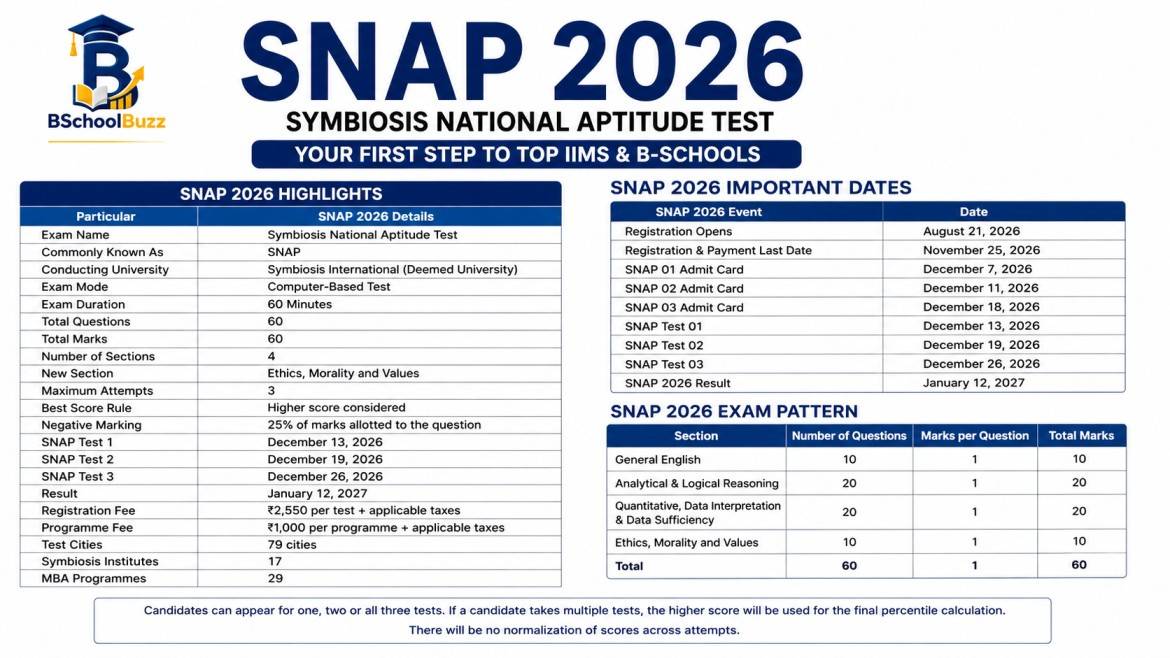
The SNAP Notification 2026 brings a significant change for MBA aspirants targeting Symbiosis International (Deemed University). The Symbiosis National Aptitude Test (SNAP) 2026 will continue to be a 60-minute computer-based entrance test, but the examination structure has been revised for 2026.
The biggest change is the introduction of a new section called Ethics, Morality and Values. SNAP 2026 will now have four sections instead of three, with 60 questions carrying 60 marks in total. The revised structure includes 10 questions from General English, 20 from Analytical & Logical Reasoning, 20 from Quantitative, Data Interpretation & Data Sufficiency, and 10 from Ethics, Morality and Values.
The SNAP 2026 exam dates are December 13, December 19 and December 26, 2026. Candidates can appear for up to three tests, and if they take more than one attempt, the higher score will be considered for the final percentile calculation. The official notification states that there will be no normalization of scores across attempts.
For aspirants targeting leading Symbiosis MBA institutes such as SIBM Pune, SCMHRD Pune, SIIB Pune and other participating institutes, understanding the new SNAP 2026 exam pattern is now more important than ever.
SNAP 2026 Highlights
Particular | SNAP 2026 Details |
|---|---|
Exam Name | Symbiosis National Aptitude Test |
Commonly Known As | SNAP |
Conducting University | Symbiosis International (Deemed University) |
Exam Mode | Computer-Based Test |
Exam Duration | 60 Minutes |
Total Questions | 60 |
Total Marks | 60 |
Number of Sections | 4 |
New Section | Ethics, Morality and Values |
Maximum Attempts | 3 |
Best Score Rule | Higher score considered |
Negative Marking | 25% of marks allotted to the question |
SNAP Test 1 | December 13, 2026 |
SNAP Test 2 | December 19, 2026 |
SNAP Test 3 | December 26, 2026 |
Result | January 12, 2027 |
Registration Fee | ₹2,550 per test + applicable taxes |
Programme Fee | ₹1,000 per programme + applicable taxes |
Test Cities | 79 cities |
Symbiosis Institutes | 17 |
MBA Programmes | 29 |
The official SNAP portal currently highlights 17 Symbiosis institutes, 29 MBA programmes and 79 test cities for the admission cycle.
SNAP 2026 Important Dates
Knowing the SNAP 2026 important dates is essential because the examination gives candidates multiple attempts but requires separate planning for registration, test dates and admit cards.
SNAP 2026 Exam Dates and Schedule
SNAP 2026 Event | Date |
Registration Opens | August 21, 2026 |
Registration & Payment Last Date | November 25, 2026 |
SNAP 01 Admit Card | December 7, 2026 |
SNAP 02 Admit Card | December 11, 2026 |
SNAP 03 Admit Card | December 18, 2026 |
SNAP Test 01 | December 13, 2026 |
SNAP Test 02 | December 19, 2026 |
SNAP Test 03 | December 26, 2026 |
SNAP 2026 Result | January 12, 2027 |
The official SNAP schedule states that applications open on August 21, 2026, registration and payment close on November 25, 2026, and the result is scheduled for January 12, 2027.
Important: Candidates should not wait until the final day to complete their registration. The official registration instructions state that test date and city availability can be affected by capacity, and earlier payment improves the chances of getting the preferred option.
SNAP Exam Date 2026
The SNAP Exam 2026 will be conducted three times:
SNAP Test 1
December 13, 2026
SNAP Test 2
December 19, 2026
SNAP Test 3
December 26, 2026
Each test will be conducted for 60 minutes. Candidates can appear for one, two or all three tests. If a candidate takes multiple tests, the higher score will be used for the final percentile calculation.
This three-attempt structure is one of the biggest strategic advantages of SNAP.
Instead of treating three attempts as three completely separate examinations, aspirants can use the first attempt to understand their performance and use subsequent attempts to improve their score.
SNAP 2026 New Exam Pattern: What Has Changed?
The biggest change in the SNAP 2026 exam pattern is the introduction of the fourth section:
Ethics, Morality and Values.
Earlier SNAP structures had three sections. For 2026, the official test structure has been revised to four sections while keeping the overall paper at 60 questions and 60 marks.
SNAP 2026 Section-Wise Pattern
Section | Questions | Marks |
General English | 10 | 10 |
Analytical & Logical Reasoning | 20 | 20 |
Quantitative, Data Interpretation & Data Sufficiency | 20 | 20 |
Ethics, Morality and Values | 10 | 10 |
Total | 60 | 60 |
Every correct answer carries one mark. An incorrect answer attracts a penalty equivalent to 25% of the marks allotted to that question.
Ethics, Morality and Values: The New SNAP 2026 Section
The introduction of Ethics, Morality and Values is the defining change in SNAP 2026.
The section carries:
10 questions
10 marks
One mark for each correct answer
25% negative marking for an incorrect answer
Because this is a newly introduced component, aspirants should not prepare for it by blindly following previous-year SNAP papers.
The practical approach should be to understand concepts involving ethical reasoning, values, responsible decision-making, professional conduct and situational judgement, while also closely following official updates about the section.
Why Is This Section Important?
Although the section contains only 10 questions, it can influence the overall score because SNAP is a highly speed-driven examination.
A candidate who prepares effectively for the new section can potentially create an additional scoring opportunity rather than treating it as an unfamiliar obstacle.
The larger message from the new pattern is clear: SNAP preparation for 2026 cannot simply be a copy of SNAP 2025 preparation.
SNAP 2026 Marking Scheme
The SNAP 2026 marking scheme is simple but makes accuracy important.
For every correct answer:
+1 mark
For every incorrect answer:
-0.25 mark
For an unattempted question:
No marks
Since the examination has 60 questions in 60 minutes, candidates need to balance speed and accuracy.
Random guessing can be costly because negative marking applies across the paper.
SNAP 2026 Syllabus
The SNAP 2026 syllabus should be approached section-wise.
The official notification confirms the four sections, while candidates can use the broader topic areas below to structure their preparation.
- General English
The General English section can be prepared through:
Reading Comprehension
Vocabulary
Grammar
Sentence Correction
Verbal Ability
Synonyms and Antonyms
Para Jumbles
Fill in the Blanks
Sentence Completion
Verbal Reasoning
Since the section contains 10 questions in the revised pattern, candidates should prioritize accuracy and speed.
- Analytical & Logical Reasoning
Analytical & Logical Reasoning carries the highest number of questions along with Quantitative, DI & DS.
Important preparation areas include:
Seating Arrangements
Puzzles
Blood Relations
Coding-Decoding
Series
Syllogisms
Directions
Venn Diagrams
Logical Deductions
Clocks and Calendars
Data-Based Reasoning
Analytical Reasoning
Statement and Conclusion
Cause and Effect
Candidates should focus on recognizing question structures quickly because SNAP rewards fast decision-making.
- Quantitative, Data Interpretation & Data Sufficiency
This section combines quantitative aptitude with data-based questions.
Important areas include:
Arithmetic
Percentages
Profit and Loss
Simple and Compound Interest
Ratio and Proportion
Averages
Mixtures and Allegations
Time, Speed and Distance
Time and Work
Algebra
Linear Equations
Quadratic Equations
Inequalities
Algebraic Expressions
Functions
Number System
Divisibility
HCF and LCM
Remainders
Number Properties
Geometry
Lines and Angles
Triangles
Circles
Quadrilaterals
Mensuration
Data Interpretation
Tables
Bar Graphs
Line Graphs
Pie Charts
Caselets
Data Sufficiency
Candidates should learn to determine whether the information provided is sufficient to answer the question rather than solving every question completely.
- Ethics, Morality and Values
This is the new section in SNAP 2026.
Candidates should build familiarity with areas such as:
Ethical decision-making
Professional ethics
Moral reasoning
Values
Integrity
Responsibility
Fairness
Conflict of interest
Ethical dilemmas
Corporate responsibility
Decision-making in workplace situations
Because this is a new section, aspirants should prioritize official updates and practice material that specifically reflects the revised SNAP structure.
SNAP 2026 Registration
The SNAP Registration 2026 process is conducted online through the official SNAP portal.
Applications are scheduled to open on August 21, 2026, and registration/payment closes on November 25, 2026.
How to Register for SNAP 2026?
Candidates can follow these steps:
Step 1: Visit the official SNAP registration portal.
Step 2: Click on the registration option.
Step 3: Accept the terms and conditions.
Step 4: Enter personal, academic and contact information.
Step 5: Verify the registered mobile number/email using OTP.
Step 6: Upload the required photograph.
Step 7: Pay the SNAP test registration fee.
Step 8: Select the desired SNAP test(s).
Step 9: Register for the Symbiosis MBA programme(s) you want to apply to.
Step 10: Pay the applicable programme registration fee.
Step 11: Review all information carefully.
Step 12: Save the application and payment confirmation.
The official registration instructions emphasize that candidates must provide accurate information and that changes are generally not permitted after registration.
SNAP 2026 Registration Fee
The current official SNAP 2026 fee structure is:
Fee Component | Amount |
SNAP Test Registration | ₹2,550 per test |
Programme Registration | ₹1,000 per programme |
Government Taxes | Applicable additionally |
The test fee is payable for each attempt selected, while the programme registration fee is payable separately for each programme applied to. Both fees are stated as non-refundable and non-transferable.
Example
If a candidate applies for all three SNAP tests:
₹2,550 × 3 = ₹7,650
Programme application charges are additional.
Therefore, candidates should decide their target Symbiosis programmes before completing the application.
SNAP 2026 Eligibility Criteria
The general SNAP Eligibility Criteria 2026 requires candidates to hold a bachelor's degree from a recognized university or institution of national importance with the required minimum percentage.
For many Symbiosis MBA programmes, the general requirement is:
Bachelor's degree from a recognized university/institution
Minimum 50% marks or equivalent grade
45% for SC/ST candidates
Final-year students may apply, subject to fulfilling the required eligibility at the time of admission
Candidates with foreign qualifications may require an equivalence certificate from AIU
However, programme-specific eligibility can differ.
For example, some specialized programmes may have additional academic or work-experience requirements. SCMHRD's Business Analytics programme, for instance, lists a minimum two years of full-time work experience after graduation.
Therefore, clearing the general SNAP eligibility requirement does not automatically mean that a candidate is eligible for every Symbiosis programme.
Candidates should check the eligibility criteria of the specific programme they intend to apply for.
Who Can Apply for SNAP 2026?
SNAP is open to graduates from different academic backgrounds, provided they meet the relevant eligibility requirements.
Candidates can come from backgrounds such as:
Engineering
Commerce
Management
Humanities
Science
Law
Economics
Other recognized undergraduate disciplines
The important point is that eligibility is determined by the applicable Symbiosis programme requirements rather than by having a specific undergraduate specialization.
SNAP 2026 Admit Card
The SNAP 2026 Admit Card will be released separately for each test.
Expected official schedule:
SNAP Test 1 Admit Card: December 7, 2026
SNAP Test 2 Admit Card: December 11, 2026
SNAP Test 3 Admit Card: December 18, 2026
The exact test timing will be communicated through the respective admit card.
Candidates should download the admit card from the official SNAP portal and carefully check:
Name
Photograph
Test date
Test timing
Test centre
Reporting instructions
SNAP 2026 Test Cities
SNAP has a broad testing network across India.
The official SNAP ecosystem currently lists 79 test cities.
The available city list has included locations such as:
Delhi
Gurugram
Mumbai
Pune
Bengaluru
Hyderabad
Chennai
Kolkata
Ahmedabad
Jaipur
Lucknow
Chandigarh
Noida
Greater Noida
Ghaziabad
Indore
Bhopal
Patna
Ranchi
Varanasi
Bareilly
Kanpur
Agra
Prayagraj
Dehradun
Guwahati
Bhubaneswar
Nagpur
Nashik
The final test centre and address are communicated through the admit card, and city availability can depend on capacity.
How Many Attempts Are Allowed in SNAP 2026?
Candidates can appear for up to three SNAP tests.
This means an aspirant can choose:
One attempt
Two attempts
Three attempts
If a candidate appears more than once, the higher score is considered for the final percentile calculation. The official SNAP information also states that there will be no normalization between attempts.
How Should You Use the Three Attempts?
A smart strategy could be:
Attempt 1: Establish your baseline.
Attempt 2: Improve your weak areas and attempt strategy.
Attempt 3: Maximize your score.
However, candidates should not assume that taking all three attempts is compulsory. The decision should depend on preparation level, budget, availability and target percentile.
SNAP 2026 Result
The SNAP 2026 Result is scheduled to be announced on:
January 12, 2027
Candidates will be able to access their result/score information through the official SNAP portal.
The SNAP score is an important component of the Symbiosis admission process, but the examination itself is not the complete admission process.
What Happens After SNAP 2026?
Clearing SNAP is only the first major stage.
Candidates shortlisted by individual Symbiosis institutes may have to participate in the institute-specific subsequent selection process, including Group Exercise (GE) and Personal Interaction (PI), depending on the programme.
The official SNAP information states that the subsequent admission process is conducted separately by the respective institute/programme.
Therefore:
SNAP Score → Institute Shortlist → GE/PI or applicable selection process → Final Admission
This distinction is important because a high SNAP percentile does not mean automatic admission to every Symbiosis MBA programme.
Colleges Accepting SNAP 2026
SNAP is used for admission to MBA programmes across Symbiosis International (Deemed University).
The official SNAP portal currently highlights:
17 Symbiosis Institutes
and
29 MBA Programmes.
Some of the prominent institutes associated with SNAP include:
SIBM Pune
Symbiosis Institute of Business Management, Pune is among the most sought-after Symbiosis MBA institutes.
SCMHRD Pune
Symbiosis Centre for Management and Human Resource Development offers MBA programmes including areas such as HR, Finance, Marketing and Operations.
SIIB Pune
Symbiosis Institute of International Business offers specialized management programmes.
SIBM Bengaluru
Symbiosis Institute of Business Management, Bengaluru offers an MBA programme with a focus on contemporary management education.
SIOM Nashik
Symbiosis Institute of Operations Management focuses on operations and related management education.
SCIT Pune
Symbiosis Centre for Information Technology offers programmes around IT business management and data-oriented management education.
Other Symbiosis institutes and specialized programmes also participate in the SNAP admission ecosystem.
Because programmes and eligibility requirements can differ, candidates should check the specific programme page before applying.
SNAP 2026 Cutoff: What Percentile Should You Target?
The SNAP 2026 cutoff will vary by institute and programme.
There is no single SNAP percentile that guarantees admission to every Symbiosis institute.
Instead, aspirants should think in terms of target percentile bands.
For the most competitive Symbiosis MBA programmes, candidates should generally aim for a very high SNAP percentile rather than preparing merely to cross a minimum qualifying score.
Why Does the Cutoff Vary?
The effective shortlist level can change based on:
Number of applicants
Difficulty level
Candidate performance
Number of seats
Institute popularity
Programme preference
Overall SNAP percentile distribution
Most importantly, SNAP cutoff and final admission are not the same thing.
A candidate can clear a shortlist threshold but still need to perform strongly in the subsequent selection process.
For 2026 admissions, candidates should treat previous-year cutoff figures as reference points rather than guaranteed benchmarks.
SNAP 2026 Preparation Strategy
The revised paper requires a slightly different approach.
SNAP is not simply about knowing concepts.
It is about:
Concepts + Speed + Accuracy + Selection
With 60 questions and 60 minutes, candidates effectively have about one minute per question on average.
That does not mean every question should be solved in exactly one minute. Some questions will take significantly less time, while others should be skipped if they consume too much time.
- Prepare for the New Ethics Section Early
Do not leave Ethics, Morality and Values for the last few days.
Since it is a completely new section in the official 2026 structure, candidates should build familiarity with ethical reasoning and situational decision-making early in their preparation.
- Prioritize Logical Reasoning
Analytical & Logical Reasoning contains 20 questions.
Develop the ability to identify:
Easy questions
Medium questions
Time-consuming questions
The objective should be to maximize marks, not to prove that you can solve every difficult puzzle.
- Build a Strong Arithmetic Base
For Quantitative Aptitude, arithmetic should remain a major focus.
Prioritize:
Percentages
Ratio
Averages
Profit & Loss
Time & Work
Time-Speed-Distance
Mixtures
Interest
These areas can produce relatively manageable questions when concepts are strong.
- Practice Under Time Pressure
Solving 60 questions without a timer is not enough.
Use:
Timed sectional tests → Full-length mocks → Mock analysis → Targeted practice
The analysis after the mock is often more valuable than simply taking another mock.
- Develop a Question Selection Strategy
A strong SNAP candidate does not necessarily attempt every question.
Instead, identify:
Quick wins → Moderate questions → Time-consuming questions
If a question appears unusually lengthy, move ahead and return only if time permits.
SNAP 2026 Mock Test Strategy
A good SNAP 2026 mock test strategy should change as the examination approaches.
Early Preparation
Focus on:
Concept building
Sectional practice
Accuracy
Mid Preparation
Focus on:
Timed practice
Mixed question sets
Speed improvement
Final Phase
Focus on:
Full-length mocks
Question selection
Attempt strategy
Revision
Error analysis
Do not measure preparation only by mock-test scores.
Track:
Accuracy
Questions attempted
Questions skipped
Time spent
Silly mistakes
Conceptual mistakes
Guessing mistakes
SNAP vs CAT: Which Exam Should You Take?
SNAP and CAT are both major MBA entrance examinations, but their structures and preparation demands are different.
Factor | SNAP | CAT |
Duration | 60 minutes | Longer examination |
SNAP Attempts | Up to 3 | One CAT test |
SNAP 2026 Sections | 4 | CAT has 3 sections |
Negative Marking | Yes | Yes, with CAT-specific rules |
Major Target | Symbiosis institutes | IIMs + many other B-schools |
Exam Style | Highly speed-oriented | More concept + endurance oriented |
Candidates preparing for CAT can leverage much of their Quant, Reasoning and English preparation for SNAP, but they should separately practice the speed and question-selection requirements of SNAP.
SNAP vs NMAT
SNAP and NMAT are both popular management entrance examinations, but their examination structures differ.
Candidates considering multiple MBA entrance tests should compare:
Exam pattern
Number of attempts
Test duration
Accepted colleges
Registration fees
Selection process
Target percentile
Preparation overlap
For many aspirants, preparing simultaneously for SNAP and other management entrance examinations can be efficient because Quantitative Aptitude, Logical Reasoning and English preparation overlap significantly.
Is SNAP 2026 Difficult?
The difficulty of SNAP 2026 cannot be known until the actual examination is conducted.
However, the short 60-minute duration makes time management a central challenge.
The introduction of Ethics, Morality and Values also means candidates need to adapt to the revised four-section structure.
Instead of asking only:
"Is SNAP difficult?"
A better question is:
"Can I solve enough questions accurately within 60 minutes?"
That is the skill candidates should build through mocks.
Who Should Take SNAP 2026?
SNAP 2026 is particularly relevant for candidates who want to explore MBA opportunities through Symbiosis institutes.
It can be a strong additional examination for:
CAT aspirants
NMAT aspirants
XAT aspirants
Non-engineering graduates
Engineering graduates
Fresh graduates
Candidates targeting Symbiosis MBA programmes
The key consideration should be the candidate's target college and programme rather than simply taking the examination because it is another MBA entrance test.
Common Mistakes to Avoid in SNAP 2026
Mistake 1: Preparing only according to the old pattern
The 2026 structure has changed.
Mistake 2: Ignoring Ethics, Morality and Values
It is now an official section worth 10 marks.
Mistake 3: Spending too long on difficult questions
SNAP rewards efficient question selection.
Mistake 4: Ignoring negative marking
Blind guessing can reduce your score.
Mistake 5: Taking mocks without analyzing them
The real improvement happens during analysis.
Mistake 6: Applying only for SNAP and forgetting programme registration
SNAP registration and programme registration are separate components of the application process.
Mistake 7: Waiting until the last date
Test city/date availability may be affected by capacity.
SNAP 2026: Quick Comparison of the Old and New Structure
Feature | Earlier SNAP Structure | SNAP 2026 |
Total Questions | 60 | 60 |
Duration | 60 Minutes | 60 Minutes |
Sections | 3 | 4 |
General English | 15 | 10 |
Analytical & Logical Reasoning | 25 | 20 |
Quantitative, DI & DS | 20 | 20 |
Ethics, Morality & Values | — | 10 |
Maximum Attempts | 3 | 3 |
Best Score Considered | Yes | Yes |
The 2026 structure is therefore not a completely different examination, but it redistributes the paper and introduces a new testing area.
SNAP 2026: What Should Aspirants Do Now?
If you are planning to appear for SNAP 2026, your preparation can be divided into five stages:
Stage 1: Understand the Revised Pattern
Know exactly what changed.
Stage 2: Complete the Core Syllabus
Build your foundation in English, LR and Quantitative Aptitude.
Stage 3: Add Ethics Preparation
Start preparing for the new Ethics, Morality and Values section.
Stage 4: Take Timed Tests
Build speed gradually.
Stage 5: Optimize Your Attempt Strategy
Use mocks to determine:
Which section to start with
Which questions to skip
How many questions to attempt
How much time to spend on each section
SNAP 2026 FAQs
Is SNAP Notification 2026 out?
Yes. The official SNAP portal has published the 2026 test structure and admission schedule. Applications are scheduled to open on August 21, 2026.
What is the SNAP Exam Date 2026?
SNAP 2026 will be conducted on December 13, December 19 and December 26, 2026.
How many questions are there in SNAP 2026?
SNAP 2026 has 60 questions carrying 60 marks.
What is the new section in SNAP 2026?
The new section is Ethics, Morality and Values, consisting of 10 questions for 10 marks.
What is the duration of SNAP 2026?
The SNAP 2026 test duration is 60 minutes.
How many attempts are allowed in SNAP 2026?
Candidates can appear for up to three SNAP tests. The higher score is considered if multiple tests are taken.
Is there negative marking in SNAP 2026?
Yes. An incorrect answer attracts a penalty of 25% of the marks allotted to that question.
What is the SNAP 2026 registration fee?
The SNAP test registration fee is ₹2,550 per test, plus applicable government taxes.
Is there a separate Symbiosis programme fee?
Yes. Candidates must pay ₹1,000 per programme, plus applicable taxes, in addition to the SNAP test fee.
What is the last date for SNAP 2026 registration?
The registration and payment deadline is November 25, 2026.
When will SNAP 2026 admit cards be released?
The official schedule lists December 7, December 11 and December 18, 2026 for SNAP Test 1, Test 2 and Test 3 admit cards respectively.
When will the SNAP 2026 result be announced?
The official schedule lists January 12, 2027 as the SNAP 2026 result date.
What is the SNAP 2026 eligibility criteria?
For many Symbiosis MBA programmes, candidates need a bachelor's degree with at least 50% marks or equivalent grade, with 45% applicable for SC/ST candidates. Programme-specific requirements may vary.
Can final-year students apply for SNAP 2026?
Yes, final-year candidates can apply where permitted, subject to meeting the applicable programme eligibility requirements at admission.
How many colleges accept SNAP?
The official SNAP portal currently highlights 17 Symbiosis institutes offering 29 MBA programmes through the SNAP admission ecosystem.
Is SNAP enough for admission to Symbiosis?
No. SNAP is the entrance-test component. Shortlisted candidates may need to participate in the subsequent institute-specific admission process, including GE-PI or other applicable stages.
Is SNAP 2026 easier than CAT?
The two exams test overlapping aptitude areas but have different formats. SNAP's 60-minute, 60-question structure makes speed and question selection particularly important.
Should CAT aspirants also take SNAP 2026?
If a candidate is interested in Symbiosis MBA programmes, SNAP can be a useful additional entrance examination because preparation overlaps significantly with CAT in Quantitative Aptitude, Reasoning and English.
Final Verdict: Is SNAP 2026 Worth Targeting?
For MBA aspirants interested in Symbiosis, SNAP 2026 deserves serious consideration.
The examination retains its 60-question, 60-minute format but introduces a completely new section — Ethics, Morality and Values. Candidates also get the flexibility of up to three attempts, with the higher score considered for the final percentile calculation.
The biggest mistake would be to prepare for SNAP 2026 exactly like previous years.
The smarter approach is to:
Understand the revised pattern → Build the core syllabus → Prepare for Ethics → Practice speed → Take mocks → Optimize question selection.
With 17 Symbiosis institutes, 29 MBA programmes and 79 test cities currently highlighted on the official SNAP portal, the examination provides access to a broad range of Symbiosis management programmes.
If you are targeting SIBM Pune, SCMHRD Pune, SIIB Pune, SIBM Bengaluru, SIOM Nashik, SCIT Pune or other Symbiosis MBA programmes, start your SNAP 2026 preparation with the revised pattern in mind.
The SNAP 2026 game is no longer just about solving questions. It is about solving the right questions, at the right speed, with the right strategy.
Official SNAP 2026 Reference
For the latest changes to dates, fees, eligibility, test structure and programme requirements, candidates should verify information directly on the official SNAP portal before submitting an application.
