
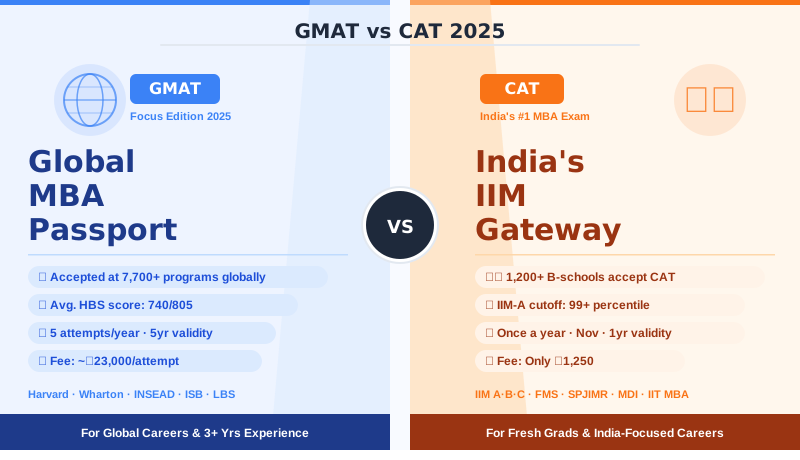
GMAT vs. CAT: Choosing the Right Exam for Your MBA Journey
Let's start with a scenario most Indian MBA aspirants live through at some point.
You're sitting at your desk, maybe after a long day at work or between college lectures, and you've just typed "MBA entrance exams India" into Google. Fifteen tabs later, you're more confused than when you started. You know you want an MBA. You know it'll probably change your career trajectory. But somewhere between reading about IIM Ahmedabad's average salary of ₹32 LPA and Harvard's $200,000 starting compensation, a single question has paralyzed you:
Should I appear for GMAT or CAT?
This is not a small question. It determines which colleges you can target, how long you study, how much you spend, and ultimately — what kind of MBA career you build. The GMAT vs CAT decision is one of the most important crossroads in any Indian MBA aspirant's journey, and most people make it without nearly enough information.
This article fixes that.
We're going to go deep — exam structure, target colleges, difficulty, cost, career outcomes, and the personal factors that ultimately tip the scale. By the end, you'll know exactly which exam is right for you, and why.
First, Understand What These Two Exams Actually Are
Before comparing GMAT vs CAT, it's worth being clear about what each exam is designed to do, because they were built for fundamentally different purposes.
CAT (Common Admission Test) is conducted by the IIMs on a rotational basis. It's a domestic exam, designed specifically to funnel students into Indian B-schools — primarily the IIMs, but also FMS Delhi, SPJIMR, MDI Gurgaon, IITs, and hundreds of other colleges that accept CAT scores. The exam has been running since 1950 in various forms. Today, it's a 2-hour computer-based test taken by approximately 3.3 to 3.5 lakh students annually.
GMAT (Graduate Management Admission Test) is a global exam managed by GMAC (Graduate Management Admission Council). It's accepted by over 7,700 business school programs across 110 countries. In India, GMAT scores are accepted by ISB Hyderabad, XLRI, SP Jain, Great Lakes, and some IIMs for their executive programs. Internationally, every top-ranked business school — Harvard, Wharton, INSEAD, LBS, NUS — runs on GMAT.
In other words: CAT is the key to Indian MBA programs. GMAT is the key to global MBA programs. If you know which world you want to operate in, the GMAT vs CAT question answers itself. But most people don't know yet — which is exactly why this comparison matters.
Exam Structure: What You're Actually Being Tested On
CAT Exam Structure
CAT 2024 followed a format that has been relatively stable over the past few years:
Section | Questions | Time |
Verbal Ability & Reading Comprehension (VARC) | 24 | 40 minutes |
Data Interpretation & Logical Reasoning (DILR) | 20 | 40 minutes |
Quantitative Ability (QA) | 22 | 40 minutes |
Total | 66 | 120 minutes |
Scoring: +3 for correct MCQ answers, -1 for wrong MCQs. Non-MCQ (TITA) questions carry no negative marking.
The final score is normalized across multiple slots (CAT is held across 2–3 slots in a single day). The score is reported as a percentile, not a raw number. A 99 percentile means you've outperformed 99% of all test-takers.
What makes CAT hard: The questions aren't conceptually deep — a Class 10 student technically knows all the math needed for QA. What makes CAT brutal is time. 40 minutes for 22 QA questions means roughly 109 seconds per question. The moment you're not in the flow, you're losing percentile points. Add the psychological pressure of sectional cutoffs (you need to cross minimum percentiles in each section, not just overall), and you have an exam that tests composure as much as it tests intelligence.
GMAT Exam Structure
GMAT Focus Edition (the current format, launched in 2023) is a significant departure from the old GMAT. Here's the updated structure:
Section | Questions | Time |
Quantitative Reasoning | 21 | 45 minutes |
Verbal Reasoning | 23 | 45 minutes |
Data Insights | 20 | 45 minutes |
Total | 64 | 135 minutes |
Scoring: GMAT Focus Edition scores range from 205 to 805. The average GMAT score globally is around 583. Top programs like Harvard Business School report average incoming GMAT scores of 740+. A 700+ score is generally considered competitive for top global programs.
Key features of GMAT:
Adaptive testing: The GMAT is section-adaptive. Performance in earlier questions influences the difficulty of later ones. There's no "guess and move on" strategy that works here.
Bookmark and edit: In the Focus Edition, you can bookmark questions and return to edit up to 3 answers per section — a significant usability improvement over the old format.
No AWA (Analytical Writing Assessment): The old GMAT's essay section has been removed. The Focus Edition is leaner and more focused on decision-making skills.
Data Insights replaces IR: This new section combines elements of the old Integrated Reasoning and Data Sufficiency into a single, more sophisticated section.
What makes GMAT hard: Unlike CAT, GMAT questions are deliberately more nuanced. The verbal section tests logical precision in a way that genuinely trips up non-native English speakers. The Data Insights section requires a different kind of analytical thinking — less formula-based, more judgment-based. And since it's adaptive, one bad streak early in a section can cascade into a lower difficulty ceiling for subsequent questions.
GMAT vs CAT: A Direct Comparison on Key Parameters
- Difficulty Level
This is the most debated aspect of GMAT vs CAT, and the answer is more nuanced than most people admit.
CAT is harder for: Students who struggle with speed, have weak quant basics, or find it hard to manage mental fatigue under timed conditions. The sheer volume of questions per unit time is CAT's defining challenge. DILR especially can be unpredictably difficult — entire sets can be unsolvable if you don't recognize the pattern early.
GMAT is harder for: Students who struggle with sophisticated verbal reasoning, logical precision, and exam adaptivity. GMAT Verbal is genuinely difficult for many Indian students who are strong in math but haven't developed the kind of analytical reading GMAT demands. The adaptive format also means you can't simply skip and return — every question carries weight.
Raw data point: The average CAT score for IIM Ahmedabad shortlist is above 99 percentile. The average GMAT score for Harvard Business School is 740 out of 805 — roughly the 96th percentile globally.
Both exams are brutally competitive at the top. The difference is what type of hard they are.
- Syllabus Coverage
CAT syllabus focus:
Heavy on arithmetic, algebra, geometry, number theory (QA)
Reading comprehension, para-jumbles, para-summary, odd sentence out (VARC)
Data interpretation (tables, charts, graphs) and logical reasoning sets (DILR)
GMAT Focus Edition syllabus:
Arithmetic, algebra, word problems, data sufficiency (Quantitative Reasoning)
Reading comprehension, critical reasoning (Verbal Reasoning)
Graphical interpretation, two-part analysis, multi-source reasoning, table analysis, data sufficiency (Data Insights)
The biggest difference: CAT has no Critical Reasoning section as a standalone. GMAT's Critical Reasoning (part of Verbal) is a distinct skill that requires specific preparation. Conversely, CAT's DILR section has no real GMAT equivalent — the puzzle-solving nature of DILR sets is uniquely CAT.
For Indian engineering graduates, CAT's QA section tends to feel more familiar. GMAT's Data Insights section tends to feel closer to real-world business problem-solving.
- Frequency and Attempts
CAT: Held once a year, typically in November. You get one shot per year. If you have a bad day, you wait 12 months.
GMAT: Can be taken up to 5 times in a rolling 12-month period (8 times lifetime). Scores are valid for 5 years. You can retake it strategically — if you score 680 in April, target 720 in July.
This is a genuinely significant difference. GMAT's retake flexibility reduces the pressure of any single attempt. CAT's annual cycle means one bad November can cost you an entire year of your career timeline.
- Cost
CAT registration fee: ₹1,250 for general category (₹625 for SC/ST/PwD). Essentially free compared to any global exam.
GMAT registration fee: $275 (approximately ₹23,000) per attempt. Rescheduling fees apply. Prep material, coaching, and multiple attempts can push total GMAT spending to ₹1–2 lakh easily.
In the GMAT vs CAT cost comparison, there's no contest. CAT is one of the most affordable high-stakes exams in the world.
- Score Validity
CAT: Valid for 1 year only. You must apply to MBA programs in the same admission cycle.
GMAT: Valid for 5 years. This matters enormously for career flexibility — you can take GMAT at 24, use the score at 27 when you have the work experience top global programs require.
- Preparation Time
CAT: Most serious aspirants spend 6–12 months in dedicated preparation. Students starting from scratch (weak quant or verbal base) sometimes spend 18 months.
GMAT: The average GMAT test-taker studies for 3–6 months. However, Indian students targeting 720+ often spend 6–9 months, particularly on Verbal and Data Insights.
A common misconception in the GMAT vs CAT debate is that GMAT is "easier" and requires less preparation. This is wrong. GMAT requires less time for average scores. It requires significant time for competitive scores at top programs.
The College Question: Where Does Each Score Take You?
This is ultimately the most important part of the GMAT vs CAT comparison — because the exam is just the vehicle. The destination is what matters.
Where CAT Scores Are Accepted
CAT score is accepted by over 1,200 B-schools in India. The ones worth targeting:
Tier 1 (Elite):
IIM Ahmedabad, Bangalore, Calcutta, Lucknow, Kozhikode, Indore (old IIMs)
FMS Delhi (arguably the best ROI MBA in India)
SPJIMR Mumbai
MDI Gurgaon
IIT Bombay, Delhi, Kharagpur (MBA programs)
Tier 2 (Strong):
IIM Shillong, Ranchi, Raipur, Rohtak, Udaipur, Trichy, Nagpur (new IIMs)
NITIE Mumbai
TAPMI, IMT Ghaziabad, IMI Delhi, Great Lakes Chennai
Placement context: IIM Ahmedabad's Class of 2024 reported an average salary of ₹35.1 LPA. FMS Delhi's average was approximately ₹32.4 LPA. Even among the newer IIMs, average placements hover between ₹12–22 LPA.
Total program cost: An IIM MBA (2-year PGP) costs between ₹23–26 lakh at old IIMs. FMS Delhi costs under ₹2 lakh — the most extreme ROI equation in Indian higher education.
Where GMAT Scores Are Accepted
International programs (top tier):
Harvard Business School (avg GMAT: 740)
Stanford GSB (avg GMAT: 738)
Wharton, Booth, Kellogg, Sloan (avg GMAT: 720–730)
INSEAD (avg GMAT: 708)
London Business School (avg GMAT: 707)
NUS Business School, HKUST, NTU (avg GMAT: 660–690)
Indian programs accepting GMAT:
ISB Hyderabad (1-year MBA, avg GMAT ~710) — one of the top GMAT vs CAT decision points for Indian students
XLRI Jamshedpur (BM and HRM programs)
SP Jain School of Global Management
Great Lakes Institute of Management
Some IIMs accept GMAT for PGPX (executive MBA) programs
Placement context: ISB Hyderabad's Class of 2024 reported a median salary of ₹34 LPA domestically, with international placements averaging significantly higher. Harvard MBA graduates' median starting compensation exceeds $200,000 in the US.
Total program cost: ISB's 1-year MBA costs approximately ₹40–43 lakh. Harvard MBA is approximately $111,000 in tuition alone — total cost of attendance exceeds $200,000.
The Work Experience Factor
This is one of the most underappreciated dimensions of the GMAT vs CAT debate.
CAT programs: Indian IIM PGP programs are designed for fresh graduates or candidates with minimal work experience. IIM Ahmedabad's PGP Class of 2024 had an average work experience of just 8–10 months. Most old IIM batches are 60–70% fresh graduates. Work experience helps, but it's not required and doesn't dramatically tilt the scales.
GMAT programs: This is where it gets important. Top global MBA programs explicitly require work experience:
Harvard Business School: Average work experience of 5 years
Wharton: Average 5 years
INSEAD: Minimum 2 years required, average 6 years
ISB Hyderabad: Minimum 2 years required, average 4.5 years
If you're a fresh graduate reading this and considering GMAT for global programs, the honest advice is: take the GMAT now if you want (scores last 5 years), but you won't be applying to top programs for 3–5 years. Plan accordingly.
For working professionals with 3–6 years of experience, GMAT opens doors that CAT structurally cannot — because IIM PGP programs aren't designed for experienced professionals. The IIM executive programs (PGPX, EPGP) do accept GMAT, but they're 1-year programs designed for 8–10 years of experience.
The fork in the road: If you're 22 and in your final year of college, CAT is almost certainly the right exam for immediate MBA plans. If you're 27 with 5 years of work experience and global ambitions, GMAT is probably the answer. The GMAT vs CAT decision is sometimes really a "which life stage am I in?" decision.
ROI Analysis: The Money Behind the Decision
Let's talk numbers, because MBA is fundamentally a career investment — and a significant financial one.
CAT ROI Scenario
Investment:
Coaching fees: ₹40,000–₹70,000 (if taken)
CAT registration: ₹1,250
IIM program fees: ₹23–26 lakh (old IIMs)
Living expenses over 2 years: ₹5–8 lakh
Total investment: ₹30–35 lakh
Return:
IIM Ahmedabad/Bangalore average salary: ₹32–35 LPA
Break-even period: ~1 year post-placement
5-year cumulative earnings (assuming 10% annual growth): ₹2+ crore
FMS Delhi makes this even more extreme — ₹2 lakh in fees, ₹32 LPA average placement. The FMS ROI calculation is arguably the best of any MBA program in the world when adjusted for cost.
GMAT / ISB ROI Scenario
Investment:
GMAT preparation: ₹50,000–₹1.5 lakh
GMAT registration (1–2 attempts): ₹46,000–₹70,000
ISB fees: ₹43 lakh
Living expenses: ₹5–7 lakh
Total investment: ₹50–55 lakh
Return:
ISB median domestic salary: ₹34 LPA
ISB international placement: significantly higher
Break-even period: ~1.5–2 years
5-year cumulative earnings: ₹2+ crore (comparable to IIM, but starting from a higher cost base)
Global MBA ROI Scenario (Harvard/Wharton)
Investment:
Total cost of attendance: $200,000–$230,000 (₹1.7–2 crore)
Opportunity cost of 2 years: significant
Return:
Median starting compensation: $200,000+ (₹1.7 crore+)
Break-even period: 1–2 years in a US job
Long-term premium: access to global networks, PE/VC/consulting roles that rarely recruit from Indian programs
The raw ROI numbers between CAT-IIM and GMAT-ISB are surprisingly similar in absolute Indian rupee terms. The difference shows up in the type of career and geography you target. GMAT-global programs deliver a different kind of return — global mobility, international networks, access to career tracks that don't exist in the Indian market.
GMAT vs CAT: Who Should Choose What?
After all this data, let's get concrete. Here are the profiles that should clearly lean one way.
Choose CAT if:
You're a fresh graduate or have under 2 years of work experience. IIM PGP programs are built for you. You can enter at 22, graduate at 24, and start a high-paying career before most people figure out what they want. The GMAT path would require you to wait 3–5 more years for top programs to consider your profile.
Your target schools are Indian. If IIM A, B, C, FMS, SPJIMR, or MDI are your aspiration, CAT is the only exam that matters. GMAT is irrelevant for these institutions (they don't accept it for PGP).
Budget is a constraint. The CAT ecosystem is vastly more affordable at every level. Coaching costs less. The exam costs less. Even if you make it to an IIM, bank loans for ₹25 lakh are far more manageable than $230,000. The GMAT vs CAT cost gap is real and shouldn't be underestimated.
You want to stay in India long-term. IIM networks are extraordinarily powerful within India. The IIM alumni network opens doors in Indian consulting, FMCG, finance, and startups in a way no global program can replicate domestically. If your career plans are India-centric, an IIM brand beats a second-tier global MBA every time.
You're an engineering graduate with strong quant skills. CAT's quant section will feel relatively natural. The GMAT's verbal and Data Insights sections require skills most engineering graduates haven't developed — and building them takes more time and effort than most expect.
Choose GMAT if:
You have 3+ years of work experience and global ambitions. You've aged out of the typical IIM PGP profile. GMAT opens ISB (1-year, India), plus INSEAD, LBS, NUS, and every other top global program. If you want to work in New York, Singapore, or London, GMAT is the entry ticket.
You want multiple attempts and score flexibility. Life happens. GMAT's retake policy (5 attempts/year) is a meaningful safety net compared to CAT's single annual shot.
Your strengths are in analytical reasoning and English. If you're a strong reader, have a background in law, economics, or liberal arts, and think analytically rather than formulaically, GMAT plays to your strengths. CAT's DILR can be brutal for non-engineers; GMAT's logical structure rewards different skills.
ISB is your dream school. ISB Hyderabad is one of the top 3 MBA destinations for Indian professionals, consistently ranked in the FT Global MBA rankings (currently around #26 globally). ISB requires GMAT (or GRE). If ISB is where you want to go, the GMAT vs CAT decision is made for you.
You want score validity beyond one year. GMAT scores last 5 years. If you're 24 and want to build your career profile first and apply at 28, taking GMAT now makes sense. CAT's 1-year validity makes this impossible.
The "Both" Strategy
Some aspirants — particularly those who are uncertain about their geography preference — prepare for both simultaneously. This is more viable than it sounds.
CAT and GMAT have overlapping quant syllabi. Strong GMAT Verbal preparation also helps CAT VARC. The additional, non-overlapping preparation is GMAT's Data Insights and Critical Reasoning, and CAT's DILR.
Students who attempt both typically spend 10–14 months in total preparation. It's intense but doable, especially for someone between jobs or in their final college year.
The risk: trying to do both and not excelling at either. The GMAT vs CAT decision isn't just about what you can do — it's about what you can do well under real exam pressure.
Common Myths About GMAT vs CAT — Debunked
Myth 1: "GMAT is easier than CAT." False. GMAT is differently hard. CAT requires extreme speed with moderate complexity. GMAT requires moderate speed with extreme precision. Top scores on both exams require serious, sustained preparation. Anyone who calls either exam "easy" hasn't taken it seriously.
Myth 2: "CAT is only for IIMs." False. Over 1,200 institutes accept CAT scores. Including very strong programs like FMS Delhi, SPJIMR, MDI, IIT MBA programs, and dozens of solid Tier 2 institutions. CAT gives you access to an entire ecosystem, not just 20 IIM seats.
Myth 3: "GMAT is for people who can't crack CAT." This is a particularly harmful myth in Indian MBA circles. GMAT is a different exam for a different set of programs, for a different life stage. Choosing GMAT isn't a consolation prize — ISB, INSEAD, and LBS are elite institutions by any global measure.
Myth 4: "Online coaching for GMAT isn't as good." The global nature of GMAT means it has an extraordinarily mature online preparation ecosystem. Manhattan Prep, Target Test Prep, GMATClub, e-GMAT, and the Official GMAT prep materials are best-in-class. In many ways, GMAT prep resources are richer and more standardized than CAT prep resources.
Myth 5: "A low GMAT score can be compensated by work experience." Partially true, but dangerously optimistic. For Harvard, Stanford, and Wharton, a sub-700 GMAT is a serious barrier regardless of your work experience. These schools use GMAT as a first filter. A truly exceptional profile might compensate for 680 vs 720 — it won't compensate for 640.
Preparing for GMAT vs CAT: What the Study Plan Looks Like
CAT Preparation: The Realistic Plan
Duration: 8–12 months for a competitive score
Month 1–3: Build fundamentals
QA: Arithmetic, percentages, ratios, algebra basics
VARC: Daily reading of Hindu editorial, Economist articles
DILR: Basic set types, bar graphs, Venn diagrams
Month 4–6: Deepen concepts
QA: Number theory, geometry, P&C, probability
VARC: RC inference questions, para-jumble strategies
DILR: Complex set types — networks, scheduling, games & tournaments
Start taking 1 mock per month
Month 7–9: Mock-heavy phase
2–3 mocks per week
Post-mock analysis sessions are non-negotiable
Topic tests to plug specific weaknesses
Month 10–11: Peak preparation
3–4 mocks per week
Previous year CAT papers under exam conditions
Strategy refinement based on mock data
Resources: TIME/IMS/2IIM for structured coaching, Cracku or Career Launcher for test series, free YouTube content from 2IIM and CATKing for concept revision.
GMAT Preparation: The Realistic Plan
Duration: 3–6 months for most students; 6–9 months for 720+ target
Month 1: Diagnostic and foundation
Take Official GMAT practice test to establish baseline
Identify weakest sections
Begin Official Guide (OG) practice
Month 2–3: Section-wise deep dive
Quant: Focus on data sufficiency (unique to GMAT), revisit algebraic reasoning
Verbal: Critical Reasoning is the make-or-break section — invest heavily here
Data Insights: Practice multi-source reasoning and graphical interpretation
Month 4–5: Integrated practice
Full-length mocks every week
Analyze score trends across adaptive difficulty
Focus on time management within section constraints
Month 6: Final sprint
Review error logs from all previous mocks
Retake official practice tests
Simulate exam-day conditions
Resources: Official GMAT Prep (mandatory), Manhattan Prep GMAT Strategy Guides, Target Test Prep (best for Quant), e-GMAT (best for non-native English Verbal), GMATClub forums for peer support and question banks.
The Application Process: Beyond the Exam
Passing the GMAT vs CAT comparison is one thing. Getting into a top program is another. Here's what the application process looks like for each path.
After CAT: The Indian MBA Application
CAT results are declared in December. The process that follows is elaborate:
Shortlisting: Each IIM publishes its own shortlisting criteria based on CAT percentile, class 10 and 12 marks, graduation marks, work experience, and gender diversity.
WAT-GD-PI: Writing Ability Test, Group Discussion, and Personal Interview. Conducted between January and March.
Final merit list: Combines CAT score, academic profile, WAT-GD-PI performance, and diversity factors.
Offer and joining: Typically May–June for July batch start.
The post-CAT process is intense. Students who clear 99.5 percentile have been rejected at the IIM interview stage. Students with 95 percentile have converted IIM Bangalore calls because of exceptional academic records and interviews. The GMAT vs CAT comparison isn't just about the exam — it's about the entire selection process.
After GMAT: The Global MBA Application
Global MBA applications are significantly more involved:
Score reporting: You select which schools receive your GMAT score.
Application components: Essays (typically 2–3), letters of recommendation (2–3), resume, transcripts, and sometimes a video essay.
Application rounds: Most schools have 3 rounds. Round 1 (September–October) gives the best admission odds. Round 2 (January) is the largest pool. Round 3 (March–April) is risky.
Interview: By invitation only. Typically conducted by admissions officers or alumni.
Decision and financial aid: Decisions come 4–8 weeks post-interview.
ISB's application follows a similar structure — essays, recommendations, and a personal interview. ISB is known for its holistic evaluation, where leadership potential and career clarity carry significant weight alongside the GMAT score.
A Note on the GRE: The Third Option Nobody Talks About
In the GMAT vs CAT debate, GRE often gets ignored — but it shouldn't.
GRE (Graduate Record Examination) is now accepted by almost all global MBA programs that accept GMAT, including Harvard, Wharton, Stanford, and INSEAD. GRE is generally considered easier than GMAT for students with strong verbal skills, and its quant section is less intimidating than GMAT's Data Insights.
If you're targeting global programs and find GMAT's format unintuitive after a diagnostic test, GRE is worth considering. It costs approximately $220 (₹18,000) and has a similar retake policy to GMAT.
ISB and XLRI have also started accepting GRE, making it a genuine alternative for India-based aspirants in the GMAT vs CAT decision tree.
Final Verdict: GMAT vs CAT — The Decision Framework
Here's the cleanest way to think about the GMAT vs CAT decision. Answer these four questions:
- What's your current work experience?
Under 2 years → CAT
2–5 years → GMAT (ISB/global) or CAT PGPX
5+ years → GMAT only
- Where do you want to work post-MBA?
India → CAT
Global / flexible → GMAT
- What's your budget ceiling?
Under ₹30 lakh total investment → CAT
Up to ₹50 lakh → GMAT (ISB track)
No hard ceiling, ROI-driven → GMAT (global programs)
- What are your genuine strengths?
Strong quant, average verbal → CAT likely suits you
Strong verbal, analytical reasoning → GMAT likely suits you
Strong both → Take a diagnostic for each, choose based on where you score better relative to target benchmarks
If your answers point in different directions, take a diagnostic mock for both exams — official CAT sectional tests and the official GMAT practice exam. Your natural diagnostic score is often the best predictor of where you'll eventually end up.
The Bottom Line
The GMAT vs CAT debate has no universal right answer. What it has is a right answer for you — based on your age, experience, geography, budget, and career vision.
CAT is one of the world's most democratically priced, highly competitive, and intellectually demanding exams. It opens the door to institutions that have built India's corporate leadership for decades. If you want to lead India's next generation of companies, the IIM brand is hard to beat.
GMAT is the passport to global business education. It demands more investment, rewards different skills, and opens a different set of doors — doors that lead to international careers, global networks, and a fundamentally different MBA experience.
Both are legitimate paths. Both are demanding. Both require serious, sustained preparation.
The only wrong choice in the GMAT vs CAT decision is making it without thinking it through — because you read a WhatsApp forward, took a coaching institute's word for it, or just followed what your college seniors did without asking whether their situation was anything like yours.
You've just spent the last 5,000 words thinking it through. Now make the call.
Frequently Asked Questions
Q: Is GMAT harder than CAT? Not in absolute terms. CAT is harder in terms of speed and time pressure. GMAT is harder in terms of logical precision and verbal depth. Both require dedicated preparation. Saying one is "harder" than the other reflects personal strengths, not objective difficulty.
Q: Can I use both GMAT and CAT scores to apply to the same school? Generally no. IIMs accept only CAT. ISB accepts only GMAT/GRE. A few programs (like some XLRI courses) accept both. Always check the specific institution's admission requirements.
Q: Which exam has better ROI for an Indian student? If targeting Indian careers: CAT (especially FMS Delhi) has extraordinary ROI. If targeting global careers: GMAT-global programs deliver significantly higher absolute compensation but at 5–7x higher cost.
Q: Should I prepare for both GMAT and CAT simultaneously? It's possible but demanding. The quant overlap is significant. The non-overlapping sections (DILR for CAT, Critical Reasoning and Data Insights for GMAT) add 3–4 months of additional preparation. Only attempt both if you have 12+ months and strong preparation discipline.
Q: Does work experience matter for CAT applications? It helps at the margin for IIM shortlisting (diversity points) but isn't required. Fresh graduates dominate IIM batches. For GMAT programs, work experience is mandatory — typically 2–5 years minimum for competitive profiles.
Q: What GMAT score do I need for ISB? ISB's average GMAT score for the Class of 2025 was approximately 710. Scores below 680 are at a significant disadvantage. Scores of 730+ are considered strong for ISB.
Q: What CAT percentile do I need for IIM Ahmedabad? IIM Ahmedabad's general category shortlist cutoff has historically been 99+ percentile overall, with section-wise cutoffs typically around 90+ percentile per section. Even clearing the shortlist doesn't guarantee selection — the WAT-PI process is highly competitive.
The GMAT vs CAT decision is ultimately a question about what kind of MBA journey you want to go on. Choose the exam that aligns with your destination — and then prepare like you mean it.
Related Resources
- TAPMI Manipal
- Delhi School of Business Delhi
- IIM Sirmaur
- IIM Sambalpur
- IIM Udaipur
- Best MBA Colleges in Bangalore 2026: Placements, Fees & ROI Guide
- CAT DILR Strategy 2026: Tips to Solve Tough LRDI Sets for 99 Percentile
- Top Free Resources for CAT Preparation 2026: YouTube, Apps & Mocks
- Best Books for CAT Preparation 2026: Subject-wise List for VARC, DILR & QA
- CAT 2026 Exam: Strategy, Syllabus & Prep Guide | B School Buzz
- AI Profile Analyzer
- College Shortlister