
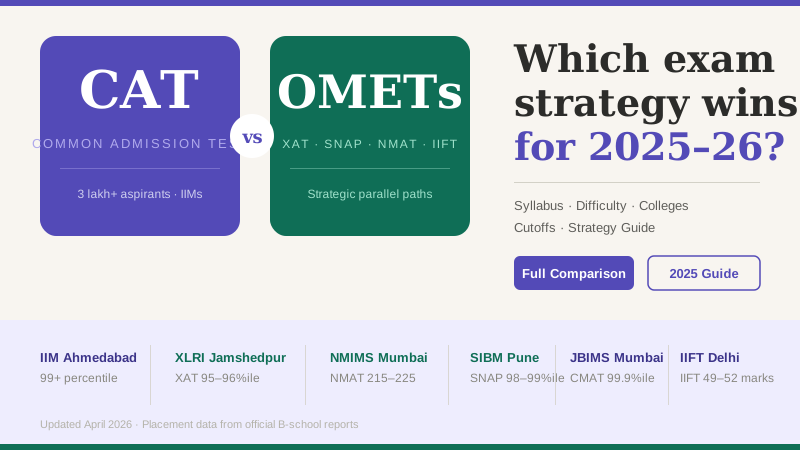
CAT vs OMETs: Difference, Syllabus & Difficulty Comparison 2025–26
Because picking the wrong exam strategy costs you more than just one year.
The Question Every MBA Aspirant Asks — But Very Few Answer Correctly
Every October, when CAT registrations open, a very predictable conversation starts in coaching centers, WhatsApp groups, and college canteens across India. Someone says, "Just focus on CAT. If you crack CAT, everything else falls in place." Someone else says, "No, you should appear for all exams. More attempts, more chances."
Both of these opinions are partially right and significantly incomplete.
The reality of the Indian MBA entrance ecosystem in 2025–26 is more nuanced than either camp acknowledges. CAT is the dominant exam, yes. But OMETs — Other Management Entrance Tests — are not backup options. For a large segment of aspirants, they are primary pathways to some of India's best B-schools.
According to data from IIM Common Admission Process, over 3.28 lakh candidates registered for CAT 2024. Of those, approximately 2.97 lakh actually appeared for the exam. The number of seats available across all 20 IIMs combined is approximately 5,400. That means even if every IIM seat went to a CAT candidate — which is not how it works — roughly 99.8% of CAT takers would not get an IIM seat through CAT alone.
Now add XAT, which had over 1.25 lakh registrations in 2025 and feeds XLRI and 160+ partner institutions. Add SNAP with 70,000+ registrations feeding the Symbiosis network. Add NMAT feeding NMIMS, MISB, and partner schools. Add IIFT and CMAT. Suddenly the picture changes dramatically.
CAT vs OMETs is not an either-or debate. It is a strategy question. And strategy requires data, not opinions.
This guide gives you that data — exam by exam, section by section, college by college.
First, Let Us Define What We Are Comparing
CAT (Common Admission Test) is conducted by the IIMs on a rotational basis. It is the primary gateway to the 20 IIMs and approximately 1,200+ other MBA programs across India that accept CAT scores. It is held once a year, typically in November, and is widely considered the most competitive MBA entrance exam in India.
OMETs (Other Management Entrance Tests) is a collective term for all non-CAT management entrance exams. The major OMETs that matter for top MBA programs in India are:
XAT — Xavier Aptitude Test (conducted by XLRI Jamshedpur) SNAP — Symbiosis National Aptitude Test (conducted by Symbiosis International University) NMAT — NMAT by GMAC (conducted by the Graduate Management Admission Council) IIFT — Indian Institute of Foreign Trade Entrance Exam CMAT — Common Management Admission Test (conducted by NTA) MAT — Management Aptitude Test (conducted by AIMA) TISSNET — Tata Institute of Social Sciences National Entrance Test MICAT — MICA Admission Test (for MICA Ahmedabad) MH-CET — Maharashtra Common Entrance Test (for Maharashtra state B-schools)
For the purpose of this article, we will focus on the five OMETs that carry the most weight in terms of college quality and career outcomes: XAT, SNAP, NMAT, IIFT, and CMAT.
CAT 2025–26: The Full Picture
Exam Structure
CAT 2025 is expected to follow the pattern established in recent years. The exam is conducted in three slots across two days in November. The total duration is 120 minutes, divided into three sections:
Section 1 — Verbal Ability and Reading Comprehension (VARC): 40 minutes, approximately 24 questions Section 2 — Data Interpretation and Logical Reasoning (DILR): 40 minutes, approximately 20 questions Section 3 — Quantitative Ability (QA): 40 minutes, approximately 22 questions
Total questions: approximately 66 (this has varied slightly across years — CAT 2023 had 66 questions, CAT 2024 maintained a similar range)
Marking scheme: +3 for correct answers, -1 for incorrect MCQ answers, 0 for TITA (Type In The Answer) questions
The calculator: A basic on-screen calculator is available. No external calculators permitted.
Sectional time limit: This is critical and often misunderstood by first-time aspirants. You cannot move between sections freely. Each section has a hard 40-minute limit. This significantly changes preparation strategy compared to exams without sectional limits.
CAT Difficulty: What the Data Actually Says
CAT is not the hardest exam in the world. But it is relentlessly competitive because of who is taking it. When 3 lakh people with engineering degrees, years of coaching preparation, and extremely high baseline aptitude are all competing for roughly 5,400 IIM seats, the effective difficulty is crushing.
Section-wise difficulty in recent years:
VARC has historically been the most divisive section. CAT 2023 and CAT 2024 both featured dense, multi-layered RC passages — often from philosophy, literary criticism, and social science. Approximately 60–65% of VARC questions are from RC, leaving only 35–40% for verbal ability questions like para-jumbles and odd-sentence identification. There are no fill-in-the-blank or vocabulary questions.
DILR has gone through significant evolution. The early 2010s DILR was primarily about calculation. Post-2015, IIMs redesigned DILR to test pure logical thinking through novel set types that cannot be solved through formula memorization. CAT 2024 DILR was rated "moderate to difficult" with 5 sets of 4 questions each, featuring unconventional set types.
QA is considered the most preparation-responsive section. Students who invest systematic effort in Arithmetic, Algebra, Geometry, and Number Theory see measurable score improvements. CAT 2024 QA had approximately 22 questions, with a mix of MCQs and TITA questions. Difficulty ranged from moderate to high.
CAT Percentile Reality
Getting into the 90th percentile requires answering roughly 55–60% of questions correctly while managing negative marking. Getting into the 99th percentile — the threshold for top IIM calls — typically requires answering 80–85% correctly with minimal mistakes.
In CAT 2024, the approximate raw score thresholds for percentiles were: 99th percentile: approximately 105+ out of 198 (scaled score) 95th percentile: approximately 85–90 90th percentile: approximately 70–75
These numbers shift slightly between slots and years due to normalization.
Colleges That Accept CAT Scores
The 20 IIMs — Ahmedabad, Bangalore, Calcutta, Lucknow, Kozhikode, Indore, Rohtak, Raipur, Ranchi, Trichy, Udaipur, Amritsar, Bodh Gaya, Jammu, Kashipur, Nagpur, Sambalpur, Sirmaur, Visakhapatnam, and Mumbai — all use CAT exclusively for their primary MBA programs.
Beyond IIMs, top non-IIM institutions that accept CAT scores include:
FMS Delhi (Faculty of Management Studies) — One of India's best value-for-money MBA programs with approximately ₹1.96 lakh total fees. Average placement package at FMS in 2024 was approximately ₹32 LPA.
MDI Gurgaon (Management Development Institute) — Average placement package in 2024 was approximately ₹28.5 LPA. Accepts CAT scores and has strong consulting and FMCG placement.
SPJIMR Mumbai (S.P. Jain Institute of Management and Research) — Average placement package in 2024 was approximately ₹31 LPA. Strong finance and marketing alumni network.
IIT Bombay SOM, IIT Delhi DMS, IIT Kharagpur VGSoM, IIT Madras DoMS — The IIT management schools collectively offer approximately 600–800 MBA seats and accept CAT scores. Average placements range from ₹18–28 LPA depending on the institution.
NITIE Mumbai (National Institute of Industrial Engineering, now rebranded as IIMM) — Strong operations management focus, accepts CAT. Average package approximately ₹25 LPA in 2024.
XAT 2025–26: The CAT vs OMETs Conversation Starts Here
Why XAT Matters More Than Most People Realize
XAT is the most academically rigorous OMET. Period. It is not a "backup exam." For students targeting XLRI Jamshedpur — widely regarded as the best private B-school in India — XAT is the primary gateway. For students targeting XIMB, IMT Ghaziabad, GIM Goa, LIBA Chennai, and 160+ other institutions, XAT scores are the admission currency.
XAT 2025 was held on January 5, 2025. Over 1.25 lakh candidates registered, of which approximately 1.1 lakh appeared.
XAT Exam Structure
Total duration: 210 minutes (3.5 hours) — significantly longer than CAT
Part 1 (190 minutes): Three tested sections Verbal and Logical Ability (VA & LR): approximately 26 questions Decision Making (DM): approximately 21 questions Quantitative Ability and Data Interpretation (QA & DI): approximately 28 questions
Part 2 (20 minutes): General Knowledge: approximately 25 questions (scores used for XLRI shortlisting in specific programs)
Essay Writing: Removed from XAT from 2023 onward. The GK section has been restructured as a standalone non-penalized section.
Marking scheme: +1 for correct, -0.25 for incorrect. Importantly, XAT also penalizes more than 8 unattempted questions in Part 1 with -0.05 per additional unattempted question. This is a unique feature that significantly affects strategy.
What Makes XAT Unique: The Decision Making Section
The DM section is XAT's most distinctive — and most feared — feature. It does not appear in CAT or any other major OMET. DM questions present complex real-world scenarios — often involving ethical dilemmas, business decisions under uncertainty, or interpersonal conflict situations — and ask you to evaluate and rank decision options.
There is no formula for DM. It tests value systems, contextual judgment, and clarity of reasoning. Students who have never encountered DM before XAT consistently underperform in this section. Students who prepare DM seriously — through case studies, mock DM sets, and ethical reasoning frameworks — find it manageable and differentiating.
In XAT 2025, the DM section was rated "moderate to difficult" with case-based clusters featuring 3–4 questions each.
XAT Difficulty Compared to CAT
Overall: XAT QA is generally considered comparable to CAT QA in difficulty, sometimes slightly easier in calculation-heavy questions but occasionally harder in reasoning-based ones. XAT VA is considered comparable to CAT VARC in reading difficulty, though XAT has more critical reasoning questions. XAT LRDI is easier than CAT DILR in the pure logic domain but harder in terms of managing time across all three sections simultaneously.
The DM section is genuinely unique — no comparison exists in CAT.
XAT Cutoffs and Colleges
XLRI Jamshedpur BM (Business Management): XAT cutoff approximately 95–96 percentile for shortlisting. One of India's highest-recruiting MBA programs. Average placement package in the 2024 batch was approximately ₹32.5 LPA. International placements account for approximately 12–15% of batch.
XLRI Jamshedpur HRM (Human Resource Management): XAT cutoff approximately 90–92 percentile. Considered India's best HR program. Average package approximately ₹27 LPA in 2024.
XIMB Bhubaneswar (Xavier Institute of Management): XAT cutoff approximately 85–88 percentile. Average package approximately ₹18–20 LPA.
IMT Ghaziabad: XAT cutoff approximately 80–82 percentile. Average package approximately ₹16 LPA.
GIM Goa (Goa Institute of Management): XAT cutoff approximately 75–80 percentile. Strong hospitality and sustainability focus. Average package approximately ₹14–15 LPA.
LIBA Chennai (Loyola Institute of Business Administration): XAT cutoff approximately 70–75 percentile.
TAPMI Manipal: XAT cutoff approximately 75 percentile.
SNAP 2025–26: The Symbiosis Gateway
Why SNAP Is a Separate Strategic Decision
SNAP is exclusive to the Symbiosis network — specifically Symbiosis International (Deemed University). It feeds 15 Symbiosis institutes across Pune, Nashik, Noida, Hyderabad, and Bengaluru. For students who are specifically targeting Symbiosis Pune programs — particularly SIBM Pune and SCMHRD Pune — SNAP is not optional. It is the only route.
SNAP 2024–25 was conducted in three windows: December 2024 and January 2025. Approximately 70,000+ candidates registered across windows.
SNAP Exam Structure
Total duration: 60 minutes — the shortest major MBA entrance exam
Total questions: 60
Section breakdown: General English: 15 questions (Reading Comprehension, Verbal Reasoning, Verbal Ability) Analytical and Logical Reasoning: 25 questions Quantitative, Data Interpretation, and Data Sufficiency: 20 questions
Marking scheme: +1.5 for correct answers, -0.5 for incorrect. There are no TITA questions — all questions are MCQs.
A unique feature of SNAP is that candidates can attempt the exam up to 3 times across the three windows in a single cycle, and the best score is considered. This significantly reduces the risk of a bad day destroying your MBA aspirations within the Symbiosis system.
SNAP Difficulty: Significantly Easier Than CAT
Let us be direct about this. SNAP is considerably easier than CAT in terms of question complexity. The QA section does not feature the advanced geometry and number theory that CAT tests. The LR section does not feature the elaborate multi-variable set types that CAT DILR is famous for. The English section is more straightforward vocabulary and grammar-oriented compared to CAT's philosophy-dense RC passages.
A student who scores in the 85th percentile on CAT would typically find SNAP relatively manageable — in the 95+ percentile range — if they prepare the SNAP-specific sections (GA, vocabulary) separately.
However, this does not mean SNAP should be dismissed. At 60 minutes, time pressure is intense. Accuracy matters enormously. And the 60-minute format means there is almost no recovery time if you misread or mismanage a section.
SNAP Cutoffs and Colleges
SIBM Pune (Symbiosis Institute of Business Management): SNAP cutoff approximately 98–99 percentile. This is the flagship Symbiosis MBA. Average placement package in 2024 was approximately ₹23–25 LPA.
SCMHRD Pune (Symbiosis Centre for Management and Human Resource Development): SNAP cutoff approximately 97–98 percentile. Strong HR and supply chain focus. Average package approximately ₹19–21 LPA.
SIIB Pune (Symbiosis Institute of International Business): SNAP cutoff approximately 92–94 percentile. Strong international trade and agribusiness focus. Average package approximately ₹14–16 LPA.
SIBM Bengaluru: SNAP cutoff approximately 93–95 percentile. Growing campus with strong South India recruitment. Average package approximately ₹16–18 LPA.
SCIT Pune (Symbiosis Centre for Information Technology): SNAP cutoff approximately 88–90 percentile. Strong IT management focus. Average package approximately ₹12–14 LPA.
SSBF Pune (Symbiosis School of Banking and Finance): SNAP cutoff approximately 85–88 percentile.
NMAT 2025–26: The Most Flexible OMET
What Makes NMAT Different From Every Other Exam
NMAT by GMAC has two features that no other major MBA entrance exam in India offers: a rolling test window and the ability to retake the exam up to 3 times per cycle, with the best score used for applications.
NMAT 2024–25 testing window opened in October 2024 and ran through January 2025 — approximately 75–80 days of testing. Candidates could schedule their exam on a day of their choice within this window, retake it if dissatisfied, and use the best score across attempts.
Approximately 85,000–90,000 candidates appear for NMAT annually.
NMAT Exam Structure
Total duration: 120 minutes
Section breakdown: Language Skills: 36 questions, 28 minutes Quantitative Skills: 52 questions, 52 minutes Logical Reasoning: 40 questions, 40 minutes
Total: 128 questions in 120 minutes
Marking scheme: +1 for correct, 0 for incorrect. No negative marking. This is critically important. The absence of negative marking fundamentally changes test-taking strategy — on NMAT, you attempt every question. There is no reason to leave anything blank.
Scoring: NMAT uses a scaled score ranging from 0 to 360. The score is scaled across attempts and windows to ensure comparability.
NMAT Difficulty: Faster and More Calculation-Heavy
NMAT is not conceptually harder than CAT, but it is faster. With 128 questions in 120 minutes, you have less than 57 seconds per question on average. The QA section has 52 questions in 52 minutes — this requires rapid calculation without mistakes. The LR section is more traditional (arrangements, syllogisms, coded relationships) compared to CAT's set-based DILR.
The Language Skills section is closer to a traditional verbal ability test — grammar, vocabulary, and reading — rather than the deep analytical RC that CAT tests.
NMAT Cutoffs and Colleges
NMIMS Mumbai (Narsee Monjee Institute of Management Studies): NMAT cutoff approximately 215–225 (scaled score) for MBA Core. One of India's most reputed private B-schools. Average placement package in 2024 was approximately ₹22–24 LPA. The Mumbai campus places strongly in banking, financial services, and consulting.
NMIMS Bengaluru: NMAT cutoff approximately 200–210. Average package approximately ₹14–16 LPA.
NMIMS Hyderabad: NMAT cutoff approximately 195–205.
NMIMS Navi Mumbai: NMAT cutoff approximately 185–195.
MISB Bocconi Mumbai (in partnership with SDA Bocconi, Italy): Accepts NMAT scores. Strongly international faculty and curriculum. Average package approximately ₹18–22 LPA.
Shiv Nadar University School of Management: NMAT cutoff approximately 195+.
VIT Business School: Accepts NMAT scores. Cutoff approximately 170+.
IIFT 2025–26: The International Trade Specialist
Why IIFT Is Unique Among All OMETs
IIFT (Indian Institute of Foreign Trade) is not a general management school. It specializes in international business, trade, and commerce. Its alumni network is uniquely positioned at the intersection of policy, trade, and business — with alumni in the WTO, UNCTAD, major export houses, FIEO, and multinational trading companies.
IIFT 2025 was conducted by NTA in January 2025. Approximately 60,000–65,000 candidates registered.
IIFT Exam Structure
Total duration: 120 minutes
IIFT's section composition has evolved over recent years. The most recent pattern features:
Verbal Ability and Reading Comprehension: approximately 35 questions Quantitative Analysis: approximately 25 questions Data Interpretation and Logical Reasoning: approximately 30 questions General Knowledge and Current Affairs: approximately 20 questions
Total: approximately 110 questions
Marking scheme: +3 for correct, -1 for incorrect. The GK section typically carries +1.5 for correct, -0.5 for incorrect.
The GK section in IIFT is significantly more demanding than in other OMETs. It specifically tests international trade data, WTO regulations, trade agreements, export-import policy, and international current affairs — not just general knowledge. This reflects IIFT's institutional identity.
IIFT Difficulty and What Sets It Apart
IIFT QA is broadly comparable to CAT QA in concept coverage but typically has slightly more questions in the Arithmetic domain. IIFT VARC features both comprehension passages and standalone vocabulary and grammar questions — the vocabulary component is more prominent here than in CAT.
The GK section is the real differentiator. Students who are unaware of India's major trade agreements (RCEP withdrawal, India-UAE CEPA, India-Australia ECTA), export policy changes, or major international economic data will struggle here. This section cannot be prepared through reasoning alone — it requires sustained reading of trade and economic news.
IIFT Cutoffs and Colleges
IIFT Delhi: Overall cutoff approximately 49–52 marks (raw score) for general category. Sectional cutoffs apply across all sections. Average placement package in 2024 was approximately ₹26 LPA. The highest placement in 2024 exceeded ₹80 LPA.
IIFT Kolkata: Overall cutoff slightly lower than Delhi campus — approximately 46–49 marks. Average package approximately ₹22–24 LPA.
IIFT Kakinada: The newest IIFT campus. Cutoff approximately 42–45 marks. Average package in the ₹14–18 LPA range as the campus matures.
IIFT is a highly specialized MBA. If you are certain about a career in international business, trade consulting, export management, or economic policy, IIFT is arguably a better choice than several IIMs for your specific domain.
CMAT 2025–26: The Underrated National Exam
Why CMAT Is More Valuable Than Its Reputation Suggests
CMAT (Common Management Admission Test) is conducted by NTA and is accepted by over 1,000 MBA programs across India. It is the primary pathway to several well-regarded B-schools in Maharashtra, Karnataka, and other states. It is also the entry point for AICTE-approved MBA programs that are not connected to the IIM or Symbiosis or NMIMS systems.
CMAT 2025 was held in March 2025. Approximately 65,000–70,000 candidates registered.
CMAT Exam Structure
Total duration: 180 minutes (3 hours)
Section breakdown: Quantitative Techniques and Data Interpretation: 20 questions Logical Reasoning: 20 questions Language Comprehension: 20 questions General Awareness: 20 questions Innovation and Entrepreneurship (added from 2021): 20 questions
Total: 100 questions
Marking scheme: +4 for correct, -1 for incorrect. No sectional time limits — candidates can move freely between sections.
The Innovation and Entrepreneurship section is unique to CMAT and tests knowledge of startup ecosystems, government schemes for entrepreneurship (Startup India, MUDRA, SIDBI), and basic business model concepts.
CMAT Difficulty: The Most Accessible Major OMET
CMAT is the least difficult among the five major OMETs in terms of conceptual complexity. QA questions are largely from standard Class 10–12 mathematics. LR questions are conventional. The reading comprehension passages are shorter and more accessible than CAT or XAT. The GA section tests standard current affairs and business knowledge.
A 90+ percentile in CMAT is achievable with 3–4 months of consistent preparation for students who have a reasonable aptitude baseline.
CMAT Cutoffs and Colleges
JBIMS Mumbai (Jamnalal Bajaj Institute of Management Studies): CMAT cutoff approximately 99.9+ percentile. One of India's most elite MBA programs for the cost — approximately ₹6–8 lakh total fees. Average placement package approximately ₹25–28 LPA in 2024. JBIMS is the jewel in the CMAT crown and should not be overlooked.
KJ Somaiya Mumbai: CMAT cutoff approximately 95–97 percentile. Average package approximately ₹14–16 LPA.
Prin. L.N. Welingkar Institute Mumbai and Bengaluru: CMAT cutoff approximately 85–90 percentile. Average package approximately ₹12–14 LPA.
PUMBA Pune (Department of Management Sciences, University of Pune): CMAT cutoff approximately 93–95 percentile for general category. Average package approximately ₹10–12 LPA.
SIMSREE Mumbai (Sydenham Institute of Management Studies Research and Entrepreneurship Education): CMAT cutoff approximately 97–98 percentile. Average package approximately ₹14–16 LPA.
MH-CET connected programs across Maharashtra also accept CMAT scores in some formats.
The Head-to-Head Comparison: CAT vs OMETs Across Every Parameter
Duration and Question Count
CAT: 120 minutes, approximately 66 questions — approximately 109 seconds per question XAT: 210 minutes, approximately 75 questions in Part 1 — approximately 152 seconds per question SNAP: 60 minutes, 60 questions — 60 seconds per question NMAT: 120 minutes, 128 questions — approximately 56 seconds per question IIFT: 120 minutes, approximately 110 questions — approximately 65 seconds per question CMAT: 180 minutes, 100 questions — 108 seconds per question
The time pressure is most severe in NMAT and SNAP. CAT's pressure comes not from time per question but from the complexity of individual questions.
Negative Marking
CAT: -1 for MCQ, 0 for TITA XAT: -0.25 per incorrect, -0.05 per unattempted beyond 8 SNAP: -0.5 per incorrect NMAT: No negative marking IIFT: -1 for QA/VA/DILR, -0.5 for GK CMAT: -1 per incorrect
NMAT's no-negative-marking policy is a significant strategic advantage for risk-averse or uncertain candidates.
Retake Policy
CAT: Once per year, no retakes within the same cycle XAT: Once per year, no retakes within the same cycle SNAP: Up to 3 attempts per cycle (best score counts) NMAT: Up to 3 attempts per cycle (best score counts) IIFT: Once per year, no retakes within the same cycle CMAT: Once per year, no retakes within the same cycle
SNAP and NMAT offer the most second-chance opportunities, making them strategically important for candidates who have variable test-day performance.
Unique Sections Not in CAT
XAT: Decision Making (DM) — no equivalent in any other exam IIFT: International Trade and GK — significantly domain-specific CMAT: Innovation and Entrepreneurship — unique to CMAT All OMETs except SNAP and NMAT: General Knowledge sections
CAT has no GK section. This is a major structural difference. Students who are strong in GK have an additional differentiator in XAT, IIFT, and CMAT that CAT does not reward.
Difficulty Ranking (Conceptual Complexity)
CAT — highest overall conceptual difficulty, especially DILR and VARC
XAT — comparable to CAT; DM adds a unique dimension
IIFT — slightly easier than CAT QA but GK is domain-specific
NMAT — easier concepts but punishing speed requirements
SNAP — relatively easier but brutal time compression
CMAT — most accessible overall
Syllabus Comparison: CAT vs OMETs
Quantitative Ability: What Each Exam Tests
The core QA syllabus is broadly similar across all exams: Arithmetic (Percentages, Profit/Loss, Time-Speed-Distance, Time and Work, Simple and Compound Interest, Mixtures) Algebra (Linear and Quadratic Equations, Functions, Progressions) Geometry (Triangles, Circles, Quadrilaterals, Coordinate Geometry) Number Theory (Divisibility, Remainders, HCF/LCM, Factorials) Modern Math (Permutation-Combination, Probability, Set Theory)
Where exams differ:
CAT goes deepest in Geometry, advanced Algebra, and Number Theory. The TITA format means no options — you must compute exact answers.
XAT QA is similar to CAT but has historically featured more Arithmetic-heavy papers. Data Interpretation is clubbed with QA, which means the QA section has a dual-character.
NMAT QA has 52 questions in 52 minutes — the emphasis is on speed and accuracy with standard concepts, not conceptual depth.
SNAP QA is the most accessible — standard concepts with no surprises, designed for 60-second solving pace.
IIFT QA is moderate — concepts similar to CAT but typically a step below in difficulty with more Arithmetic.
CMAT QA is the most straightforward — Class 10–12 level mathematics with no advanced Number Theory or Geometry.
Verbal Ability: What Each Exam Tests
CAT VARC: Heavy on Reading Comprehension (approximately 18–21 RC-based questions from 4–5 passages). Passages are from philosophy, literary criticism, history, and social science — genuinely difficult academic writing. Para-jumbles (4–6 sentences), odd-sentence identification, and paragraph completion are the VA question types. No grammar, no vocabulary, no fill-in-the-blanks.
XAT VA: Similar RC passages but also includes Critical Reasoning questions (strengthen/weaken/assumption type — similar to GMAT). The vocabulary component is slightly more present than in CAT.
SNAP English: More traditional — grammar, vocabulary, idioms, and shorter RC passages. No critical reasoning. Much more accessible than CAT.
NMAT Language Skills: Grammar-heavy, vocabulary-heavy, shorter RC. Traditional format — the exam tests language knowledge more than analytical reading ability.
IIFT VARC: Mix of RC and vocabulary/grammar. The passages are shorter and more conventional than CAT. Vocabulary questions (synonyms, antonyms) appear explicitly.
CMAT Language Comprehension: The most accessible of all — standard reading comprehension and grammar. No advanced analytical reasoning in the verbal component.
Logical Reasoning: What Each Exam Tests
CAT DILR: The most feared section among serious aspirants. Unique, novel set types every year. No formula memorization helps here — you must genuinely be able to construct logical structures. In recent years, sets have involved mixed constraints, unconventional arrangements, and multi-variable grids.
XAT LR: Clubbed with VA. Features critical reasoning, syllogisms, and some arrangement-based questions. Decision Making (DM) is separate and features situational reasoning.
SNAP LR: The most dominant section of SNAP at 25 questions. Features standard types — arrangements, blood relations, coding-decoding, syllogisms, and input-output. More formula-compatible than CAT DILR.
NMAT LR: 40 questions, standard types. Similar to SNAP in format. Seating arrangements, directions, analogies, series completion. Speed-dependent.
IIFT DILR: Moderate — DI sets and LR puzzles that are more structured than CAT. Calculation-heavy in the DI component.
CMAT LR: Standard, accessible — classic LR question types from standard coaching material. Most predictable of all the OMETs.
Strategy: How to Prioritize CAT vs OMETs in 2025–26
This is the section most aspirants actually need. Here is how to think through your exam portfolio.
The Three Types of MBA Aspirants and Their Ideal Strategy
Type 1 — The IIM-or-Nothing Aspirant
This aspirant has a clear goal: IIM Ahmedabad, Bangalore, or Calcutta. They are willing to take 1–2 years to achieve it if necessary. They have a strong academic profile and consistently score in the 95+ percentile range on mocks.
Recommended strategy: Prioritize CAT heavily. Appear for XAT as a meaningful backup since it feeds XLRI, which is a genuine alternative to IIM for many profiles. Consider IIFT if international business aligns with long-term goals. Skip SNAP and CMAT unless time permits without distraction.
Risk: Over-focus on CAT while ignoring OMETs entirely means that a bad CAT day — which happens to many aspirants — leaves you with nothing.
Type 2 — The Tier-A Non-IIM Aspirant
This aspirant's target list includes XLRI, NMIMS, SIBM Pune, FMS, SPJIMR, and top IITs. They are not exclusively IIM-focused. They want an MBA from a reputable institution within 1–2 years.
Recommended strategy: Prepare CAT and XAT simultaneously — they share 75% of syllabus. Add NMAT for NMIMS. Add SNAP for SIBM Pune and SCMHRD. This gives you 4 bites at the apple: CAT/XAT shared prep + NMAT sprint + SNAP sprint.
Type 3 — The Safety-Net-Included Aspirant
This aspirant has a realistic assessment of their profile and wants to maximize admission probability across B-schools from Tier A to Tier B. They are open to a wide range of institutions if the fit is right.
Recommended strategy: Full exam portfolio — CAT, XAT, SNAP (3 attempts), NMAT (3 attempts), CMAT. Add IIFT if international trade interests you. Preparation for CMAT and SNAP adds minimal marginal effort if CAT/XAT prep is already underway.
The Shared Syllabus Advantage: Where OMETs and CAT Overlap
The most important strategic insight in the CAT vs OMETs debate is this: strong CAT preparation automatically prepares you for a significant portion of every major OMET.
Here is the rough overlap breakdown:
CAT prep covers approximately 85% of XAT QA, 80% of XAT VA (add critical reasoning separately) CAT prep covers approximately 75% of NMAT QA, 70% of NMAT LR (add speed training separately) CAT prep covers approximately 80% of SNAP QA, 75% of SNAP LR (add speed training separately) CAT prep covers approximately 75% of IIFT QA, 70% of IIFT VARC (add GK and vocabulary separately) CAT prep covers approximately 70% of CMAT QA, 65% of CMAT LR (add entrepreneurship section separately)
The incremental effort required to add XAT, NMAT, or SNAP to a CAT-prepared aspirant is 3–6 weeks of targeted practice per exam — not months of fresh preparation.
Which OMETs to Skip If You Are Short on Time
If you genuinely cannot prepare for more than 2–3 exams well:
Skip CMAT if your target institutions are Tier A only (you will not need it). Skip IIFT if international business is not specifically your career direction. Never skip XAT if you have any interest in XLRI, XIMB, or IMT. Never skip NMAT if NMIMS Mumbai is on your target list. Never skip SNAP if Symbiosis Pune programs are on your list.
Common Myths About CAT vs OMETs
Myth 1: "OMETs are easier so they are less valuable."
JBIMS Mumbai, accessible through CMAT, places students at an average ₹25–28 LPA and has fees of under ₹8 lakh. XLRI, accessible through XAT, places students at ₹32 LPA and is among India's most respected MBA brands. The exam difficulty does not determine the quality of the institution or the outcome of your MBA. The institution and your performance within it determine that.
Myth 2: "If I crack CAT, I do not need OMETs."
Cracking CAT means clearing the written exam. IIM conversion rates from CAT shortlist to final selection range from 15% to 45% depending on the institute and profile category. A 99 percentile in CAT does not guarantee an IIM seat. Many aspirants with stellar CAT scores do not convert any IIM because of interview performance, academic background penalties, or work experience gaps. OMETs provide genuine parallel pathways.
Myth 3: "NMAT and SNAP are not worth serious preparation."
NMIMS Mumbai and SIBM Pune are legitimate career-transforming institutions. Companies that recruit at IIMs also recruit at these campuses. A student who goes to SIBM Pune or NMIMS Mumbai over a lower-ranked IIM is not necessarily making a worse decision — depending on their target function, city preference, and alumni network relevance.
Myth 4: "CAT preparation is enough for all OMETs."
CAT preparation is a strong foundation but not a complete substitute. XAT DM, IIFT GK, CMAT's Entrepreneurship section, and NMAT's speed requirements all need targeted additional preparation. Treating OMETs as pure CAT subsets leads to underperformance in their unique sections.
The Registration Timeline: CAT vs OMETs in 2025–26
For aspirants beginning their preparation cycle, here is the typical exam calendar to plan around (based on recent year patterns; exact dates for 2025–26 will be announced by respective bodies):
CAT 2025: Registration approximately August–September 2025. Exam approximately November 2025.
XAT 2026: Registration approximately September–November 2025. Exam approximately January 5, 2026.
SNAP 2025: Registration approximately August–October 2025. Exam across December 2025–January 2026 (three windows).
NMAT 2025: Registration approximately July–October 2025. Testing window approximately October 2025–January 2026.
IIFT 2026: Registration approximately September–November 2025. Exam approximately January 2026.
CMAT 2026: Registration approximately February–March 2026. Exam approximately March 2026.
The sequencing matters. NMAT begins earliest, which is why early preparation benefits NMAT aspirants disproportionately. CMAT comes last, giving aspirants who already have other exam results the most informed decision-making position.
Final Verdict: CAT vs OMETs — What Should You Actually Do?
Here is the honest answer, based on everything laid out in this guide.
CAT is the most important exam in the Indian MBA ecosystem. No other exam opens as many doors across as many quality institutions. If you can invest serious preparation time in only one exam, it should be CAT.
But the word "only" is doing a lot of work in that sentence. Most aspirants can and should appear for at least 3–4 exams in a single cycle. The additional effort required — given shared syllabus — is manageable. The downside risk of a bad CAT day with no OMET backup is significant.
The ideal approach for the 2025–26 cycle is:
Build your preparation on CAT as the primary foundation. Register for XAT and prepare DM and GK specifically. Register for NMAT early (October window) to bank a score and retake if needed. Register for SNAP for its three-attempt flexibility. Add IIFT if international trade is your target domain. Add CMAT if top Maharashtra B-schools like JBIMS are on your list.
The aspirants who regret their MBA application cycle are usually not the ones who over-prepared. They are the ones who put all their effort into one exam, had a bad day, and spent an entire year waiting for the next cycle.
Build your target list. Map the exams to the institutions. Register early. Prepare smart.
The exam you prioritize should be determined by the college you want — not by which exam sounds more prestigious or which one your peers are talking about more.
In the CAT vs OMETs conversation, the real answer is: both, strategically.
Data referenced in this article is sourced from official IIM, XLRI, Symbiosis, NMIMS, IIFT, and NTA publications, placement reports from respective institutions for the 2023–24 and 2024–25 batches, and candidate registration figures from publicly available sources as of April 2026.
Related Resources
- TAPMI Manipal
- Jadavpur University MBA
- IIM Sirmaur
- IIM Sambalpur
- IIM Udaipur
- CAT DILR Strategy 2026: Tips to Solve Tough LRDI Sets for 99 Percentile
- Top Free Resources for CAT Preparation 2026: YouTube, Apps & Mocks
- List of All IIMs in India 2026: Rankings, Fees & CAT Cutoffs
- CAT 2026 Exam: Strategy, Syllabus & Prep Guide | B School Buzz
- Best CAT Coaching in India: Top Reviews & Rankings (2026)
- AI Profile Analyzer
- College Shortlister