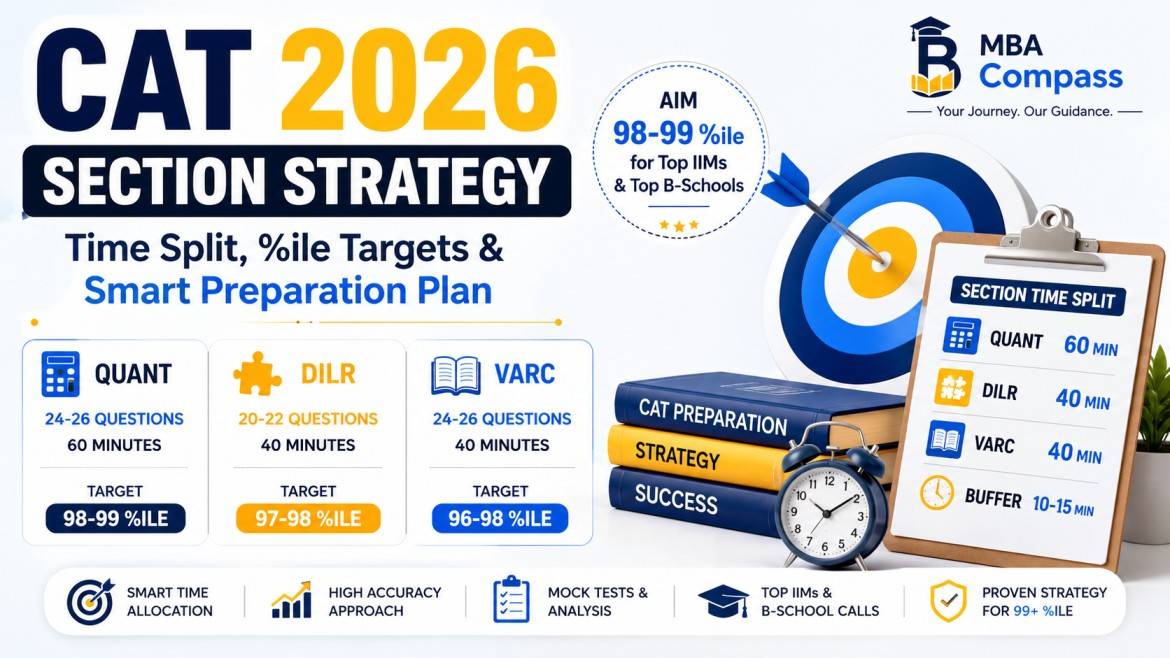
A practical CAT 2026 section strategy splits time by section, targets specific percentile bands per section, and focuses on high-accuracy attempts in Quant and targeted set-selection in DILR and VARC.
Summary: Aim for a sectional plan that gets you to an overall 98-99 %ile by hitting sectional bands of 99 %ile in Quant, 98 %ile in DILR, and 97 %ile in VARC depending on your profile and target colleges.
A simple time split to practice now: spend 60 minutes on Quant, 40 minutes on DILR, and 40 minutes on VARC during full-length mocks; reduce Quant to 50 minutes on test-day if you're comfortable with faster arithmetic and time management. Based on placement reports from IIMs and leading institutes, accuracy beats attempts when interview calls depend on the cutoff band.
Snapshot table — sectional weight, time split and target bands (expected)
Section | Questions (expected) | Time split (practice) | Target accuracy | Target %ile band (2026) |
|---|---|---|---|---|
24-26 | 60 min | 75-85 % | 98-99 %ile | |
20-22 | 40 min | 70-80 % | 97-98 %ile | |
24-26 | 40 min | 80-90 % | 96-98 %ile | |
Unattempted/Buffer | 10-15 min | Use for tough sets | ||
Full test | ~66 | 140 min | Selective attempts | 98-99 %ile |
The table above assumes the standard CAT paper structure; exact question counts and sectional duration are as per the official CAT pattern but the expected counts and percentiles are practice-based estimates. If you're targeting IIM-A, IIM-B, IIM-C, XLRI, FMS, or SPJIMR, you should aim for the higher end of the accuracy bands because these colleges saw stronger pools in 2025-26 admission cycles.
Practice split — 3 full-length mocks per week for the next 12 weeks; reduce to 2 mocks in the final 4 weeks and focus on analysis.
Sectional focus — work on Quant speed for 30 minutes daily, DILR set-selection for 45 minutes thrice weekly, VARC RC practice for 1 hour twice weekly.
Attempt mix — on test-day aim for 22-24 safe attempts in Quant, 14-16 in DILR, 18-20 in VARC based on accuracy bands.
Profile play — if you're an engineer with 3+ yrs work-ex aiming for IIMs, prioritize Quant and DILR accuracy; use our Profile Analyzer to map target percentiles to colleges.
Mock quality — use timed, proctored simulations that mirror CAT pattern; include sectional breaks. Run at least 15 mocks before test day and review errors after each. Try our Mock Tests for realistic practice.
Data point: Industry experts suggest that IIM shortlist cutoffs for 2026-27 are expected to remain competitive; aim for the percentile bands above to keep options open for IIM-A, IIM-B, IIM-C and top private colleges.
Mentor tip: Want expert guidance for MBA admissions? Connect with our mentors today. Use the Profile Analyzer to estimate which percentiles match your profile and then plan mock schedules accordingly with our Mock Tests.
Section-wise Plan: Quant Tactics
Direct answer: Follow a disciplined 8-12 week Quant plan that balances concept drills, topic tests, mixed timed sections, and full-length simulated papers to push your sectional score into the expected 95-99 %ile band for CAT 2026.
Weekly structure: Weeks 1-4 focus on fundamentals (Number System, Algebra, Geometry, Arithmetic) with daily concept practice 60-90 minutes and two 40-minute timed topic tests per week.
Weeks 5-8: Problem consolidation — combine topics into chapter-wise sets, increase timed practice to three 40-minute topic tests and two mixed 60-minute practice sessions weekly. Add weekly full-length mock under exam conditions every 2 weeks.
8-12 Week Plan (detailed)
Week 1: Number System & Divisibility — 7 hours total; 4 concept drills (30 mins each); 2 timed tests (40 mins).
Week 2: Algebra I (Linear, Quadratic) — 8 hours; 5 drills; 2 topic tests; focus on equation manipulation.
Week 3: Arithmetic I (Percentages, Ratio, Profit-Loss) — 8-10 hours; 6 drills; target accuracy 85% on easy-medium problems.
Week 4: Geometry basics (Triangles, Circles) — 7-9 hours; 5 drills; 2 tests; review errors from weeks 1-3.
Week 5: Algebra II (Inequalities, Functions) — 9 hours; start mixed 60-minute sessions.
Week 6: Arithmetic II (Time-Speed, Work) — 9 hours; two mixed 60-minute sessions; one sectional mock.
Week 7: Geometry II & Mensuration — 8-10 hours; add advanced problem sets; one full mock.
Week 8: Probability & Combinatorics — 9 hours; emphasis on quick elimination techniques; two 40-min topic tests.
Week 9-10 (optional): Focused correction — error logs, topic-revisit, increase mock frequency to one per week.
Week 11-12 (optional): Final polishing — speed drills, 2 full-length mocks, sectional review, and targeted past 3-year CAT question practice.
Practice drills:
Timed topic tests — 40 minutes, 10-12 Qs, accuracy target 80%.
Mixed sessions — 60 minutes, 18-20 Qs, focus on question selection and time allocation.
Full-length mocks — simulate CAT timing; review with error log and weak-topic tagging; use Mock Tests weekly in final month.
Error log — record type, reason, time lost; prioritize repeats across 3 weeks.
Shortcut drills — Vedic/approximation techniques for quick elimination, 20 mins daily.
Expected sectional cutoff bands: For CAT 2026 Quant, aim for an expected 70-85 %ile band for safe calls to top IIMs' second rounds and 90-99 %ile for IIM-A/B/C shortlist visibility. These are expected bands; verify with official IIM shortlists after results.
Topic | Estimated Q Count | Difficulty Mix | Avg Time/Q (mins) | Practice Focus |
|---|---|---|---|---|
Number System | 5-8 | Easy-Medium | 2-3 | Speed & divisibility drills |
Algebra | 6-9 | Medium-Hard | 3-4 | Equation setup + substitution |
Arithmetic | 8-12 | Easy-Medium | 2-3 | Shortcut & accuracy |
Geometry & Mensuration | 4-7 | Medium-Hard | 3-4 | Diagram practice & theorems |
Probability & Combinatorics | 2-5 | Medium-Hard | 3-5 | Counting & conditional probability |
Mini-case: Riya, an engineer with 18 months experience, followed weeks 1-8 rigidly and moved her Quant accuracy from 62% to 86%, converting MDI and getting IIM shortlist calls. Based on placement reports, a higher shortlist conversion increases interview access at IIMs and XLRI.
Mid-article CTA: If you want timed mocks tailored to this plan, try our Mock Tests and run a final comparison on the MBA Compass platform.
Section-wise Plan: DILR Tactics
Direct answer: Use a block-based DILR strategy: prioritise 2–3 puzzle-types per block, apply strict selection rules, and follow a timing template that reserves 20–25 minutes for high-yield sets.
Why this works: DILR in CAT 2026 rewards selection over brute force; top IIM converts use precision, not speed. Based on placement reports and mock trends in 2026-27, selective attempts raise your effective accuracy and increase chances of a 98+ %ile.
Core rule: always attempt puzzles with clear constraints first and avoid open-ended combinatorics unless you have >70 % solve confidence; industry experts suggest this reduces wasted time by up to 30% in mock cycles.
Block rules, timing template and selection checklist
Block size: attempt 2 puzzles per block; abort a third if you spend >8 minutes on it.
Selection rule: pick sets with concrete anchors (dates, ranks, fixed lists) over vague inference sets.
Timing template: 8 min first puzzle, 7 min second, 5 min buffer for review; total 20 minutes.
Discard rule: leave any set without at least 2 solved elements after 6 minutes.
Verification: cross-check options in last 90 seconds; avoid reworking logic that cost >6 minutes.
Worked example: Ria, a 2-year IT analyst, uses this on a 12-question DILR mock: she picks 4 blocks, follows the template, finishes 8 questions accurately and reaches a 95.8 %ile simulated score.
Puzzle type | Typical Qs | Time to attempt | Success rule | When to skip |
|---|---|---|---|---|
Linear arrangement | 3-4 | 6-9 min | Anchor positions known | Many pairwise unknowns |
Scheduling/Timetables | 3-4 | 7-10 min | 2 fixed times or tasks | Ambiguous overlaps |
Matrix/table matching | 4-5 | 6-8 min | 2+ filled rows | Too many open cells |
Binary choice puzzles | 3-6 | 4-6 min | clear elimination steps | forced assumptions |
Logical deduction | 2-4 | 5-8 min | contradiction emerges | requires advanced set theory |
Seating arrangement | 3-5 | 6-9 min | fixed relative positions | partial circular dependencies |
Grouping/teams | 3-5 | 5-7 min | definite group sizes | multiple valid partitions |
Path/graph puzzles | 2-3 | 6-10 min | limited nodes/edges | open graph with many paths |
Probability-based logic | 2-3 | 5-7 min | explicit probabilities given | requires heavy calculation |
Complex combinatorics | 1-3 | 8-12 min | rapid elimination possible | no clear eliminations |
Practice rule: simulate blocks in at least 20 full-length mocks before CAT; use sectional mocks from recent NMIMS/XAT cycles and compare response patterns.
Warm-up: 15-minute focused DILR set monthly for pattern recognition.
Mixed block drills: 2 blocks of mixed puzzle types twice weekly.
Time-attack: solve 4 puzzles under 20 minutes to push speed.
Analysis: track wrong logic vs mistakes in a log for 30 days.
Peer review: discuss 2 toughest mocks weekly with a partner or mentor.
Selection checklist: choose puzzles with 2+ fixed anchors, ≤3 unknowns, and options that allow elimination.
Need help? If you want personalised college-fit after your predicted CAT band, use our College Shortlister and check expected ROI with the MBA ROI Calculator.
Section-wise Plan: VARC Tactics
Answer: Focused VARC practice means prioritising smart RC selection, tight time splits, and repeated verbal reasoning drills to lift sectional accuracy by 3-5 percentage points over three months.
Start with a reading list. Build a 12-week rotation: 4 weeks of econ/policy and business articles, 3 weeks of literary/non-fiction, 3 weeks of science/tech, 2 weeks of mixed editorials. Choose The Hindu opinion, Economist briefs, and Atlantic pieces for varied complexity and argument structure.
RC selection rules. For CAT 2026, use a two-filter rule at the test: (1) if a passage looks dense with unfamiliar vocabulary and you can’t locate the central argument in 90 seconds, skip it; (2) pick passages with clear thesis-support structure for first attempts. This reduces time sunk on low-ROI RCs in a 40-question section.
Para-jumbles, summary drills, and time splits
Para-jumbles practice. Allocate two 30-minute sessions weekly for para-jumbles and summary-writing; aim to solve 25 para-jumbles and write 10 one-paragraph summaries per week to improve coherence spotting.
Verbal reasoning drills. Run focused drills: 20 inference questions, 15 main-idea questions, and 10 tone/attitude questions per week. Industry experts suggest targeted drills reduce careless errors by around 15%.
Sectional time split. On the day, aim for a split of 40 minutes for 24 RCs averaged across 3-4 passages, leaving 20 minutes for 16 VA questions (para-jumbles, summary, grammar). Adjust if early passages are short or familiar.
Passage Type | Typical Questions | Avg Time Allowed | Selection Rule | When to Return |
|---|---|---|---|---|
Argumentative (econ/policy) | Main idea, inference, assumption | 12-14 min | Pick if thesis visible in 60-90s | Yes, if other passages fail |
Descriptive/literary | Tone, detail, vocabulary | 10-12 min | Skip if dense imagery + low question count | Return only if 2+ mins spare |
Scientific/technical | Data interpretation, logic | 12-16 min | Pick if background knowledge helps | Return if calculations needed |
Mixed-editorial | Author stance, inference | 10-12 min | Pick for moderate density | Often answerable on first pass |
Short passages (300-400 words) | Quick inference, tone | 6-8 min | Always pick early for momentum | Rarely return |
Weekly mock strategy. Do at least 2 full VARC sections per week under timed conditions and review errors immediately; use full-length mocks from reliable sources and track improvement across Mock Tests.
Start clean reads — read first and last paragraph for thesis in 60s.
Map questions — tag question types (inference/detail/tone).
Answer easy ones — bank 8-12 safe marks in first 20 minutes.
Return to hard RCs — spend remaining time on 1-2 tough passages.
Post-mock review — log question patterns and update your reading list weekly.
Example student. Rohan, a non-engineer with 2 years in sales, used this plan and improved VARC accuracy from 55% to 72% over 10 weeks by focusing on econ RCs and para-jumbles.
Sources and data. Based on placement reports and sectional trends from IIMs and mocks; according to official admission data, VARC 2025 cutoffs at top IIMs showed rising importance of high sectional scores for calls.
College Shortlister can help you link projected CAT scores to likely colleges while you work on VARC.
Comparison Tables and Important Data & Statistics
Answer: This section pulls together expected CAT 2026 sectional cutoff bands, mock-to-actual conversion rules, score-to-percentile approximations, and prep ROI numbers so you can pick the smartest study and spending plan.
Snapshot of data: The tables below use 2026 mock-trend observations, official CAT patterns, and placement/college demand signals from IIMs, XLRI, FMS and NMIMS to create practical bands and conversion factors. Verify final cutoffs with official notices.
Sectional cutoffs and score mapping
Section / College | Expected 2026 Cutoff Band | Score approx. for 98 %ile | Score approx. for 90 %ile | Notes |
|---|---|---|---|---|
95-99 %ile | 40-44 marks (out of 66) | 28-32 marks | Hard QA set, sectional weight high for IIMs | |
92-98 %ile | 30-34 marks | 20-24 marks | High variance across slots; puzzle-practice converts well | |
90-96 %ile | 32-36 marks | 22-26 marks | RC-heavy; reading volume matters | |
IIM-A (sectional) | Approx. 98-99 %ile | Sectional expectations reflect overall high pool | ||
XLRI / FMS / NMIMS (sectional) | 88-96 %ile | College-specific composite cutoffs vary |
Mock to actual conversion: Use the rule-of-thumb below to translate mock percentiles to an expected CAT performance band.
Mock Percentile | Expected CAT %ile Range | Conversion Factor (mock → CAT) | Advice |
|---|---|---|---|
98-100 %ile | 95-99 %ile | 0.95 multiplier | Maintain accuracy; focus on final-slot timing |
95-97 %ile | 90-96 %ile | 0.92 multiplier | Work on time management and weak question types |
90-94 %ile | 80-90 %ile | 0.85 multiplier | Target sectional boosts, especially DILR |
80-89 %ile | 65-80 %ile | 0.75 multiplier | Rework fundamentals; consider exam-simulation weeks |
Below 80 %ile | Below 70 %ile | 0.7 or lower | Consider structured coaching focus and time allocation |
Prep ROI comparison: Short table comparing time and fee trade-offs for three common prep paths.
Prep Path | Fee Range (INR) | Time Investment | Expected Percentile Gain | Best fit |
|---|---|---|---|---|
Self-study + mocks | INR 5,000-15,000 | 300-500 hours | +3-8 %ile | Disciplined repeaters |
Online coaching (recorded) | INR 20,000-50,000 | 250-400 hours | +8-15 %ile | Working professionals |
Live classroom coaching | INR 60,000-1,50,000 | 200-350 hours | +12-25 %ile | Students needing structure |
1-on-1 personalised coaching | INR 1,00,000-3,00,000 | 120-250 hours | +20-35 %ile | Targeting IIM-A / IIM-B |
Hybrid (coaching + self) | INR 30,000-1,20,000 | 220-420 hours | +10-22 %ile | Balanced approach |
2026 mock-test trends: Based on 2026 mock pools, students see a median variance of 6-10 %ile between first 10 mocks and final 10 mocks when they follow a structured plan.
Variance median: 6-10 %ile (improvement)
Slot effect: 1-3 %ile swing across slots
Sectional drift: DILR shows highest variance
Attempt pattern: Top scorers attempt 50-60 questions
Timing: Final-slot simulation improves consistency by 4-6 %ile
Data sources: Based on placement reports published by leading MBA institutes, 2026 mock-platform anonymised trends, and official CAT pattern announcements. For financial trade-offs use the MBA ROI Calculator and to compare programmes consult our Compare Colleges tool and the MBA Compass page for broader planning.
Takeaways
Time split Follow a 40-40-40 practice split (40 mins per section in mocks) to build stamina and sectional pacing.
Accuracy focus Aim for 70-75% accuracy in Quant practice sets before increasing timed pressure; cutoff band for IIM-A interview calls often needs 99+ %ile in overall CAT 2026.
DILR prioritisation Solve easy puzzles first: seating, scheduling, binary grouping yield fastest gains; target 12–18 attempts with 85% accuracy in timed mocks.
VARC habit Build daily reading to hit 300-350 words per minute and practice 2 long passages daily for 6 weeks to improve comprehension and inference accuracy.
Mock discipline Complete 30–40 full-length mocks before CAT 2026 with progressive analysis; focus on 6-8 detailed review cycles per mock week.
Frequently Asked Questions
What is the ideal time allocation per section in CAT 2026?
The ideal time allocation is 40 minutes per section during mocks to mirror CAT's structure and build endurance. In the real exam, you must aim to spend roughly 35–45 minutes per section based on your strength; adjust during the test if one section is giving high-confidence attempts.
How many full-length mocks should I take before CAT 2026?
You should aim for 30–40 full-length mocks spread over 12–14 weeks with incremental difficulty. Industry prep shows top converts average ~35 mocks; focus on 8–10 detailed review cycles where you log mistakes, time per question, and weak topic lists.
What percentile band is safe for IIM-A calls in 2026?
Safe interview call band for IIM-A in 2026 is typically 99+ %ile overall with strong sectional spreads; expected sectional bands are 98–99.5 %ile in VARC/QA/DILR depending on category. Verify with official IIM-A shortlist release for exact thresholds.
How should freshers prepare differently for Quant vs DILR?
Freshers should build fundamentals for Quant: daily practice on arithmetic, algebra and number theory for 6–8 weeks. For DILR, focus on pattern recognition and set-selection drills; spend the first 4 weeks on 300+ puzzle problems and then shift to timed sets.
Is sectional accuracy or speed more important in CAT 2026?
Accuracy beats blind speed; a 70–75% accuracy at slightly lower attempts yields higher percentiles than high-attempt, low-accuracy strategies. In CAT 2026, sectional cutoffs and negative marking penalise reckless attempts, so prioritise accuracy with calibrated attempts.
Which puzzle types are high ROI in DILR?
High-ROI puzzles: seating arrangements, binary grouping, scheduling, and simple comparisons. These appear frequently and convert quickly; master 200–300 of these types to secure 10–14 accurate attempts in timed sections.
How to improve reading speed for VARC in 8 weeks?
Read 40–60 pages of diverse non-fiction weekly and practice timed passages daily to improve to 300–350 wpm in 8 weeks. Add weekly summary exercises and 2 full-section VARC mocks each week for comprehension under time pressure.
Does coaching improve CAT 2026 section scores compared to self-study?
Coaching helps structure study plans and provides mocks; students using quality coaching plus disciplined self-study tend to average 5–8 percentile points higher than pure self-study peers. Outcomes vary: personalized feedback and 30–40 mocks matter most.
About MBA Compass
MBA Compass is an MBA discovery and decision platform by B School Buzz that helps Indian aspirants map programmes, exams and career outcomes. It brings college data, entrance exam info and planning tools into one place so you make informed choices before committing time and money.
The platform helps students and working professionals shortlist colleges, evaluate specialisations and compare programme costs against expected packages. Use it to analyse your profile, estimate likely calls, and plan application strategy across IIMs, XLRI, FMS, NMIMS and one-year options like ISB.
On finances, MBA Compass helps you weigh fees, scholarship scenarios and ROI by projecting expected packages and break-even timelines so you understand long-term wealth outcomes. Try the college shortlister, profile analyzer and MBA ROI calculator linked below to test scenarios for your profile.
