CAT 2026 Exam: Strategy, Syllabus & Prep Guide
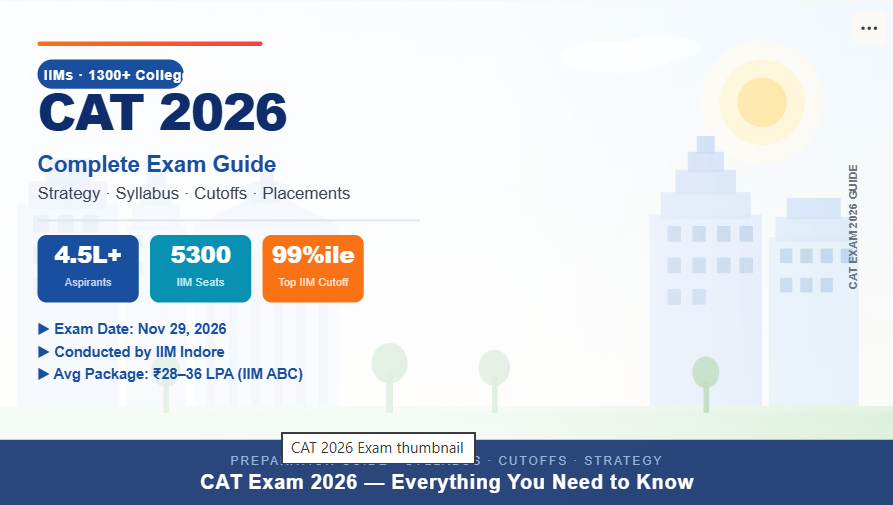
Every year, hundreds of thousands of students sit for one exam that can genuinely change the direction of their careers. The CAT Exam 2026 — the Common Admission Test — is that exam. It is the gateway to 21 IIMs and over 1,300 top business schools across India. And the numbers around it are staggering.
Around 4.5 lakh candidates are expected to register for the CAT Exam 2026. Of those, roughly 5,300 seats are available across all IIMs combined. Do the math — that is less than 1.2% of all applicants making it into an IIM. The competition is real. But so is the opportunity, if you prepare the right way.
This guide gives you everything — the exam date, eligibility, the complete CAT 2026 syllabus section by section, detailed exam pattern, registration steps, college-wise cutoffs with placement stats for every major institute, and a preparation strategy that actually works.
What Is the CAT Exam 2026?
The Common Admission Test (CAT) is a national-level MBA entrance exam conducted once a year by one of the six old IIMs on a rotational basis. For 2026, IIM Indore is expected to conduct the exam. The official notification is expected in the last week of July 2026 on the official website iimcat.ac.in.
CAT scores are accepted by 21 IIMs and over 1,300 MBA colleges across India including FMS Delhi, SPJIMR Mumbai, MDI Gurgaon, XLRI Jamshedpur, IIFT, IITs, and many others. The score is valid for one year.
CAT Exam 2026 Important Dates
Here are the expected dates based on consistent trends from the last several years:
Event | Expected Date |
|---|---|
Official Notification Release | Last week of July 2026 (around July 26) |
Registration Opens | August 1, 2026 |
Registration Closes | September 20, 2026 |
Admit Card Release | Last week of October 2026 |
CAT Exam 2026 Date | November 29, 2026 (Sunday) |
Answer Key Release | First week of December 2026 |
Result Declaration | January 2027 |
The CAT Exam 2026 will be conducted in three slots on a single day — morning, afternoon, and evening. Each slot is 2 hours long. These dates will be confirmed once the official CAT 2026 notification is released on iimcat.ac.in.
CAT Exam 2026 Eligibility Criteria
One of the reasons the CAT Exam 2026 is so popular is how open its eligibility criteria are. There is no upper age limit. There is no cap on the number of attempts. Whether you are a 22-year-old fresh graduate or a 35-year-old professional with a decade of work experience, you can apply.
Here is what you need:
Educational Qualification: A bachelor's degree from a recognized university or institution in any discipline. Engineering, Commerce, Arts, Science — all are eligible.
Minimum Percentage:
General and NC-OBC category: 50% aggregate marks or equivalent CGPA
SC, ST, and PwD category: 45% aggregate marks or equivalent CGPA
Final Year Students: Students in the final year of their bachelor's degree can also apply, subject to the condition that they complete the required percentage before the time of admission.
Age Limit: No age restriction.
Number of Attempts: Unlimited. You can appear for the CAT Exam 2026 regardless of how many times you have attempted it before.
Persons with Disabilities (PwD): PwD candidates receive extra time — 53 minutes and 20 seconds per section instead of the standard 40 minutes — along with scribe facility if required.
NRI/OCI/PIO candidates: Eligible to apply and appear for the exam at test centers in India.
CAT 2026 Registration Fee
Category | Registration Fee |
|---|---|
General / EWS / NC-OBC | ₹2,600 |
SC / ST / PwD | ₹1,300 |
The fee is paid online only — via debit card, credit card, net banking, or UPI. It is non-refundable. A candidate pays this fee only once, regardless of how many IIM programs or other institutes they are applying to through the CAT score.
CAT 2026 Exam Pattern
The CAT Exam 2026 is a computer-based test. Total duration is 120 minutes — 2 hours. The exam has 3 sections, and each section gets exactly 40 minutes. You cannot move between sections once the timer for one section starts. This makes time management within each section extremely important.
Section | No. of Questions | Duration |
|---|---|---|
Verbal Ability & Reading Comprehension (VARC) | 24 | 40 minutes |
Data Interpretation & Logical Reasoning (DILR) | 22 | 40 minutes |
Quantitative Ability (QA) | 22 | 40 minutes |
Total | 68 | 120 minutes |
Marking Scheme:
Correct answer (MCQ): +3 marks
Wrong answer (MCQ): -1 mark (negative marking)
TITA (Type in the Answer) questions: +3 for correct, 0 for wrong, no negative marking
TITA questions are your safe zone. Attempt all of them — even an educated guess has no downside.
The number and type of questions have remained consistent in recent years. No major changes are expected in the CAT Exam 2026 pattern.
CAT 2026 Syllabus: Section-by-Section Breakdown
IIMs do not publish an official CAT syllabus. But based on the last 10+ years of papers, the topics tested are well-established and consistent. Here is the detailed breakdown:
Section 1: Verbal Ability and Reading Comprehension (VARC) — 24 Questions
VARC is the section that separates disciplined readers from everyone else. It cannot be crammed in the last month. This section typically has two components:
Reading Comprehension (RC) — approximately 16–18 questions: RC passages are drawn from areas like philosophy, economics, science, history, literature, and current affairs. Each passage is typically 500–800 words. There are usually 4 to 5 RC passages in the section. Questions test inference, tone of the author, central idea, vocabulary in context, and logical deduction.
Verbal Ability (VA) — approximately 6–8 questions:
Para Jumbles: Arrange sentences in the correct logical order
Para Summary: Identify the best summary of a passage
Odd Sentence Out: Find the sentence that does not fit
Sentence Completion and Inferences
Key tip: RC is the heavier component. Improving RC scores directly improves your VARC score. Daily reading of dense, idea-heavy content — The Economist, Aeon Essays, The Hindu Opinion pages — is the best long-term investment here.
Section 2: Data Interpretation and Logical Reasoning (DILR) — 22 Questions
This section is widely considered the most unpredictable of the three. It tests your ability to read data, find patterns, and apply logical reasoning under time pressure.
Data Interpretation (DI) topics:
Bar Graphs, Pie Charts, Line Graphs
Tables and Caselets
Data Sufficiency
Combination charts
Logical Reasoning (LR) topics:
Seating Arrangements (linear and circular)
Blood Relations
Syllogisms
Clocks and Calendars
Coding-Decoding
Grid-based puzzles
Team selection and distribution
The section consists of 4 to 6 sets, each containing 3 to 5 questions. The sets are interlinked — once you crack the logic of a set, all questions in it become answerable. Choosing the right sets to attempt is a critical skill. Attempt 3 sets well rather than 5 sets poorly.
Section 3: Quantitative Ability (QA) — 22 Questions
QA is based on Class 10 and Class 12 mathematics. It does not test advanced mathematics — it tests speed, accuracy, and smart shortcuts. Arithmetic carries the highest weightage at roughly 40% of the QA section.
Topic-wise breakdown:
Arithmetic (highest weightage — ~40%):
Percentages, Profit & Loss, Ratio & Proportion
Time, Speed & Distance; Time & Work
Simple and Compound Interest
Mixtures and Alligations
Algebra (~20%):
Linear and Quadratic Equations
Inequalities
Functions and Graphs
Logarithms
Geometry & Mensuration (~20%):
Lines, Angles, Triangles, Circles
Coordinate Geometry
Mensuration (areas and volumes)
Number System (~15%):
Factors and Multiples
Remainders, Divisibility Rules
HCF, LCM
Surds, Indices
Modern Math (~5%):
Permutation & Combination
Probability
Set Theory and Venn Diagrams
Progressions (AP, GP)
Engineers often over-index on QA and neglect VARC. Non-engineers sometimes struggle with QA. Balance is everything.
How to Register for CAT Exam 2026
Registration is 100% online. No offline mode. No hard copy needed. Here is the step-by-step process:
Visit the official website: iimcat.ac.in
Click on "New Candidate Registration" and enter your name, date of birth, mobile number, and email ID
Verify your email and set a password
Log in and fill in personal details, academic qualifications, and work experience
Upload scanned documents — photograph and signature in the specified format
Select your preferred exam cities (you can choose up to 6 cities in order of preference; the test center is allotted in the city of first preference based on availability)
Pay the registration fee online via debit card, credit card, net banking, or UPI
Save and submit the form — keep a printout for your records
The edit window is available for a limited time after submission. Use it if you need to make corrections to specific fields. Once the window closes, no changes can be made.
Registration is expected to open on August 1, 2026 and close around September 20, 2026.
CAT Exam 2026 Admit Card
The CAT Admit Card 2026 will be released in the last week of October 2026 — roughly 10 to 15 days before the exam. It will be available only online at iimcat.ac.in.
The admit card will contain your name, roll number, exam slot, exam center address, and reporting time. You must carry it to the exam center along with a valid photo identity proof (Aadhaar, PAN, Passport, Driving License, etc.). No admit card means no entry.
CAT 2026 Cutoffs for All IIMs and Top Colleges
This is where most aspirants need the clearest picture. Cutoffs for the CAT Exam 2026 function at two levels: a qualifying cutoff (the minimum to be considered eligible) and an actual interview call cutoff (the percentile where real shortlisting happens). The gap between the two is large. For example, IIM Ahmedabad has a qualifying cutoff of 95 for General category — but in practice, a General category engineer male typically needs 99.5+ to get a realistic call.
Here is the detailed college-wise expected cutoff data:
IIM Ahmedabad (IIM A)
IIM Ahmedabad is India's most prestigious management school and consistently ranked No. 1 by NIRF. It offers approximately 400 seats in its flagship PGP program.
Expected CAT 2026 overall cutoff (General): 99.5+ percentile for a realistic call
Qualifying cutoff: 95 percentile (increased from 80 in the previous year)
SC cutoff: 85 percentile | ST cutoff: 75 percentile | NC-OBC: 90 percentile
Sectional cutoffs (General): 70+ in each section at qualifying level; actual calls require 85+ per section
IIM Ahmedabad's composite score (used for shortlisting) includes CAT score, Class 10 and Class 12 marks, gender and academic diversity, and work experience. The highest domestic package in the 2025 placement season was reported at ₹1.10 crore per annum. The average package at IIM A is in the ₹28–36 LPA range.
IIM Bangalore (IIM B)
IIM Bangalore consistently ranks among the top 2 B-schools in India and is known for its strong consulting and finance placements. Batch size is approximately 430–450 for the PGP program.
Expected CAT 2026 cutoff (General): 99.0–99.5+ percentile for a realistic call
Qualifying cutoff: 85 percentile
SC cutoff: 75 percentile | ST: 60 percentile | NC-OBC: 75 percentile
IIM Bangalore gives strong weightage to profile diversity — non-engineers and women candidates receive relaxation in the composite score
IIM Bangalore average package ranges between ₹28–34 LPA. The institute is particularly known for its placements in management consulting, investment banking, and technology strategy roles.
IIM Calcutta (IIM C)
IIM Calcutta is the oldest IIM in India, established in 1961. It has one of the largest alumni networks in Indian management. Batch size for PGP is approximately 460–480.
Expected CAT 2026 cutoff (General): 99.0–99.5+ percentile
Qualifying cutoff: General 80, SC 60, ST 50, NC-OBC 75
IIM Calcutta uses an 85-point composite score system for shortlisting that includes CAT score, academics, work experience, and gender
IIM Calcutta confirmed 100% placements in its 2026 batch with the highest domestic package touching ₹1.45 crore per annum. Average package is in the ₹28–34 LPA range. Finance and consulting remain the dominant sectors.
IIM Lucknow (IIM L)
IIM Lucknow has a strong presence in the FMCG, consulting, and finance sectors. Batch size is approximately 460–480 for the PGP program.
Expected CAT 2026 cutoff (General): 97–98+ percentile
Qualifying cutoff: General 90, SC 65, ST 60, NC-OBC 80
Sectional cutoffs are among the highest for new-wave IIMs — 80–85 required per section for General category
IIM Lucknow placed all 559 students in the 2026 placement season with Accenture being the top recruiter with 57 offers. The highest domestic salary crossed ₹1 crore per annum. Average package is in the ₹18–25 LPA range.
IIM Kozhikode (IIM K)
IIM Kozhikode is known for its diverse batch profile and strong focus on diversity in admissions — women, non-engineers, and candidates from varied academic backgrounds have a structural advantage here.
Expected CAT 2026 cutoff (General): 95–97 percentile
Qualifying cutoff: 85 percentile for General
SC cutoff: 55–56 percentile | ST: 55–56 percentile
General Female candidates often receive calls at 92–94 percentile owing to the diversity-heavy composite score
Average package at IIM Kozhikode is in the ₹18–23 LPA range. Consulting and analytics are the top sectors.
IIM Indore (IIM I)
IIM Indore is the expected convener for CAT Exam 2026. It is known for its large batch size (approximately 550 students) and strong placements in the consulting and BFSI sectors.
Expected CAT 2026 cutoff (General): 95–97 percentile
Qualifying cutoff: General 90, SC 65, ST 60, NC-OBC 82
Sectional cutoffs are 80–85 for General category
Average package at IIM Indore is in the ₹18–22 LPA range. The institute consistently achieves near-100% placements.
FMS Delhi (Faculty of Management Studies, Delhi University)
FMS Delhi is arguably the best value-for-money management education in India. The total MBA fee is under ₹2 lakh for a two-year program. The batch size is approximately 251 students. For context, IIM ABC charges around ₹23–24 lakh for the same duration. FMS placements are often comparable to IIM ABC.
Expected CAT 2026 cutoff (General): 98–99+ percentile
FMS calls approximately 10 times its intake — meaning about 2,500 candidates are called for interviews
Getting a call is one thing; conversion requires a very strong WAT and PI performance
FMS Delhi average package is in the ₹18–22 LPA range. Top recruiters include BCG, McKinsey, Bain, Amazon, Accenture Strategy, ITC, and Hindustan Unilever. The ROI at FMS is unmatched — your first month's salary clears the total course fee.
MDI Gurgaon (Management Development Institute)
MDI Gurgaon is a top-tier private management institution located in Haryana. It has strong industry connections and consistent placements. Batch size is approximately 472 students.
Expected CAT 2026 cutoff (General): 96–97 percentile
MDI does not follow reservation norms as a private institution
Composite score includes CAT percentile, academics, work experience, and PI performance
MDI Gurgaon average package is in the ₹16–22 LPA range. The highest package offered has crossed ₹60 LPA. Top sectors include consulting, BFSI, and FMCG.
SPJIMR Mumbai (S.P. Jain Institute of Management and Research)
SPJIMR is one of India's most sought-after management schools, known for its unconventional admission process and focus on social consciousness alongside business acumen. It increased its batch size to 356 students.
Expected CAT 2026 cutoff (General): 90–95 percentile (profile-based shortlisting)
SPJIMR screens heavily on profile, diversity, and essays — a strong profile can get a call even at 90 percentile
46% of the 2026 batch secured Pre-Placement Offers (PPOs)
SPJIMR average CTC for the 2026 batch rose to ₹33.75 LPA despite the larger batch size. The highest international package stood at ₹77.88 LPA. Consulting dominates at SPJIMR, typically absorbing 35–45% of the batch.
XLRI Jamshedpur
XLRI is India's premier HR and Business Management school with strong alumni networks in FMCG, consulting, and finance. It accepts CAT scores for its PGDM (BM) and PGDM (HRM) programs.
Expected CAT 2026 cutoff (General): 95–97 percentile for BM; similar for HRM
XLRI also conducts XAT, its own entrance exam — most serious aspirants appear for both
Average package at XLRI is in the ₹20–28 LPA range. The highest international package was ₹1.1 crore in the 2026 placement season. 42.5% of students received PPOs.
IIT MBA Programs (IIT Bombay, IIT Delhi, IIT Kharagpur, IIT Kanpur, IIT Madras)
The IIT management departments (DMS/SJMSOM) have gained tremendous ground in recent years. Strong IIT brand value, rigorous analytical training, and powerful alumni networks make these extremely competitive.
IIT Bombay (SJMSOM): Expected cutoff 98+ percentile, average package ₹22–28 LPA
IIT Delhi (DMS): Expected cutoff 96+ percentile, average package ₹20–26 LPA
IIT Kharagpur (VGSoM): Expected cutoff 95+ percentile, average package ₹18–24 LPA
IIT Kanpur (MBA): Expected cutoff 95+ percentile, average package ₹17–22 LPA
IIT Madras (DoMS): Expected cutoff 93–95 percentile, average package ₹16–20 LPA
IIT MBA programs typically have small batch sizes (60–120 students), which means more personalized attention and strong placement ratios.
New IIMs (IIM Shillong, IIM Trichy, IIM Udaipur, IIM Raipur, IIM Ranchi, IIM Kashipur, IIM Rohtak, IIM Visakhapatnam, IIM Nagpur, IIM Amritsar, IIM Bodh Gaya, IIM Jammu, IIM Sirmaur, IIM Sambalpur)
The newer IIMs offer a credible IIM tag with more accessible cutoffs. They are ideal for candidates scoring in the 80–96 percentile range.
General category actual call cutoffs: 80–95 percentile depending on the specific IIM
IIM Rohtak has a unique policy: General Female candidates often receive calls at 92–94 percentile while General Male candidates may need 98+
Average packages range from ₹10–18 LPA depending on the institute
These IIMs participate in the Common Admission Process (CAP), where a single PI round covers multiple institutes — improving cost efficiency for applicants
Other Notable Colleges Accepting CAT 2026 Scores
IIFT Delhi/Kolkata (Indian Institute of Foreign Trade): Cutoff around 95–97 percentile, strong for international business careers. Average package ₹16–22 LPA.
IMT Ghaziabad: Cutoff 90–93 percentile, average package around ₹14.5 LPA, strong in BFSI sector (24% of offers from BFSI).
GIM Goa (Goa Institute of Management): Cutoff 85–90 percentile, excellent ROI and campus life, average package ₹13–16 LPA.
TAPMI Manipal: Cutoff 85–90 percentile, strong in BFSI and analytics.
XIMB (Xavier Institute of Management, Bhubaneswar): Cutoff 88–92 percentile, strong placement record.
Great Lakes Chennai: Cutoff 85–90 percentile, popular among working professionals.
CAT 2026 Preparation Strategy: Month-by-Month
Here is a realistic, no-nonsense preparation plan for the CAT Exam 2026. The exam is on November 29, 2026. You have time — but you need to use it.
April–May 2026: Build the Foundation
These two months are for fundamentals. Do not start mock tests yet — focus on understanding concepts.
For QA: Revisit Class 9 and 10 mathematics. Arithmetic is the backbone — nail percentages, ratios, time & work, and speed-distance first. Spend 10–12 days per topic. Use a quality study material or standard reference book. Solve 30–40 problems per topic after concept revision.
For VARC: Start reading. Daily. Choose one long-form article every day from The Economist, Aeon, The Atlantic, or similar publications. Read for understanding and argument structure, not just vocabulary. This habit, built over 7–8 months, is worth more than any mock test score in VARC.
For DILR: Solve 1 DI set and 1 LR set every day. Focus on seating arrangements and data tables first — these appear most frequently.
Time to invest: Minimum 3 hours a day for freshers; 2 hours a day for working professionals.
June–July 2026: Deepen Conceptual Strength
Continue building QA — now move to Algebra, Geometry, and Number Systems. These require more time and cleaner concept clarity.
For DILR, start practicing under time pressure. Set a 20-minute timer for each set and track your accuracy.
For VARC, start doing para jumble and para summary exercises daily — 5 to 10 questions each day.
Take your first sectional mock tests at the end of July. Identify your weakest areas clearly and build a focused plan.
August 2026: Registration + First Full Mocks
CAT 2026 registration opens around August
- Complete your registration at the start of the month and move on.
This month, take 2 full-length CAT mocks per week. The most important part is not the score — it is the post-mock analysis. For every mock, spend at least as much time analyzing as you did attempting. Tag every wrong answer — was it a concept gap, a careless error, or a time management issue? Each type needs a different fix.
Track section-wise accuracy, not just total score. CAT has sectional cutoffs — a low score in one section can eliminate you even if your overall percentile is high.
September 2026: Targeted Improvement + Mocks
Increase mock frequency to 3 per week. By now, your pattern of errors should be visible. This month is about fixing those patterns.
Work specifically on your weakest section. If QA is weak, spend 60% of your daily study time on it. If VARC is weak, double your reading and practice.
For DILR, practice at least 2 sets daily. Speed and accuracy in DILR often come together at around the 6-month mark of consistent practice.
October 2026: Peak Preparation + Admit Card
Your admit card will be released in the last week of October. Download it immediately and verify all details.
October is about refinement, not new learning. Do not try to learn new topics now. Focus on:
Strengthening your strong areas so they are autopilot on exam day
Reducing error rates in mid-level topics
Taking 4 mocks per week and analyzing all of them
Revise all shortcuts, formulas, and time-saving techniques. Build your exam-day strategy — which sections to attempt first, how many questions to target per section, when to move on from a difficult question.
November 2026: Final Month
The last 4 weeks before the CAT Exam 2026 are not for cramming new content. They are for:
Maintaining exam readiness with 2–3 mocks per week
Reviewing your error log from all past mocks
Practicing 10–15 minutes of light quant every day to stay sharp
Getting sleep in order — 7 to 8 hours every night
In the final week, do not take any full-length mocks. Take sectional tests only to stay warm. Revise key formulas and vocabulary. Sleep well the night before the exam.
CAT Exam Day: What to Know
The CAT Exam 2026 is conducted in three slots:
Slot 1: Morning (approximately 8:30 AM)
Slot 2: Afternoon (approximately 12:30 PM)
Slot 3: Evening (approximately 4:30 PM)
Arrive at your exam center at least 45–60 minutes before your slot. Carry your admit card and a valid photo ID — both are mandatory. No electronic devices are allowed inside. A rough sheet is provided for calculations. The exam is on a computer and every answer is submitted digitally.
You cannot switch between sections. Once the 40 minutes for a section end, the next section begins automatically.
CAT 2026 Result and What Happens After
The CAT Exam 2026 result is expected in January 2027. Results are declared on iimcat.ac.in. Each candidate receives a scorecard showing raw scores and percentiles in each section as well as an overall percentile.
After the result, here is the typical admission process:
Step 1 — IIM Shortlisting: Each IIM uses its own composite score formula to shortlist candidates for the next round. The formula typically includes CAT percentile (weight of 40–65%), Class 10 and 12 marks, gender diversity, work experience, and academic background. Simply clearing the cutoff does not guarantee a call.
Step 2 — WAT-PI Round: Shortlisted candidates are called for a Written Ability Test (WAT) and Personal Interview (PI). This round takes place between January and March 2027. The WAT tests your ability to write a coherent argument on a given topic in 10–15 minutes. The PI assesses your personality, career intent, and fit for the program.
Step 3 — Final Admission Offer: Based on the composite score from CAT, academics, work experience, WAT, and PI, the final offer is made. This typically happens in March–May 2027.
Common Mistakes CAT Aspirants Make
Most students who do not crack the CAT Exam 2026 will trace their struggle back to one of these errors:
Starting too late: Solid CAT preparation realistically needs 6 to 12 months. Starting in September for a November exam is a recipe for panic.
Ignoring mock test analysis: Taking 50 mocks without proper analysis is worse than taking 20 mocks with deep analysis. The score tells you where you are. The analysis tells you how to improve.
Neglecting VARC: Most engineering students focus entirely on QA and DILR and leave VARC too late. VARC needs daily sustained practice — it cannot be rushed in the last 6 weeks.
Sectional imbalance: Even if your overall percentile is strong, a weak score in one section can eliminate you from top IIMs. Sectional cutoffs are enforced strictly.
Not simulating exam conditions: Many students practice at a relaxed pace at home, then freeze under 40-minute time pressure in the actual exam. Every practice session should be timed.
Books and Resources for CAT Exam 2026
Here is a reliable set of resources widely used by successful CAT candidates:
For Quantitative Ability:
Quantitative Aptitude for CAT by Arun Sharma (Tata McGraw-Hill) — standard reference for most topics
How to Prepare for Quantitative Aptitude for CAT by Arun Sharma
NCERT Mathematics (Class 9 and 10) for foundational concepts
For VARC:
How to Prepare for Verbal Ability and Reading Comprehension by Arun Sharma and Meenakshi Upadhyay
Regular reading of The Economist, Aeon Essays, and The Atlantic — non-negotiable
For DILR:
How to Prepare for Data Interpretation for CAT by Arun Sharma
Logical Reasoning and Data Interpretation for the CAT by Nishit K. Sinha
For Mock Tests:
Official CAT mock tests on iimcat.ac.in (released after notification)
Full-length mock tests from test prep platforms with detailed analytics
Choose the newest editions available. Content accuracy and alignment with current CAT patterns matter.
CAT 2026 vs Other MBA Entrance Exams
CAT is not the only route to a top MBA. Here is how it compares to other major exams in 2026:
Exam | Conducting Body | Top Colleges | Exam Duration | Frequency |
|---|---|---|---|---|
CAT 2026 | IIM Indore | 21 IIMs + 1,300+ colleges | 120 minutes | Once a year |
XAT 2026 | XLRI | XLRI, XIMB, GIM + 150+ colleges | 210 minutes | Once a year |
SNAP 2026 | Symbiosis | SIBM, SCMHRD + 15 Symbiosis institutes | 60 minutes | 3 attempts |
NMAT 2026 | GMAC | NMIMS + 35+ colleges | 108 minutes | 3 attempts |
IIFT 2026 | IIFT | IIFT Delhi, Kolkata | 120 minutes | Once a year |
CMAT 2026 | NTA | JBIMS + 1,000+ AICTE colleges | 180 minutes | Once a year |
For most serious MBA aspirants targeting top schools, CAT Exam 2026 remains the primary target. Many also appear for XAT, IIFT, and SNAP to maximize their options.
Is One Year Enough to Crack CAT 2026?
Yes. One year is more than enough — if you are consistent.
The students who score 99+ percentile in the CAT Exam 2026 are not necessarily smarter than everyone else. They are more disciplined and more systematic. They read every day. They take mocks every week. They analyze every mistake. And they do not skip the boring parts — revision, formula practice, slow careful reading.
A candidate starting in April 2026 with 3 hours of daily focused preparation has approximately 2,100 hours before the exam. That is significantly more than enough to master all three sections, take 40+ full-length mocks, and be genuinely exam-ready on November 29.
The formula is simple: start now, be consistent, analyze everything.
Final Thoughts
The CAT Exam 2026 will open or close career doors for over 4 lakh people on November 29, 2026. About 5,300 of them will walk into one of India's 21 IIMs. Many more will find their way into FMS, MDI, SPJIMR, XLRI, IIT management programs, and hundreds of other respected colleges.
The exam is hard. The competition is real. The syllabus is manageable. The strategy is straightforward. What separates students who crack the CAT Exam 2026 from those who do not is almost never intelligence — it is almost always preparation quality and consistency.
You have the date. You have the syllabus. You have the cutoffs. You have the strategy. The only thing left is to start.
Official website for CAT 2026: iimcat.ac.in All dates are expected/tentative based on past trends. Confirm details once the official CAT 2026 notification is released.
