
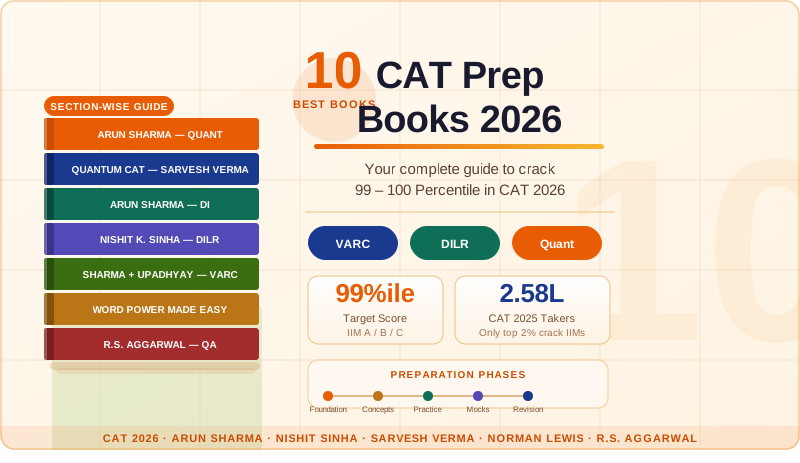
10 Best CAT Preparation Books for 2026: Section-Wise Guide to Hit 99–100 Percentile
Let's be honest. Every year, thousands of CAT aspirants spend the first three months of their preparation just figuring out which books to study. They buy five books for Quant, three for VARC, and two for DILR — and end up finishing none of them properly.
That's a mistake you cannot afford in 2026.
CAT 2025 was attempted by approximately 2.58 lakh candidates. Out of 3.29 lakh registered aspirants, only those with a focused, consistent strategy cleared the 99th percentile barrier. The competition for IIM Ahmedabad, IIM Bangalore, and IIM Calcutta is fierce — you need a 99.97+ percentile just to get a shortlist call. Even for FMS Delhi or JBIMS Mumbai, you are looking at 99.3+ percentile as a realistic target.
The right set of CAT books is your first tactical decision. In this guide, we break down the 10 best CAT preparation books for 2026 — section-wise, with honest assessments, stats, who each book is for, and how to actually use it in your preparation.
Before You Pick Your CAT Books: Understanding the Exam in 2026
CAT 2026 is expected to follow the same pattern as CAT 2025 — 68 questions across 120 minutes, split into three sections: Verbal Ability and Reading Comprehension (VARC), Data Interpretation and Logical Reasoning (DILR), and Quantitative Ability (QA). Each section gets 40 minutes with no option to switch.
Based on CAT 2025 analysis:
A raw score of 118–136+ is needed for 99.9+ percentile
A score of 85–110 typically lands around the 99th percentile
The 95th percentile requires approximately 64–66 marks
The 90th percentile requires approximately 52–61 marks
CAT 2025 difficulty was rated moderate to difficult, especially in DILR and QA
The success rate for CAT has historically been around 2% for top IIM seats — which means even a small improvement in book strategy has a compounding effect on your final score.
Now let us get into the books.
- How to Prepare for Quantitative Aptitude for the CAT — Arun Sharma (McGraw-Hill)
Section: Quantitative Ability (QA) Best For: All levels — beginners to advanced Editions Available: Updated regularly; use the latest 2024–25 edition
If there is one book that almost every CAT 99 percentiler has studied at some point, it is this one. Arun Sharma's Quant book has been the gold standard for CAT QA preparation for over two decades, and for good reason.
The book is structured around a Level of Difficulty (LOD) framework — LOD 1, LOD 2, and LOD 3 — which makes it perfect for progressive learning. You do not start with the hardest questions on Day
- You build. That is exactly the mindset that CAT rewards.
Key features of this book include its coverage of all major QA topics: Number System, Arithmetic (which alone accounts for 25–30% of QA questions in CAT), Algebra, Geometry, Modern Math, and Mensuration. Each chapter opens with a concept review, followed by progressively harder practice problems. The LOD 3 questions are genuinely CAT-level and often trickier than what appears in the actual paper.
Statistics on this book: In a Cracku survey of CAT 99+ percentilers, Arun Sharma's Quant book was cited as the primary QA reference by over 60% of respondents. That number alone tells you everything.
Who should use it: Every CAT aspirant, regardless of their Quant background. If you are from a non-engineering background, start with the LOD 1 questions and build from there. If you are an engineer, skip LOD 1 for familiar topics and go straight to LOD 2 and 3.
How to use it: Do not try to finish the entire book. Prioritise Arithmetic chapters first. Maintain an error log. Revisit LOD 3 questions of chapters you struggle with at least twice.
- Quantitative Aptitude Quantum CAT — Sarvesh Kumar Verma (Arihant)
Section: Quantitative Ability (QA) Best For: Intermediate to advanced aspirants Popularly Known As: Quantum CAT
This book is thick. We are talking about 1,000+ pages of pure Quant content. But every page earns its place.
Sarvesh Verma's Quantum CAT is different from Arun Sharma in one key way — the approach to shortcuts and alternative methods. Where Arun Sharma teaches you to think conceptually and build from fundamentals, Quantum CAT introduces you to faster techniques, tricks, and unconventional methods that can save 30–60 seconds per question during the actual exam. At 40 minutes per section and roughly 22–26 QA questions, saving even 45 seconds per question gives you 2–3 extra attempts. That can be the difference between 96 percentile and 99 percentile.
The book covers over 4,000 practice questions spread across all major topics. The Arithmetic section alone has enough questions to keep you busy for two months. What is especially useful is the CAT-specific focus — the questions are modelled closely on actual CAT patterns, unlike general aptitude books that are designed for banking or SSC exams.
Statistics to note: In CAT 2025, the QA section had approximately 22 questions. Among 99.5+ percentilers who cleared QA, a majority reported using either Arun Sharma or Sarvesh Verma — often both in combination, using one for concept understanding and the other for speed and shortcuts.
Who should use it: Best suited for aspirants who have already cleared their conceptual basics. Do not start with this book if you are a complete beginner in Quant. It can be overwhelming without a foundation.
How to use it: After finishing a chapter in Arun Sharma, use Quantum CAT for additional practice and shortcut exposure. Do not attempt all 4,000+ questions — pick the relevant chapter practice sets and focus on speed drills.
- How to Prepare for Data Interpretation for the CAT — Arun Sharma (McGraw-Hill)
Section: DILR (Data Interpretation component) Best For: All levels Key Strength: Structured approach to DI sets
Data Interpretation in CAT is not what most aspirants expect when they start preparing. It is not simple graph-reading. Modern CAT DI involves complex multi-layered datasets — tables with conditions, networks, games and tournaments, and scenario-based caselets — that require both analytical thinking and speed.
Arun Sharma's DI book is the most structured resource available for this component. It introduces the various formats of DI questions — bar graphs, pie charts, tables, caselets, line graphs — and then builds complexity progressively. The book uses the same LOD system (LOD 1, 2, 3) that makes Arun Sharma's Quant book so effective, allowing aspirants to build skill at a pace that matches their current level.
What makes this book stand out for CAT 2026 specifically is its relevance to the caselet and logical DI format that has dominated recent CAT papers. The CAT 2024 and CAT 2025 DI sets were significantly more reasoning-heavy than calculation-heavy — this book prepares you for exactly that pattern.
Statistics: In CAT 2025, the DILR section had approximately 20 questions. The average time spent per DILR set by 99+ percentilers was under 12 minutes for a 4-question set. This kind of speed only comes from systematic, structured DI practice — exactly what this book offers.
Who should use it: Essential for every CAT aspirant. Those from non-engineering backgrounds especially need this book as their DI foundation.
How to use it: Do not just solve — analyse your solution approach. After each DI set, ask yourself whether you picked the most efficient entry point into the data. This habit of process review is what separates 85th percentile from 98th percentile performance in DILR.
- Logical Reasoning and Data Interpretation for the CAT — Nishit K. Sinha (Pearson)
Section: DILR (full section) Best For: Intermediate to advanced aspirants Key Strength: Most CAT-aligned LR content available in book format
If Arun Sharma's DI book is your foundation, Nishit Sinha's DILR book is where you build the structure on top of it. This book is often cited as the best single-volume resource for the Logical Reasoning component of the DILR section.
The LR portion of CAT is notoriously unpredictable. Puzzles, seating arrangements, blood relations, binary logic, constraint-based sets — the variety is enormous. What Nishit Sinha does exceptionally well is categorise LR question types systematically and then teach you a methodical approach to each type. The book also has a strong focus on sets that combine DI and LR elements — the format that CAT has increasingly used over the last three years.
A key data point: Tejas Sharma, a documented CAT 2025 success story on Cracku, went from 44 percentile in DILR to 99.09 percentile in a single attempt. Structured DILR practice using targeted books — including Nishit Sinha's guide — was a central part of that transformation.
This book includes previous year CAT DILR questions with detailed solutions, which is extremely valuable because it shows you how IIM paper-setters think and what kind of reasoning patterns they favour.
Who should use it: Anyone who finds LR sets confusing or is inconsistent in DILR performance. Also essential for aspirants targeting 99+ percentile because DILR is often the differentiating section at the top end.
How to use it: Solve one complete LR set under timed conditions every day. Even if you get it wrong, the review process — understanding where your reasoning went off — is more valuable than solving three sets casually.
- How to Prepare for Verbal Ability and Reading Comprehension for the CAT — Arun Sharma & Meenakshi Upadhyay (McGraw-Hill)
Section: VARC Best For: All levels Key Strength: Comprehensive coverage of both RC and Verbal Ability
This is the definitive CAT VARC book in the Indian market. Jointly authored by Arun Sharma and Meenakshi Upadhyay, it covers the full spectrum of what CAT tests in the verbal domain — Reading Comprehension passages, Para-Jumbles, Para-Summary, Odd Sentence Out, and critical verbal reasoning.
What sets this book apart is the quality and diversity of RC passages. CAT passages in recent years have been drawn from philosophy, economics, science and technology, literature, and political theory. This book mirrors that variety, training you to handle unfamiliar, dense text without panic. The RC questions are written in the CAT style — abstract, inference-heavy, and designed to test depth of understanding rather than surface-level recall.
Manhar Joshi, who scored 99.97 percentile in CAT 2025 with a perfect 100 in VARC, stated that consistent reading practice and targeted RC work was the foundation of his verbal preparation. Books like this one — used repeatedly, with quality review — are the foundation of that kind of VARC dominance.
Statistics: VARC in CAT 2025 had approximately 24 questions, split roughly 16 RC questions and 8 VA questions. RC accuracy is the single biggest lever for improving VARC percentile, and this book gives you the practice volume needed to develop that accuracy.
Who should use it: Every CAT aspirant. Even those who are naturally strong readers benefit from the structured approach to RC question types that this book teaches.
How to use it: Do not just read the passage and attempt the questions. After each RC set, go back and annotate the passage — identify the main idea, the author's tone, the structure of the argument. This active reading habit will improve your accuracy within 4–6 weeks of practice.
- Word Power Made Easy — Norman Lewis (Pocket Books / Goyal Publishers)
Section: VARC (Vocabulary and Reading Foundation) Best For: Beginners and intermediate aspirants building vocabulary Key Strength: The most accessible and engaging vocabulary-building book ever written
Norman Lewis's Word Power Made Easy is not technically a CAT book. It was written decades ago for general English improvement. But almost every CAT topper, every coaching faculty member, and every serious MBA aspirant will recommend it — and for good reason.
While CAT does not directly test vocabulary through definitions or fill-in-the-blank grammar questions, a strong vocabulary directly impacts your RC performance. When you encounter a philosophy or economics passage in CAT and the author uses words like "epistemic," "mercantile," or "teleological" — your familiarity with those words determines how quickly you grasp the passage. Speed of comprehension in VARC is directly tied to vocabulary depth.
Word Power Made Easy uses a root-word approach. Instead of memorising 500 isolated words, you learn the Latin and Greek roots behind words — enabling you to decode unfamiliar words intelligently during the exam. This is significantly more durable than rote vocabulary learning.
Statistics: Most CAT 99+ percentilers in VARC report that regular reading (editorials + long-form articles) combined with structured vocabulary building was the backbone of their verbal preparation. Word Power Made Easy is the recommended entry point for vocabulary, trusted by CAT toppers for over 30 years.
Who should use it: Anyone who finds dense RC passages slow to process, or who frequently encounters words they do not understand in VARC practice. Ideally start this book 8–10 months before the exam.
How to use it: Read one chapter a day. Do not skip the exercises — they are designed to reinforce retention. Complete the book once, then revisit the chapters you found difficult for a second round.
- Quantitative Aptitude for Competitive Examinations — R.S. Aggarwal (S. Chand)
Section: Quantitative Ability (QA) — Foundation Level Best For: Beginners, non-engineers, and those rebuilding from scratch Key Strength: The best book for establishing Class 6–10 level mathematical fundamentals
R.S. Aggarwal's Quantitative Aptitude is not specifically designed for CAT. It is a general competitive exam book used across bank exams, SSC, Railways, and MBA entrances. But for CAT aspirants who have weak mathematical foundations — especially those from arts, commerce, or humanities backgrounds — it is the most important starting point.
The book covers everything from basic arithmetic (percentages, ratios, profit and loss, simple and compound interest) to Number System, HCF-LCM, Time-Speed-Distance, and simple Algebra. These are the exact topics that form the foundation of CAT QA. You cannot solve an LOD 2 Arun Sharma problem efficiently if your basic arithmetic is shaky.
R.S. Aggarwal fills that gap. It is straightforward, has thousands of practice problems with answers, and is structured topic-by-topic in a manner that makes the learning progression logical.
Statistics: Approximately 35–40% of CAT QA questions directly test Arithmetic topics — making it the single heaviest category in the section. Building a strong Arithmetic base through books like R.S. Aggarwal before moving to CAT-specific books can improve QA percentile by 10–15 percentile points for aspirants with weak math backgrounds, based on patterns observed among repeat CAT takers.
Who should use it: Non-engineers, Arts/Commerce graduates, and any aspirant who finds LOD 1 in Arun Sharma's Quant book challenging. Also useful for aspirants who are 6–8 months away from CAT and want to lay a strong foundation before intensifying their preparation.
How to use it: Do not try to finish the entire book. Focus on the chapters that map directly to CAT QA topics: Arithmetic (all subtopics), Number System, Basic Algebra, Time-Speed-Distance, and Geometry basics. Move to Arun Sharma once you can solve these without basic calculation errors.
- The Pearson Guide to Verbal Ability and Logical Reasoning for the CAT — Nishit K. Sinha (Pearson)
Section: VARC + Verbal Reasoning Best For: Intermediate to advanced aspirants Key Strength: Deep coverage of Verbal Ability question types and logical reasoning within VARC
Nishit Sinha's verbal book is the most comprehensive guide available for the verbal reasoning aspects of CAT VARC. While the Arun Sharma + Meenakshi Upadhyay book is strong on RC, this book is stronger on the logical and reasoning-heavy VA questions — Para-Jumbles, Para-Summary, and Odd Sentence Out — which together account for roughly 8 questions in CAT VARC.
In CAT, these 8 questions are entirely non-MCQ (no negative marking), which means they are particularly valuable to attempt. A 100% attempt rate on these questions with even 60–70% accuracy can add 4–5 marks to your VARC raw score, which at the top percentile levels is significant.
Nishit Sinha's approach to Para-Jumbles is particularly strong. He teaches you to identify logical connectors, pronoun references, cause-effect relationships, and contrast signals — the structural cues that reveal the correct sentence order. This is not just rote practice; it is a teachable skill.
Statistics: In CAT 2025, VARC had approximately 8 verbal ability questions (Para-Jumbles, Odd Sentence, Para-Summary). These 8 questions can be the difference between a 90 percentile and a 97 percentile in VARC for many aspirants, given that RC accuracy tends to plateau after sufficient practice.
Who should use it: Aspirants targeting 97+ percentile in VARC who have already built their RC foundation and want to sharpen their VA accuracy. Also useful for anyone who finds Para-Jumbles particularly difficult.
How to use it: Use this book specifically for Para-Jumble and Odd Sentence practice. Solve 10–15 practice items daily. Focus on understanding WHY a particular arrangement is correct, not just what the answer is.
- Wren & Martin's High School English Grammar and Composition — P.C. Wren & H. Martin (S. Chand)
Section: VARC (Grammar Foundation) Best For: Aspirants with weak English grammar foundations Key Strength: The most thorough English grammar textbook available in the Indian market
Let us be clear: CAT does not directly test grammar through fill-in-the-blank or error-correction questions. Those question formats disappeared from CAT years ago. So why is Wren & Martin on this list?
Because your grammar knowledge indirectly impacts almost every aspect of VARC. When you are reading a dense RC passage and trying to understand the author's argument, weak grammar makes you misparse sentences. When you are solving Para-Jumbles, a shaky understanding of subject-verb agreement and sentence construction makes you guess rather than reason.
Wren & Martin gives you the structural understanding of English that enables confident VARC performance. It covers all parts of speech, sentence structure, clauses, conditionals, reported speech, punctuation, and composition. It is exhaustive — and you do not need to read all of it. For CAT aspirants, the focus should be on sentence structure, clause identification, and punctuation rules.
Statistics: Career Launcher, one of India's leading CAT coaching institutions, recommends Wren & Martin specifically for aspirants from non-English medium backgrounds who find VARC consistently below the 70th percentile. Among aspirants who improved their VARC from below 70 percentile to above 85 percentile, strengthening grammar foundations was cited as a key factor in post-analysis sessions.
Who should use it: Aspirants from non-English medium backgrounds, those who studied in regional language medium schools, or anyone who struggles to parse complex sentences in RC passages. Not necessary for aspirants who are already comfortable with English sentence structures.
How to use it: Do not read cover-to-cover. Focus on Part 2 (Sentences) and Part 3 (Composition). Read one chapter a week during the early phase of preparation. This is a foundational investment — not an exam-specific drill.
- CAT Previous Year Solved Papers (Last 10–25 Years) — Oswaal / Arihant / TIME
Section: All sections (VARC, DILR, QA) Best For: All aspirants — especially in the final 3–4 months before CAT Key Strength: The single most authentic CAT practice material that exists
No matter how many books you study, no book perfectly replicates the actual CAT. The closest thing to that — and the most underutilised resource among first-time CAT takers — is the collection of Previous Year CAT Question Papers.
Oswaal's 25 Years Chapterwise & Topicwise Solved Papers and Arihant's CAT previous year compilations are the most widely available editions. These books organise past CAT questions by topic, which means you can practice Number System questions from 10 different years in a single sitting, seeing exactly how the question style has evolved.
Here is what makes previous year papers irreplaceable: The question philosophy at IIM paper-setting committees is consistent. Certain question types recur. Certain RC passage styles appear repeatedly. Certain types of LR puzzles have appeared multiple times over the years. When you solve 15 years' worth of actual CAT papers, you internalise these patterns at a subconscious level. You stop being surprised on exam day.
Statistics: According to Oswaal's internal analysis, aspirants who solved at least 10 years of previous CAT papers showed an average percentile improvement of 8–12 percentile points compared to those who only used standard preparation books. Aspirants aiming for 99+ percentile are recommended to solve at least 15–20 full past papers as part of their preparation.
Additional data point: A raw score of 102–120+ is considered excellent in CAT 2025, corresponding to 99th percentile. Reviewing how topper-level questions were set in previous years gives you a benchmark for the kind of accuracy and speed you need to develop.
Who should use it: Every single CAT aspirant. There is no exception here. Previous year papers are not optional — they are essential.
How to use it: Do not use them at the start of your preparation. Save them for the last 4–5 months. Solve full papers under strict timed conditions — 40 minutes per section, no switching. Then spend 2–3 hours reviewing every single question, whether you got it right or wrong.
How to Build Your CAT 2026 Book Strategy: A Practical Approach
Buying all 10 books on this list and then using none of them properly is worse than buying 3 books and finishing them thoroughly. Here is a suggested phased approach based on expert recommendations and patterns from CAT toppers.
Phase 1 — Foundation (Months 1 to 3): Start with R.S. Aggarwal for basic Quant if needed. Read Word Power Made Easy daily (one chapter). Begin NCERT Class 9–10 Mathematics to solidify Geometry and Algebra. Start reading two English editorials daily to build reading habit and speed.
Phase 2 — Concept Building (Months 4 to 6): Move to Arun Sharma's Quant book (LOD 1 and LOD 2). Begin Arun Sharma's DI book and Nishit Sinha's DILR book simultaneously. Use the Sharma + Upadhyay VARC book for daily RC practice (one passage per day).
Phase 3 — Intensive Practice (Months 7 to 9): Shift to Quantum CAT for advanced Quant and shortcut building. Complete Nishit Sinha's VARC book for Para-Jumble and VA practice. Introduce LOD 3 problems from Arun Sharma's Quant book. Start solving previous year CAT papers — one per week initially.
Phase 4 — Mock and Revision (Months 10 to 12): Previous year papers become your primary practice material. Supplement with mock tests (full-length and sectional). Use books only for specific weak-area revision — not new learning. Review error logs weekly.
Section-Wise Quick Reference: Which Books to Use for CAT 2026
Quantitative Ability (QA): Primary — Arun Sharma (How to Prepare for QA for CAT). Secondary — Sarvesh Verma (Quantum CAT). Foundation (if needed) — R.S. Aggarwal.
Data Interpretation and Logical Reasoning (DILR): DI component — Arun Sharma (How to Prepare for DI for CAT). LR component — Nishit K. Sinha (Logical Reasoning and Data Interpretation). Both components — previous year CAT papers.
Verbal Ability and Reading Comprehension (VARC): RC-focused — Arun Sharma + Meenakshi Upadhyay (VARC for CAT). VA-focused — Nishit K. Sinha (Verbal Ability and Logical Reasoning). Vocabulary — Norman Lewis (Word Power Made Easy). Grammar foundation (if needed) — Wren & Martin.
All Sections — Previous Year Papers: Oswaal or Arihant 10–25 year compilations.
Common Mistakes to Avoid When Using CAT Books
Buying too many books and finishing none of them is the number one mistake CAT aspirants make. Two books per section, used thoroughly, will always outperform five books used casually. The goal is not coverage of books — it is mastery of the exam.
Solving questions without reviewing errors is the second most costly mistake. Every question you get wrong is information. It tells you exactly where your understanding breaks down. An aspirant who solves 500 questions and reviews all errors will outperform one who solves 2,000 questions carelessly.
Starting with advanced books too early is a trap that discourages many aspirants. Quantum CAT is an incredible book — but if you open it without Quant fundamentals in place, it will feel impossible and demoralising. Build the foundation first.
Ignoring previous year papers until the last month is a mistake that costs 5–10 percentile points. These papers should be integrated from Month 7 onwards.
Final Word: The Book Is the Tool, Not the Strategy
In CAT 2025, approximately 2.58 lakh people sat for the exam. Fewer than 500 crossed the 99.9 percentile. The exam is genuinely hard, and the competition is real.
But the people who score 99.9+ percentile do not necessarily study more than everyone else. They study smarter — with the right books, used the right way, at the right time. They review their mistakes. They simulate exam conditions. They build section-specific skills, not just general knowledge.
The 10 CAT books listed here represent the collective wisdom of decades of IIM-focused preparation. Used intelligently — as tools in a larger strategy — they give you everything you need to target a top percentile in CAT 2026.
Pick your books. Build your plan. And start today.
CAT 2026 is expected in November 2026. Registration is expected to open in August 2026. Plan your preparation backward from the exam date.
Related Resources
- TAPMI Manipal
- Delhi School of Business Delhi
- IIM Sirmaur
- IIM Sambalpur
- IIM Udaipur
- Best MBA Colleges in Bangalore 2026: Placements, Fees & ROI Guide
- CAT DILR Strategy 2026: Tips to Solve Tough LRDI Sets for 99 Percentile
- Top Free Resources for CAT Preparation 2026: YouTube, Apps & Mocks
- Best Books for CAT Preparation 2026: Subject-wise List for VARC, DILR & QA
- CAT 2026 Exam: Strategy, Syllabus & Prep Guide | B School Buzz
- AI Profile Analyzer
- College Shortlister
Key Highlights
- Overview: 10 Best CAT Books for 2026 | Section-Wise CAT Books for 99-100 Percentile — comprehensive details for MBA aspirants.
- Eligibility & Process: Standard MBA admission requirements and steps.
- Fees & Placements: Latest fee structure and placement insights.
- Why it matters: Trusted, up-to-date guidance from MBA Compass.
- Next step: Explore related colleges, exams and coaching options.